
Home/ The Journal/ buying guide
buying guide
Best creatine gummies: what to check for sugar, dose, and testing

Short version: The best creatine gummies give 3 to 5 g of creatine monohydrate a day in a few gummies, list the grams per gummy, keep sugar low, and carry a named outside test or seal. In a 2025 lab test, only 2 of 6 gummy brands matched their label. So read six lines on the label before you buy.
- Dose: divide 5 g by the grams in one gummy. More than 5 gummies a day is a lot of candy.
- Sugar: multiply sugar per serving by 30. That is your monthly total.
- Testing: look for a seal like NSF Certified for Sport, not just "lab tested."
Last updated November 2026.
Every creatine gummy tub says roughly the same thing on the front. The truth is on the back.
Gummies are a hard place to put creatine. You need grams of it, not milligrams. That leaves less room for anything else. In June 2025, a lab paid by SuppCo tested 6 creatine gummy brands. Only 2 had the amount the label promised. See SuppCo's results (June 2025).
This guide skips the brand ranking. Our creatine gummy brands compared post has that. Here you will learn how to judge any tub on the shelf, in about two minutes. Seya does not sell a creatine gummy yet, and no brand paid to be here.
What makes the best creatine gummies?
Six things. A good gummy passes all of them:
- It lists the grams of creatine in each gummy.
- It uses creatine monohydrate.
- A full dose takes 5 gummies or fewer.
- The sugar adds up to a number you are fine with every day.
- You can live with the sweetener it uses.
- An outside group has tested it, and you can look that up.
Price comes last. A cheap gummy that comes up short on creatine is not cheap. Let's walk through each line.
How much creatine should a gummy contain?
Aim for 3 to 5 g a day in total. That is the daily range in a 2021 expert review. See Antonio et al. (JISSN, 2021).
Most gummies hold 1 to 1.5 g each. So do the math:
- 1.5 g per gummy: 3 gummies for 4.5 g.
- 1.25 g per gummy: 4 gummies for 5 g.
- 1 g per gummy: 5 gummies for 5 g.
The low end of the range still works. In one study, 3 g a day for 28 days raised muscle creatine about as much as a loading week. See Hultman et al. (J Appl Physiol, 1996). What matters is taking it every day.
Watch for a "blend" or "complex." US label rules let a blend list its ingredients by weight order, with only one total weight for the whole mix. See 21 CFR 101.36. So you can't tell how much of that weight is creatine. If the grams of creatine are not on their own line, put the tub back.
Which form of creatine should be in the gummy?
Creatine monohydrate. It is the form with the most research by far.
A 2022 review looked at other forms sold in supplements, such as HCl and buffered creatine. It found no form that beat monohydrate as a source of creatine. See Kreider et al. (Nutrients, 2022).
So a "new" or "advanced" form is not a reason to pay more. Our creatine monohydrate vs HCl guide covers the trials.
Two other words you may see:
- Micronized means the powder is ground finer. It mixes better. It is still monohydrate.
- Creapure is a brand name for monohydrate made in Germany. It is still monohydrate.
The gummy base does not change the creatine either. Pectin, from fruit, is vegan. Gelatin comes from animals. A vegan gummy with the full dose should work the same as one made with gelatin.
How much sugar is in creatine gummies?
Anywhere from 0 to about 8 g per daily serving. That small number grows fast, because you take it every day.
The American Heart Association suggests most women keep added sugar under 100 calories a day, and most men under 150. That is about 25 g and 37 g. See Johnson et al. (Circulation, 2009).
| Sugar per daily serving | Per month | Share of a 25 g day |
|---|---|---|
| 0 g | 0 g | 0% |
| 3 g | 90 g | 12% |
| 5 g | 150 g | 20% |
| 8 g | 240 g | 32% |
For a real example, Legion's Sour Blue Raspberry flavor has 8 g of added sugar in its 5 gummy serving. Create lists 3.3 to 5 g, depending on flavor. Both figures come from the labels in our brand comparison.
Read "Total Sugars" and "Includes Added Sugars" on the Supplement Facts panel. Sour coatings often add more.

Do creatine gummies use sugar alcohols?
Many "sugar free" ones do. Others use allulose, a rare sugar, or stevia.
Sugar alcohols have names that end in "-itol," like erythritol, maltitol, and sorbitol. A 2017 review found they can cause gas, belly discomfort, and loose stools. The effect grows with the dose. See Lenhart and Chey (Adv Nutr, 2017).
Allulose has its own gut effects at high amounts. In a 2026 trial, adults took 24 or 36 g a day for 30 days. About 48% had gut symptoms. Most were mild and showed up in the first 3 days. See Qi et al. (Food Sci Nutr, 2026). A gummy has far less than that, but it adds to what you eat elsewhere.
One catch: the sugar alcohol line is often optional on a supplement label. It must be listed when the brand makes a claim about it, per 21 CFR 101.36 (above). So check the ingredient list too.
If your gut is touchy, a gummy with a few grams of real sugar may sit better. Our post on whether creatine causes bloating explains how to tell the two apart.
Are creatine gummies third-party tested?
Some are, and that is the line that most separates good from bad.
The FDA does not approve supplements before they are sold. See the FDA's supplement Q&A. So no one checks a gummy's dose before it reaches the shelf unless the brand pays for it.
Two public tests show why that matters:
- In 2024, NOW Foods tested creatine gummy brands. Overall, 46% failed to meet their label claims. See the WholeFoods Magazine report (March 2024).
- In 2025, SuppCo's test passed only 2 of 6 brands (above).
What to look for on the tub:
- Best: a seal you can search, like NSF Certified for Sport. Type the brand name into the directory.
- Okay: a brand that posts a named lab's report for your batch.
- Weak: "lab tested" or "third-party tested" with no lab, no seal, and no report.
Our guide to creatine purity and safety explains what each seal checks.
Is creatine GRAS under FDA rules?
Yes, for certain foods. But a "GRAS" badge on a gummy does not mean the FDA checked that gummy.
GRAS stands for "generally recognized as safe." In 2020, the FDA closed a GRAS notice for creatine monohydrate, GRN 931, with "no questions." The uses it covers are foods like energy drinks, protein bars, and drink mixes, at 1.2 g per serving. See the FDA's GRN 931 page.
That is good news for creatine monohydrate as an ingredient. It says nothing about how much creatine is in a given tub, or whether a gummy holds its dose over time. Testing answers those questions. GRAS does not.
What does a full dose cost?
Compare price per full dose, not price per tub. Tubs hold different counts, and serving sizes differ.
Here is the formula: price of the tub, divided by the number of gummies, times the gummies you need for 3 to 5 g.
In late 2026, popular brands ran about $1.33 to $1.93 per daily serving, based on list prices in our brand comparison. Plain powder usually costs far less per gram. Our gummies vs powder post breaks that down.
A gummy is worth the extra cost if it is the form you will take every day. Skipping days costs more than any price gap.
Your two-minute creatine gummy checklist
- Grams of creatine per gummy are listed on their own line.
- The form is creatine monohydrate.
- 3 to 5 g takes 5 gummies or fewer.
- Sugar per serving, times 30, is a number you accept.
- You know the sweetener, and your gut is fine with it.
- The seal or lab report is one you can look up.
Also check the "best by" date and keep the tub cool and dry. Our post on whether creatine gummies work explains why heat and time matter.
If you are a woman choosing between brands, see the best creatine gummies for women.
Is creatine safe to take every day?
For healthy adults, 3 to 5 g a day of creatine monohydrate has a long safety record. The 2021 review found no sign it harms healthy kidneys at those doses (Antonio et al., above).
Talk with your doctor first if you have kidney disease, are pregnant or nursing, or take medicine that affects your kidneys. Many brands say their gummies are not for anyone under 18.
Where Seya fits
Seya sells one product today, a vegan fiber gummy that supports regularity. Our creatine gummy is coming January 2027. It is not on sale yet, so we are not sharing a dose or price.
When it launches, hold it to this same six-line checklist.
This guide is education, not medical advice. No supplement can promise results.
These statements have not been evaluated by the Food and Drug Administration. This product is not intended to diagnose, treat, cure, or prevent any disease.
Frequently asked questions
Are creatine gummies as effective as powder?
They can be, if each serving really holds 3 to 5 g of creatine monohydrate. Creatine works by filling your muscles over time, so the form matters less than the dose and daily use. The risk with gummies is a short dose, so look for outside testing.
How much creatine should a gummy contain?
Most gummies hold 1 to 1.5 g each. You want 3 to 5 g a day in total, so a good gummy reaches that in 5 gummies or fewer. The grams per gummy should be listed on the label.
Do creatine gummies actually contain creatine?
Most contain some, but not all contain what the label says. In a 2025 lab test, only 2 of 6 brands matched their label. A seal like NSF Certified for Sport is the best sign the dose is real.
What certifications should creatine gummies have?
Look for a seal you can search, such as NSF Certified for Sport. A brand that posts a named lab's report for your batch is the next best thing. "Lab tested" with no lab or seal named tells you little.
How much sugar is in creatine gummies?
From 0 to about 8 g per daily serving. Over a month, 8 g a day adds up to 240 g of sugar. Check the "Includes Added Sugars" line on the label.
Do creatine gummies use sugar alcohols?
Many sugar-free ones do, such as erythritol or maltitol. Sugar alcohols can cause gas or loose stools in some people, and the effect grows with the amount. Others use allulose or stevia instead.
Is creatine GRAS under FDA rules?
Creatine monohydrate has a GRAS notice, GRN 931, which the FDA closed in 2020 with no questions. It covers foods such as energy drinks and protein bars. It does not mean the FDA checked any gummy's dose.
Are vegan creatine gummies as effective?
Yes, if the dose is the same. Creatine monohydrate is made in a lab, not from animals. The gummy base, pectin or gelatin, does not change how the creatine works.
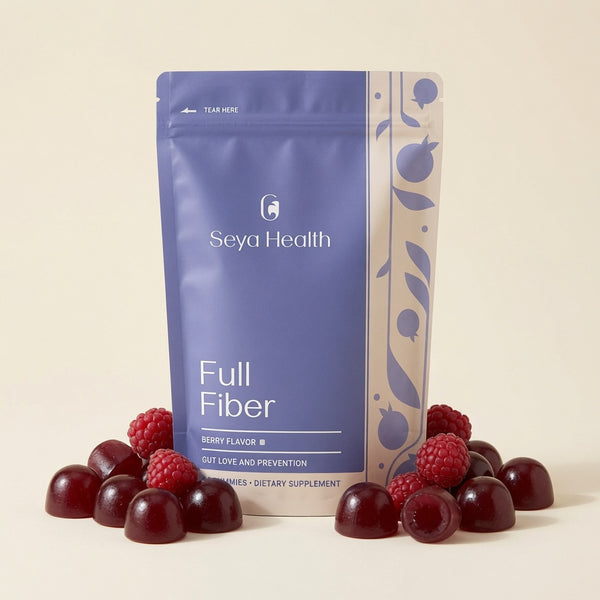
Seya Full Fiber
Most women fall short on fiber. Seya Full Fiber gives you 6 grams from three fibers in three small vegan gummies. Plant based, no gelatin, no sugar alcohols.
Shop Full FiberKeep reading

bone health
Best supplements for women over 40: what the evidence supports for heart, bones and muscles (and what's hype)

creatine
How long does creatine take to work? A realistic timeline for women

constipation