
Home/ The Journal/ luteal phase
luteal phase
PMS Explained: Mood Swings, Symptoms & What Actually Helps

Short version: PMS is not a personality problem that shows up once a month. It is a scheduled reaction to a normal hormone shift, and the clearest evidence for that is a study where hormones were switched off and switched back on.
- Over 90% of women report some premenstrual symptoms. Fewer than 5% have the severe form, PMDD.
- PMS symptoms land in the 5 days before your period and clear within 4 days after it starts.
- Colonic transit ran 40.9 hours in the luteal phase against 20.6 hours in the follicular phase.
- Across 15 trials in 717 women, exercise cut global PMS symptom scores.
Last updated August 2026.
Your period is five days out. You cried at a commercial. Your jeans fit differently than they did on Tuesday.
PMS is the name for that week. Over 90% of women report some premenstrual symptoms, per the HHS Office on Women's Health. As many as 3 in 4 say they get PMS at some point.
You are not being dramatic.
You are on a schedule.
What is PMS, exactly?
PMS stands for premenstrual syndrome. It is a cluster of physical and emotional symptoms that arrive on a predictable timeline and then leave.
The Office on Women's Health defines the pattern by that timing. Symptoms show up in the 5 days before your period, for at least 3 cycles in a row, and end within 4 days of your period starting.
The physical list is long. Sore breasts, bloating, cramping, headache, and a gut that swings between constipated and loose.
The emotional list is longer. Irritability, anxiety, low mood, poor sleep, trouble concentrating, and mood swings.
Women in their 30s report it most.
One thing matters more than the list. If your symptoms never fully leave once your period arrives, that is a different pattern, and it is worth saying out loud to a clinician.
Why am I moody before my period?
Because your hormones drop, and your brain reacts to the drop.
Here is the part that gets skipped. Women with PMS do not have unusual hormone levels. Their blood work looks like everyone else's.
Researchers at the National Institute of Mental Health tested this directly in 1998. They shut down ovarian function in 20 women with PMS using leuprolide. Symptoms improved. Then they added estradiol and progesterone back, one at a time, blind.
Symptoms came roaring back in the women with PMS. In 15 women without PMS, given the same hormones on the same schedule, mood did not budge.
The authors wrote the conclusion plainly in the New England Journal of Medicine (PMID 9435325):
"In women with premenstrual syndrome, the occurrence of symptoms represents an abnormal response to normal hormonal changes."
Read that again with yourself in it. The hormones are normal. The response is yours, and it is physical.
That is not a character flaw. It is a sensitivity, and sensitivity is a body thing.

What makes the signal so loud?
The best current answer involves one molecule with an ugly name: allopregnanolone.
Your body makes it from progesterone, so it rises and falls with the second half of your cycle. It works on the same brain receptor that calming medicines act on, the GABA-A receptor.
In most women that system rides the wave quietly. In PMDD, the severe form, the receptor appears to handle the swing poorly, which is why the same hormone curve produces a very different week.
A 2020 review in Neurobiology of Stress makes that case. The problem sits in the receptor response, not in the hormone swing. The full argument is in Hantsoo and Epperson (PMID 32435664).
So the mood is downstream of a receptor, not downstream of your discipline.
Why does your gut slow down the same week?
Because the whole digestive tract is on the same calendar.
Researchers measured colonic transit time in 42 healthy adults with swallowed markers and two abdominal X-rays. Women measured in the luteal phase, the stretch after ovulation, averaged 40.9 hours. Women measured in the follicular phase averaged 20.6 hours. Roughly double. Those numbers come from the Korean Journal of Internal Medicine (PMID 14619388).
Slower transit means more water pulled out of stool, harder stool, and more gas sitting in the same space. That is the bloat and the constipation on the PMS symptom list, arriving on schedule.
Now the honest caveat, because we grade our own evidence. The tidy story is that progesterone relaxes smooth muscle and the gut slows. That study found no link between progesterone levels and transit time. A randomized trial in 49 postmenopausal women (PMID 16961694) found micronized progesterone did not slow colonic transit either.
The timing is well measured. The mechanism is still argued.
What that changes for you is nothing. Your gut is slower that week regardless of which molecule gets the blame. We go deeper on the belly side of it in luteal-phase bloating, and on the phase itself in the luteal phase, explained.
What actually helps PMS?
Start by proving the pattern. Track symptoms and dates for 2 to 3 cycles. That is how the timing criteria get met, and it turns a vague bad week into something a clinician can act on.
Then movement, which has the strongest non-prescription evidence here.
A 2020 systematic review pulled 15 randomized trials covering 717 women. Every program ran at least 8 weeks. Seven trials with 265 women could be pooled, and exercise lowered global PMS symptom scores by a standardized mean difference of -1.08.
The mood symptoms moved most. The trials also varied a lot, and the authors say so, which is why we call this promising rather than settled. Read the meta-analysis in BJGP Open (PMID 32522750).
What about relaxation, sleep, and food?
Structured relaxation has trial support too. In a single-blind randomized trial, 79 women did progressive muscle relaxation daily for 8 weeks. Their symptom scores dropped. The control group's did not (PMID 39034082).
Sleep and food do the quiet work. The Office on Women's Health suggests 8 hours a night, regular aerobic activity, and easing back on caffeine, salt, and sugar in that window.
For the gut half of the week, more fiber and more water is the plain move. Foods worth reaching for are in high-fiber foods for women, and most women start from a deficit, which we cover in the fiber gap.
If the week is wrecking your work or your relationships, that is a medical conversation, not a self-help project. Fewer than 5% of women of childbearing age have PMDD, and there are real prescription options for it.
Where Seya fits, honestly
Seya makes one product at launch. A fiber gummy.
3 vegan gummies give you about 5 g of resistant tapioca fiber. That is roughly half the dose used in the larger constipation trials, so we grade our own evidence a C and make exactly one claim. It supports regularity.
Fiber does nothing for a GABA-A receptor. It will not lift your mood in the week before your period, and we are not going to pretend otherwise. What it addresses is the slower-gut half of that week, and only partly.
Talk to a clinician before adding fiber if you are pregnant, on medication that slows digestion, or living with inflammatory bowel disease.
These statements have not been evaluated by the Food and Drug Administration. This product is not intended to diagnose, treat, cure, or prevent any disease.
Frequently asked questions
What is premenstrual syndrome?
Premenstrual syndrome, or PMS, is a set of physical and emotional symptoms tied to the days before your period. The Office on Women's Health defines it by timing: symptoms occur in the 5 days before your period for at least 3 menstrual cycles in a row, and end within 4 days after your period starts.
Physical symptoms include swollen or tender breasts, bloating, cramping, headache, and constipation or diarrhea. Emotional symptoms include irritability, anxiety, low mood, fatigue, sleep trouble, appetite changes, and mood swings. Over 90% of women report some premenstrual symptoms, and as many as 3 in 4 report PMS at some point. Fewer than 5% of women of childbearing age have the severe form, premenstrual dysphoric disorder.
What is a remedy for PMS?
There is no single remedy, and anything sold as one is overselling. The best-supported self-directed step is regular aerobic exercise. A 2020 systematic review of 15 randomized trials in 717 women found that exercise programs of at least 8 weeks reduced global PMS symptom scores, with a standardized mean difference of -1.08 in the pooled analysis, though the trials varied widely.
Structured relaxation also has randomized support: 79 women practicing progressive muscle relaxation daily for 8 weeks had significantly lower symptom scores than controls. The Office on Women's Health adds 8 hours of sleep, stress management, and cutting back on caffeine, salt, and sugar. Tracking symptoms for 2 to 3 cycles is the step that makes any of it measurable. For severe symptoms or PMDD, prescription options exist and should be discussed with a clinician.
Why am I moody before my period?
Because estrogen and progesterone fall sharply in the days before your period, and mood tracks that drop. The timing is the tell: the mood shift arrives in a 5-day window and lifts within 4 days of bleeding starting, cycle after cycle.
It is worth being precise about what is happening. Your hormone levels are typically normal. In a 1998 National Institute of Mental Health study published in the New England Journal of Medicine, ovarian function was suppressed in 20 women with PMS, symptoms improved, and symptoms returned when estradiol or progesterone was added back. Women without PMS given the identical regimen had no mood change. The symptoms are a response to a normal hormonal change, not evidence of a hormone problem or a willpower problem.
Why do women get mood swings during PMS?
Current evidence points to brain sensitivity to a progesterone byproduct called allopregnanolone. It rises and falls with the second half of the cycle and acts on the GABA-A receptor, the same receptor that calming medicines target.
A 2020 review in Neurobiology of Stress argues that premenstrual dysphoric disorder reflects an impaired GABA-A receptor response to those normal allopregnanolone swings, which also disrupts stress regulation in the luteal phase. That model explains why two women with the same hormone curve can have completely different weeks, and why mood swings cluster in a fixed window rather than appearing at random.
Related reading
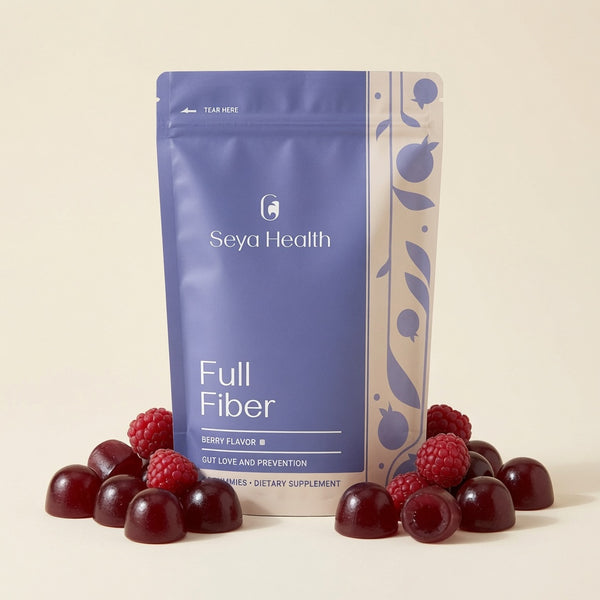
Seya Full Fiber
More than 90% of women fall short on fiber. Seya Full Fiber gives you 6 grams from three fibers in one, in three small gummies that feed the beneficial bacteria in your gut. Plant based, no gelatin, no sugar alcohols.
Shop Full FiberKeep reading

fiber
Can a Multivitamin Replace Vegetables? What Supplements Can't Do for Your Gut

constipation
The Best Way to Beat Constipation in Your 30s (and Where Fiber Gummies Fit)
fiber
The Gut-Skin Axis: Does Your Gut Health Affect Your Skin?
The gut-skin axis, explained: how your gut bacteria and blood sugar affect your skin, w...