Short version: Creatine side effects in older women are rare and mild in clinical trials. A 2026 meta-analysis pooled 7 trials in 608 women after menopause, with an average age near 62. Side effects were about the same as placebo, and kidney tests did not change.
- Most common: a mild upset stomach or bloating, about as often as on placebo.
- The scale: expect about 1 to 2 lb of water and muscle, not fat.
- Lab tests: blood creatinine can tick up. Tell your doctor you take creatine.
- Longest data: two 2-year trials in women after menopause found no safety signal.
Last updated November 2026.
You are past menopause. You keep hearing that creatine helps you hold on to muscle.
But most creatine studies were done on young men who lift. You want to know what happens to a body like yours.
So we went to the trials run in women after menopause, and the meta-analyses that pooled them. Here is what they logged.
What are creatine side effects in older women?
Mostly a mild upset stomach, some bloating, and a little water weight. In trials, these showed up about as often in women taking a placebo.
The best summary is a 2026 meta-analysis. It pooled 7 placebo-controlled trials in 608 women after menopause. The trials ran from 12 weeks to 2 years. See Naddafha et al. (JISSN, 2026).
Its safety verdict was short. Side effects were mild and similar to placebo. Kidney markers did not change. No trial reported kidney damage.
Doses ran from 1 to 5 g a day, with some trials using a short loading phase of 20 g a day. The authors called that range safe and well tolerated for 3 to 24 months.
What did a 2-year trial in women after menopause log?
The biggest single trial gives the most detail. 237 women, average age 59, took creatine or a placebo for 2 years. They also lifted weights 3 days a week and walked 6 days a week. See Chilibeck et al. (Med Sci Sports Exerc, 2023).
The dose was 0.14 g per kg of body weight a day. For a 150 lb woman, that is about 9.5 g a day, which is higher than most people take.
Doctors on the team reviewed the side effect reports. Here is what the original trial report lists.
| What was tracked (2 years) | Creatine | Placebo |
|---|---|---|
| Women with stomach or gut complaints | 13 | 14 |
| Women with muscle cramps | 2 | 2 |
| Women with a kidney-related flag | 15 | 21 |
| Women with a liver-related flag | 7 | 5 |
| Quit because of a side effect | 2 | 1 |
None of these gaps were statistically significant. Almost all the flags were rated mild.
Two women on creatine stopped early. One had diarrhea. The other reported an allergy to the metal on the gym machines.
The team also counted falls for one year after the study ended. There were 30 in the creatine group and 19 on placebo. That gap was not statistically significant.
What about a lower dose over 2 years?
A Brazilian trial tested a smaller amount. 200 women after menopause, all with thinning bones, took 3 g of creatine or a placebo every day for 2 years. See Sales et al. (J Gerontol A, 2020).
Creatine did not change their health lab results. Per the 2026 meta-analysis, the share of women with any side effect, mostly mild joint pain, was about the same in both groups.
That trial did not find a bone or muscle benefit either. The meta-analysis found muscle and strength gains mainly when women took 5 g or more and also did strength training.

Is creatine hard on the kidneys after menopause?
The trials in older women say no. But your lab report may look different, so it helps to know why.
Your body turns creatine into creatinine, a waste product. Doctors use blood creatinine to estimate how well your kidneys filter. More creatine in, more creatinine out, even when the kidneys are fine.
A 2026 meta-analysis of 26 trials and 1,036 people showed this clearly. Creatine raised blood creatinine by 0.14 mg/dL. Kidney filtering estimated from creatinine looked lower. But when filtering was measured directly with a tracer, there was no significant change. See de Souza Almeida et al. (Int Urol Nephrol, 2026).
A second 2026 review of 20 trials found the same creatinine rise, with no change in urea or estimated filtering. See Tsiaras et al. (J Ren Nutr, 2026).
One honest caveat. Few trials have measured kidney filtering directly, so one review rated the evidence low certainty. See Raihan and Supriyanta (Int Urol Nephrol, 2026).
So tell your doctor you take creatine before a blood test. Our post on creatine vs creatinine explains how to read the numbers.
Does creatine cause weight gain or bloating in older women?
A little weight, yes. Bloating, sometimes.
Creatine pulls water into your muscles. The meta-analysis notes most people gain about 0.5 to 1 kg, or 1 to 2 lb, in the first week. In one trial, the creatine group ended about 0.8 kg heavier than placebo, in step with more muscle.
No trial in women after menopause found more body fat from creatine.
Bloating is most likely with a big single dose. Splitting the dose and taking it with food and water helps. See does creatine cause bloating? and creatine water retention for the timeline.
What do meta-analyses say about creatine safety overall?
They agree with the trials in older women. The largest one pulled side effect data from 685 trials, with over 12,800 people on creatine and over 13,400 on placebo. See Kreider et al. (JISSN, 2025).
- Any side effect: 4.60% on creatine vs 4.21% on placebo.
- Stomach or gut issues: 5.51% vs 4.05%.
- Muscle cramps or pain: 0.52% vs 0.07%.
None of those gaps were significant, and kidney markers did not differ. The average dose was about 12.5 g a day, more than most women take.
The postmenopausal meta-analysis put it plainly. No age-specific or sex-specific safety signal has shown up.
Who should check with a doctor first?
Trials enrolled healthy women. Talk to your doctor before you start if you:
- Have kidney disease, or a past low kidney filtering result.
- Have diabetes or take a drug that affects the kidneys, like some blood pressure pills.
- Take several prescriptions. See creatine and medications.
- Have liver disease. See is creatine bad for your liver?
How to lower the chance of side effects
- Skip loading. A steady 3 to 5 g a day is enough for most women.
- Split bigger amounts into two smaller doses.
- Take it with a meal and a glass of water.
- Pick a third-party tested product with plain creatine monohydrate.
- Pair it with strength training. That is where trials found the benefit.
For benefits by age, see creatine for women over 60 and creatine gummies for menopause and life after 50.
Where Seya fits, honestly
Right now, the only Seya product you can buy is our fiber gummy, which supports regularity.
A Seya creatine gummy is coming January 2027. Until it launches, we will not share its dose, price, or ingredients.
For the broader picture, see is creatine safe for women? and creatine side effects in women. This is education, not medical advice.
These statements have not been evaluated by the Food and Drug Administration. This product is not intended to diagnose, treat, cure, or prevent any disease.
Frequently asked questions
What are creatine side effects for older women?
Mostly a mild upset stomach, some bloating, and 1 to 2 lb of water weight. A 2026 meta-analysis of 7 trials in 608 women after menopause found side effects similar to placebo.
Is creatine safe after menopause?
Trials say yes for healthy women. Doses of 1 to 5 g a day were well tolerated for up to 2 years, and kidney markers did not change. Check with your doctor if you have kidney disease.
What do meta-analyses say about creatine safety?
A 2025 analysis of 685 trials found side effects in 4.60% of people on creatine vs 4.21% on placebo, not a significant gap. Kidney reviews find a small creatinine rise but no change in directly measured filtering.
Does creatine raise creatinine on blood tests?
Yes, by about 0.13 to 0.14 mg/dL on average. That comes from creatine breakdown, not kidney damage. Tell your doctor you take it so the result is read correctly.
Can creatine cause muscle cramps in older women?
Rarely. In a 2-year trial of 237 women after menopause, 2 women on creatine and 2 on placebo reported cramps.
How much creatine did older women take in trials?
Most trials used 1 to 5 g a day. One 2-year trial used about 9.5 g a day for a 150 lb woman. Gains in muscle and strength showed up mainly at 5 g or more with strength training.
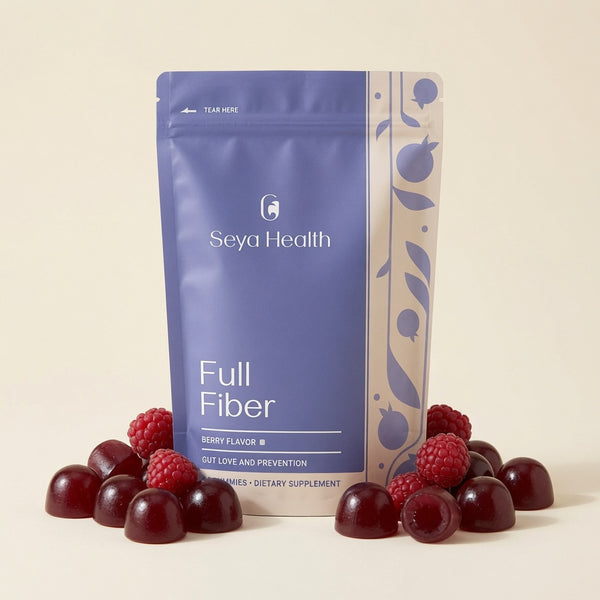
Seya Full Fiber
Most women fall short on fiber. Seya Full Fiber gives you 6 grams from three fibers in three small vegan gummies. Plant based, no gelatin, no sugar alcohols.
Shop Full Fiber