Home/ The Journal/ fiber foods
fiber foods
Prebiotic fiber foods vs. powders: how to get enough every day

Short version: Prebiotic fiber foods give most Americans only about 5 g a day of inulin-type prebiotics, and most of that comes from wheat and onions. Studies see helpful gut bacteria rise at about 5 to 8 g a day. Food can get you there, but only if you eat the right roots and bulbs most days. A powder makes the dose exact. The best plan for most women is food first, then a measured scoop or gummy to fill the gap.
- Food now: about 2.6 g of inulin plus 2.5 g of oligofructose a day in the average US diet.
- Studied amount: 5 to 8 g a day raised bifidobacteria in trials.
- Food can do it: one trial hit 15 g a day with leeks, onion, garlic and root vegetables.
- Powders work best on top of food: people who already ate more fiber had a bigger response.
Last updated November 2026.
You can buy prebiotic fiber in a tub. You can also find it in an onion. So which one should you count on?
The honest answer is both, in a set order. Food gives you a mix of fibers and nutrients that no scoop can copy. A powder gives you a known number of grams. This guide puts real numbers on each side, so you can see how close your plate already gets you and what is left to fill.
If you are new to the term, start with what prebiotic fiber does for your gut. Here we stay on one question: how do you get enough, every day?
How much prebiotic fiber do you need a day?
There is no official daily target for prebiotics. The official target is for total fiber: about 25 g a day for women, and about 21 g after age 50, per the National Academies. Only about 5% of Americans meet the fiber goal, per Quagliani and Felt-Gunderson, American Journal of Lifestyle Medicine, 2017 (PMID 30202317).
For prebiotics, the research gives a working range. A review in Nutrients found that inulin, oligofructose and FOS raised bifidobacteria at fairly low intakes, about 5 to 8 g a day, per Slavin, 2013 (PMID 23609775). Bifidobacteria are a group of helpful gut bacteria.
There is also a ceiling to respect. In a trial of 26 healthy adults, native inulin was well tolerated up to 10 g a day. Shorter-chain oligofructose was fine at 5 g, but 10 g clearly raised gas and bloating, per Bonnema et al., Journal of the American Dietetic Association, 2010 (PMID 20497775).
So a useful goal is about 5 to 8 g of prebiotic fiber a day, inside your 25 g of total fiber.
How much prebiotic fiber do you get from food now?
Less than you might think. A USDA survey of more than 15,000 Americans found the average diet held 2.6 g of inulin and 2.5 g of oligofructose a day. Wheat supplied about 70% of it, and onions about 25%, per Moshfegh et al., Journal of Nutrition, 1999 (PMID 10395608).
Newer lab tests tell a similar story. Researchers in Slovenia measured fructans, the fiber family that includes inulin, in 40 common foods. Most foods held under 2 g per 100 g. The average person got only about 1.6 to 1.7 g a day, per a 2024 study in Frontiers in Nutrition (PMC11327153).
Here is what everyday portions held in that study.
| Food (as tested) | Fructan per 100 g | Typical portion | Fructan per portion |
|---|---|---|---|
| Onion | 1.97 g | 70 g | 1.38 g |
| Wheat flour | 0.75 g | 125 g | 0.94 g |
| Canned beans | 0.24 g | 179 g | 0.43 g |
| Canned peas | 0.33 g | 79 g | 0.26 g |
| Leek | 0.24 g | 89 g | 0.21 g |
| Almonds | 0.60 g | 28 g | 0.17 g |
| Banana | 0.11 g | 126 g | 0.14 g |
Source: Fructan content in commonly consumed Slovenian foods, Frontiers in Nutrition, 2024. Amounts vary with the variety, how long the food was stored, and how it was cooked.
That last point matters. An older review found that inulin is lost during storage and cooking, and that standard fiber tests often miss it, so food tables tend to leave it out, per Van Loo et al., Critical Reviews in Food Science and Nutrition, 1995 (PMID 8777017). The same review put typical intake at 1 to 10 g a day, depending on where and how people eat.
The takeaway: an onion a day is a good start. A banana and a handful of almonds add very little.
Can you get enough prebiotic fiber from food alone?
Yes, but it takes specific foods, eaten on purpose.
In a Belgian trial, 26 healthy adults ate a hot lunch and a soup each day for two weeks. Each meal was built on inulin-rich vegetables: salsify, Jerusalem artichoke, artichoke, leek, onion, garlic and scorzonera. They took in at least 9 g and on average 15 g of inulin-type fiber a day, per Hiel et al., American Journal of Clinical Nutrition, 2019 (PMID 31108510).
Three results stand out:
- It worked. Bifidobacteria rose during the vegetable diet.
- It was gentle. Gas went up, but bloating, cramps and discomfort did not.
- It faded. Three weeks after people went back to their usual diet, the gut changes had reversed.
So food can match a supplement dose. The catch is the menu. Salsify and scorzonera are not on most grocery lists. Our guide to Jerusalem artichoke covers one of the easier roots to find.

What do prebiotic powders offer?
A powder gives you a fixed, known dose of one or two isolated fibers. Common ones include:
- Inulin and FOS, usually from chicory root.
- GOS (galactooligosaccharides), made from milk sugar.
- Partially hydrolyzed guar gum (PHGG), sold as Sunfiber and similar brands.
- Acacia gum and resistant starch.
Many of these count as dietary fiber on a US label. The FDA lists guar gum, psyllium and beta-glucan as meeting its fiber definition. It has also said it plans to add inulin-type fructans, GOS, resistant starch and acacia gum, per the FDA dietary fiber Q&A.
Not every isolated fiber does the same job. In a meta-analysis of 64 trials with 2,099 healthy adults, fructans and GOS gave the clearest rise in bifidobacteria and lactobacilli, per So et al., American Journal of Clinical Nutrition, 2018 (PMID 29757343). We compare specific products in the best soluble fiber supplements.
Prebiotic fiber foods vs. powders: side by side
| Prebiotic fiber foods | Prebiotic powders | |
|---|---|---|
| Dose | Hard to know; varies with storage and cooking | Exact grams on the label |
| Fiber types | Many at once, plus the rest of your 25 g | Usually one or two |
| Other nutrients | Vitamins, minerals, plant compounds | Little or none |
| Reaching 5 to 8 g | Takes roots and bulbs most days | One measured serving |
| Gas risk | Mild in the vegetable trial | Rises fast with short-chain types like FOS |
| Oversight | Regular food | FDA does not approve supplements before sale |
Does your diet change how well a prebiotic powder works?
It seems to. In a crossover trial, 34 healthy adults took 16 g a day of an inulin-type prebiotic or a placebo for three weeks. Bifidobacteria rose in both low-fiber and high-fiber eaters. But the people who already ate more fiber had a broader response, with more shifts in their gut bacteria, per Healey et al., British Journal of Nutrition, 2018 (PMID 29307330).
That is the strongest case for doing both. A powder is a top-up. It does not stand in for a fiber-rich plate.
A simple daily plan to get enough
- Cook with alliums daily. Onion, garlic or leek in one meal a day is the easiest prebiotic habit.
- Pick whole wheat and beans. Wheat is the top US source, and beans add fiber of many kinds.
- Add one root a week. Try artichoke, Jerusalem artichoke or salsify in a soup or roast.
- Fill the gap with a measured dose. A powder or gummy makes sense if your meals fall short.
- Start low. Begin with 2 to 3 g of an isolated prebiotic and add a little each week.
- Drink water and spread fiber across meals.
Need more food ideas? See our list of high-fiber foods for women. If you are choosing a format, fiber gummies vs. powder vs. capsules walks through it.
What should you know before taking a dietary supplement?
Three things, per the FDA.
- Talk to a clinician first. The FDA advises asking your doctor, pharmacist or other health care professional, because some supplements can interact with medicines or other supplements.
- No pre-market approval. Under DSHEA, the FDA cannot approve dietary supplements before they are sold. The maker is responsible for safety and labeling, per the FDA dietary supplement Q&A.
- Read the label. Look for the fiber type by name and the grams per serving, not a vague blend.
If prebiotics leave you with pain, blood in your stool or a big change in habits, stop and see a clinician. Our post on when bloating isn't normal lists the signs.
Where Seya fits, honestly
Seya makes a vegan fiber gummy with resistant tapioca fiber, a fermentable fiber, at about 6 g of fiber in three gummies. That lands inside the 5 to 8 g range studied for prebiotics, but it is a different fiber than the inulin in most of those trials.
So the claim stays simple. It supports regularity and helps close part of your daily fiber gap. It is a top-up to food, not a swap for it. You can read how the ingredient works in what resistant tapioca starch is, or see the Seya fiber gummy.
This is education, not medical advice.
These statements have not been evaluated by the Food and Drug Administration. This product is not intended to diagnose, treat, cure, or prevent any disease.
Frequently asked questions
How much prebiotic fiber should I eat a day?
There is no official target for prebiotics alone. Trials of inulin, oligofructose and FOS raised bifidobacteria at about 5 to 8 g a day. Keep that inside a total fiber goal of about 25 g a day for women, or about 21 g after age 50.
Is it better to get prebiotics from food or a supplement?
Food first, then a supplement to fill the gap. Food brings many fiber types and nutrients. A powder gives an exact dose. In one trial, people who already ate more fiber had a broader gut response to an inulin supplement.
Which foods have the most prebiotic fiber?
Roots and bulbs such as Jerusalem artichoke, salsify, artichoke, chicory root, leek, onion and garlic. A diet built on these supplied about 15 g of inulin-type fiber a day in a two-week trial. Wheat and onions are the biggest sources in the average US diet.
What should you know before taking a dietary supplement?
The FDA advises talking to your doctor, pharmacist or other health care professional first, since some supplements interact with medicines. The FDA does not approve supplements before they are sold. Check the label for the fiber type by name and the grams per serving.
Can you take too much prebiotic fiber?
Yes, in the sense that gas and bloating rise with the dose. In one trial, native inulin was well tolerated up to 10 g a day, while 10 g of oligofructose caused clearly more symptoms. Start with a few grams and build up over a few weeks.
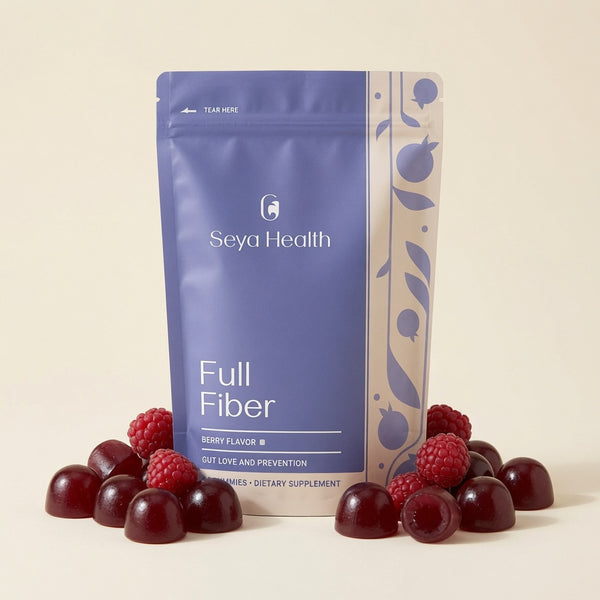
Seya Full Fiber
Most women fall short on fiber. Seya Full Fiber gives you 6 grams from three fibers in three small vegan gummies. Plant based, no gelatin, no sugar alcohols.
Shop Full Fiber