Short version: Creatine and spironolactone have no known interaction, and the same is true for lisinopril. But no study has tested either pair. A 2026 review searched the research and found zero human studies of creatine taken with any prescription drug.
- Spironolactone (for acne or PCOS): the real watch-out is potassium, not creatine. Skip creatine blends with added potassium.
- Lisinopril: same potassium rule. Creatine can also nudge your creatinine, a kidney lab your doctor may watch on this drug.
- Both drugs plus daily ibuprofen: this mix is the one with real kidney data behind it. Ask your doctor first.
- Gout: creatine is not a purine and does not break down into uric acid. No trial has tested it in people with gout.
Last updated November 2026.
Maybe your dermatologist put you on spironolactone for adult acne. Maybe your doctor started you on lisinopril last year. Or maybe you had one gout flare and now you read every label twice.
Then you hear creatine is good for women's muscles, bones, and brains. You want to try it. Is it safe with what you already take?
Here is what the research shows for each one. We will be clear about what is proven, what is a guess, and where a doctor's OK matters. Seya does not sell a creatine product yet, so no brand paid for this view.
Creatine and spironolactone or lisinopril: is it safe?
As far as anyone knows, yes for most healthy people. But "as far as anyone knows" is doing real work here.
In 2026, a researcher searched three medical databases for human studies of creatine taken with prescription drugs. Of 132 unique papers, none qualified. Seven drug-interaction tools, including Drugs.com and the FDA's resource, listed no creatine interaction of moderate or high severity. See Ostojic (Curr Ther Res Clin Exp, 2026).
The small signals that do exist point to one organ: the kidneys. That matters here, because spironolactone and lisinopril both act on how your kidneys handle salt, water, and potassium.
So the useful question is not "does creatine clash with my pill?" It is "what else in my routine stresses the same system?" That answer is more specific, and more useful. Our creatine and medications guide covers GLP-1s, antidepressants, and ADHD meds.
Spironolactone for acne or PCOS: what about potassium?
Spironolactone is a water pill that holds on to potassium. Its drug guide lists potassium supplements as a product that may interact, and it says to avoid salt substitutes made with potassium. See MedlinePlus: Spironolactone.
Plain creatine monohydrate has no potassium in it. The catch is the tub. Some "hydration" creatine blends add electrolytes, and potassium is a common one. Read the label. Our creatine with electrolytes guide explains what those add-ons do.
If you are a young, healthy woman taking it for acne, the potassium risk itself looks small. A study of 974 women on spironolactone for acne found high potassium in 13 of 1,802 blood tests. That 0.72% rate matched the 0.76% rate in similar women not taking it. See Plovanich et al. (JAMA Dermatol, 2015).
One key detail: that study left out women on blood pressure drugs like lisinopril. If you take both, that reassurance does not cover you. For the PCOS side of creatine, see creatine and PCOS.
Lisinopril: potassium, kidney labs, and creatine
Lisinopril is an ACE inhibitor. Like spironolactone, it can raise potassium. Its drug guide lists potassium supplements and pain relievers like ibuprofen as products that may interact. It also says to talk to your doctor before using potassium salt substitutes. See MedlinePlus: Lisinopril.
Creatine adds a second wrinkle: your lab report. Creatine breaks down into creatinine, the waste product doctors use to estimate kidney function. See Wyss and Kaddurah-Daouk (Physiol Rev, 2000).
Across 19 trials, creatine raised blood creatinine by about 0.13 mg/dL. The actual kidney filtering rate did not change. See Tsiaras et al. (2026).
That bump is small. But if your doctor is watching your kidney numbers on lisinopril, a higher creatinine could look like a drug problem when it is really your supplement. Tell them you take creatine before any blood work. Our creatine vs creatinine guide walks through how to read the result.

The combo that has real data: water pill + ACE inhibitor + ibuprofen
Here is the part most creatine articles skip. The best-studied kidney risk in this group has nothing to do with creatine.
A UK study followed 487,372 people on blood pressure drugs for about six years. Taking a water pill plus an ACE inhibitor or similar drug, plus an NSAID like ibuprofen or naproxen, raised the rate of sudden kidney injury by 31%. In the first 30 days of that mix, the rate was 82% higher. Two of the three together did not raise the rate. See Lapi et al. (BMJ, 2013).
Spironolactone is a water pill. Lisinopril is an ACE inhibitor. Add ibuprofen for sore muscles after lifting, and you have that exact trio.
So if you take both drugs, the safest move with creatine is really about the pain reliever. Ask your doctor what to take for workout soreness. And drink well on days you sweat, since the lisinopril guide notes heavy sweating and low fluids can drop your blood pressure.
Can creatine cause a gout flare?
There is no evidence it does. We found no trial of creatine in people with gout, so we cannot promise it is safe for you. But the chemistry points away from a problem.
Gout happens when uric acid builds up and forms crystals in a joint. Uric acid comes from breaking down purines, which are found in your cells and in foods like red meat, organ meats, and some seafood. See MedlinePlus: Uric acid test.
Creatine is not a purine. Your body turns it into creatinine, not uric acid. See Wyss and Kaddurah-Daouk (2000).
Long-term data is reassuring too. In 98 college athletes followed for up to 21 months, creatine users showed no meaningful change across a 54-item blood and urine health panel. See Kreider et al. (Mol Cell Biochem, 2003).
Food is a different story. In 633 people with gout, those who ate the most purines over two days had about 4.8 times the odds of a flare. See Zhang et al. (Ann Rheum Dis, 2012). So getting your creatine from a supplement is a cleaner route than eating extra steak to get it.
Your blood pressure pill may matter more for gout than creatine
This is where lisinopril and gout connect. A large UK study compared 24,768 people with new gout against 50,000 people without it. See Choi et al. (BMJ, 2012).
| Blood pressure drug type | Gout risk vs not taking it |
|---|---|
| Diuretics (water pills) | 2.36 times |
| ACE inhibitors, like lisinopril | 1.24 times |
| Calcium channel blockers | 0.87 times (lower) |
| Losartan | 0.81 times (lower) |
These are links in a big data set, not proof that one pill causes gout. The study also grouped all diuretics together, so it does not single out spironolactone.
Still, if you have gout and high blood pressure, ask your doctor whether your current pill is the best fit. Never stop or switch a blood pressure drug on your own.
Creatine dose and other habits if you take these drugs
If your doctor says yes, keep it simple:
- Stick to 3 to 5 g a day. That is the standard daily dose in the research. See Antonio et al. (JISSN, 2021).
- Loading is optional. A steady daily dose fills your muscles too, just over a few weeks instead of one, per the same review.
- Choose plain creatine monohydrate. No added potassium, no stimulant blend.
- Ask before you reach for ibuprofen. Especially if you take spironolactone and lisinopril together.
- Drink water on hot or sweaty days. Dehydration is a problem on both drugs, with or without creatine.
- Flag it before blood work. Say "I take creatine" so a small creatinine bump is not misread.
For the full safety picture, see is creatine safe for women and creatine side effects in women.
Where Seya fits, honestly
Seya sells one product today: a fiber gummy that supports regularity. Our creatine gummy is coming January 2027. It is not on sale yet, and we will not share its dose, price, or ingredients until the formula is final.
No supplement, ours included, should replace or change a medicine your doctor prescribed. This is education, not medical advice.
These statements have not been evaluated by the Food and Drug Administration. This product is not intended to diagnose, treat, cure, or prevent any disease.
Frequently asked questions
Can I take creatine on spironolactone?
No interaction is known, though the pair has not been studied. Use plain creatine with no added potassium, and avoid potassium salt substitutes. Tell your prescriber you take it.
Can I take creatine if I take lisinopril?
Probably, for most people, but get your doctor's OK. Avoid added potassium, go easy on ibuprofen, and mention creatine before blood work, since it can nudge creatinine up.
Can creatine cause a gout flare-up?
There is no evidence it does. Creatine is not a purine and breaks down into creatinine, not uric acid. Purine-rich foods and some water pills are much bigger gout triggers.
Does creatine raise uric acid?
Creatine breaks down into creatinine, not uric acid. No study has tested it in people with gout, so ask your doctor if you have frequent flares.
Is creatine safe with spironolactone and lisinopril together?
This is the pairing to clear with your doctor first. Both drugs raise potassium, and adding an NSAID like ibuprofen to a water pill plus an ACE inhibitor raised kidney injury risk in a large study.
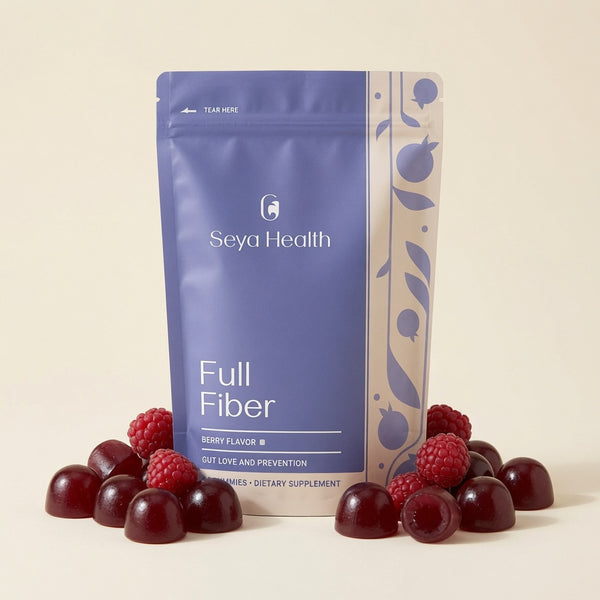
Seya Full Fiber
Most women fall short on fiber. Seya Full Fiber gives you 6 grams from three fibers in three small vegan gummies. Plant based, no gelatin, no sugar alcohols.
Shop Full Fiber