Short version: Creatine and PCOS have never been studied together in a clinical trial. Creatine has a strong safety record in healthy adults, and nothing suggests PCOS changes that. Insulin resistance is the big lever in PCOS. A review of 28 studies found women with PCOS are about 27% less sensitive to insulin, whatever their weight (Cassar, 2016). Creatine may help a little there, but only alongside exercise.
- Safe? Likely yes at 3 to 5 g a day, if your kidneys are healthy.
- Cause PCOS? No. There is no evidence for that.
- Help symptoms? Possibly strength, energy, and memory. None of it has been tested in PCOS yet.
- Best paired with: lifting twice a week, which the PCOS guideline already advises.
Last updated November 2026.
If you have PCOS, you have probably seen creatine pop up in your feed. Some posts call it a hormone fix. Others warn it will make your acne or hair worse.
Both camps are guessing. We went through the research to sort out what is known, what is borrowed from other groups, and what nobody has tested yet.

Is creatine safe for women with PCOS?
Probably, for most women. But the honest answer starts with a gap.
When we searched the medical literature in November 2026, we found no trial that gave creatine supplements to women with PCOS. The only PCOS paper with creatine in the title measured a muscle enzyme in the blood, not a supplement (2019 study in Qatari women).
So the safety picture comes from other groups. There, the record is long. The International Society of Sports Nutrition reviewed decades of research. It found creatine monohydrate safe for healthy people when taken as directed (Kreider, 2017).
PCOS does not change how your kidneys or liver handle creatine, as far as anyone knows. A few cases call for a talk with your doctor first:
- You have kidney disease, or your labs have flagged your kidneys.
- You are pregnant, breastfeeding, or trying to conceive. Research in pregnancy is limited.
- You take several medicines. Our guide to creatine and medications covers the common ones.
One lab quirk to know. Creatine can nudge up creatinine, a kidney marker, without any harm to the kidneys. A 2026 review put the average rise at about 0.13 mg/dL (Tsiaras, 2026). Tell your doctor you take it before blood work.
Can creatine cause PCOS?
No. No study links creatine to PCOS starting or getting worse.
PCOS runs in families and involves hormones, insulin, and the ovaries. The 2023 international guideline puts it at 10% to 13% of women worldwide (Teede, 2023). That is common enough that many women who take creatine will also have PCOS. That overlap is not cause and effect.
Your body already makes about half the creatine it uses each day. The rest comes from meat and fish (Kreider, 2017). A supplement tops up a fuel your cells already run on. It is not a hormone.
What does the research say about creatine and PCOS?
Here is the evidence, sorted by how close it gets to women with PCOS.
| Question | Best evidence | Tested in PCOS? |
|---|---|---|
| Is it safe? | Decades of trials in healthy adults | No |
| Blood sugar | One small trial in type 2 diabetes, with exercise | No |
| Memory and focus | 16 trials, 492 adults | No |
| Strength | Many trials, men and women, with lifting | No |
| Hormones | One study in 20 male rugby players | No |
Every row borrows from other people. That does not make the findings wrong for you. It does mean you should hold them loosely and track how you feel.
The PCOS guideline itself does not mention creatine. Its 254 recommendations and practice points cover diet, exercise, medicines, and inositol, but not this supplement.
Does creatine help insulin resistance?
It might, a little, when you also exercise. On its own, the evidence is weak.
Insulin resistance sits at the center of PCOS for many women. In the Cassar review of 28 studies, insulin worked about 27% less well in women with PCOS. A higher weight cut it by a further 15% (Cassar, 2016). That is why so much PCOS advice targets blood sugar.
Here is what creatine trials show:
- The most cited trial: 25 adults with type 2 diabetes took 5 g of creatine a day for 12 weeks while they trained. Their HbA1c fell from 7.4% to 6.4%. The placebo group barely moved, 7.5% to 7.6% (Gualano, 2011).
- Sedentary men: 22 men took creatine and did aerobic training for 3 months. Their blood sugar curve after a glucose drink was lower (Gualano, 2008).
- No exercise, no change: healthy untrained men who took creatine without a training plan saw no shift in insulin sensitivity (Newman, 2003).
- The pooled view: a 2022 review of 9 studies found no clear effect on fasting glucose or insulin resistance overall (Delpino, 2022).
The pattern is clear enough. Muscle is where most blood sugar goes after a meal. Creatine seems to help most when it helps you train, so your muscles take up more glucose. It is not a blood sugar pill. For the full diabetes trial picture, see creatine, blood sugar, and type 2 diabetes.
Can creatine help PCOS brain fog and low energy?
Maybe for memory. Fatigue in PCOS has other causes worth ruling out first.
Your brain uses creatine too. A 2024 review pooled 16 trials with 492 adults. Creatine gave a small boost to memory, with moderate certainty in the evidence (Xu, 2024). An earlier review of 6 trials found the clearest gains in short-term memory and reasoning (Avgerinos, 2018). None of those trials looked at PCOS.
Before you blame brain fog on low creatine, check the basics. The PCOS guideline flags sleep apnoea as much more common in PCOS, at any weight. It advises screening if you snore, wake up unrefreshed, or feel sleepy in the day (Teede, 2023). Poor sleep will drain you far more than any supplement can fix.
Our deep dive on creatine for brain health covers the memory trials in detail.
Does creatine support high-intensity training with PCOS?
Yes. This is where creatine has its strongest evidence, in women and men alike.
Creatine refills the fast energy your muscles burn in short, hard efforts. Think heavy lifts, sprints, or interval rounds. Paired with training, it supports gains in strength and lean mass (Antonio, 2021).
That matters for PCOS, because exercise is a first-line tool. The guideline advises 150 to 300 minutes of moderate activity a week. It also advises muscle-strengthening work on 2 non-consecutive days (Teede, 2023).
Resistance training on its own looks helpful in PCOS. A 2022 review of the trials found small benefits, but rated the studies low in quality (Kite, 2022). Creatine is best seen as a helper for that habit. It will not do the work for you. If you are new to lifting, our guide to creatine for women who lift is a good start.
Does creatine raise testosterone or worsen PCOS hair loss?
There is no good evidence that it does. This worry comes up a lot, because many women with PCOS already have high androgens.
The fear traces back to one 2009 study. In 20 male rugby players, a form of testosterone called DHT rose after a week of creatine loading (van der Merwe, 2009). The study did not measure hair, and no one has repeated the result.
A 2021 review counted 12 other studies that measured testosterone. Most found no meaningful change (Antonio, 2021). A 2025 trial tracked hair for 12 weeks and saw no change, though it only enrolled men (Lak, 2025).
No one has measured androgens in women with PCOS who take creatine. If you notice new acne or shedding, note when it started and talk to your doctor. We walk through the full DHT story in does creatine cause hair loss?
Can you take creatine and inositol together?
No study has tested the two together. Nothing about how they work suggests a clash.
Inositol is the most popular PCOS supplement. The guideline says it could be considered, with limited harm. It also notes limited proof of benefit for ovulation, unwanted hair, or weight (Teede, 2023).
The same guideline asks women who take inositol or other add-on supplements to tell their care team. That is a good rule for creatine as well. The same goes for metformin. We found no study that tested creatine with it.
One tip: skip "PCOS blends" that pack creatine, inositol, and herbs into one scoop. You cannot tell which one is helping, or which one upsets your stomach.
Do you need more water when taking creatine?
Just drink normally, and a bit more on training days. Creatine does not dry you out.
A review of 10 controlled trials found no sign that creatine harms fluid balance or heat tolerance (Lopez, 2009). It does pull a little extra water into your muscles. That can nudge the scale up in the first week or two. It is water in muscle, not fat. Our guide to creatine water retention explains how long it lasts.
How to try creatine if you have PCOS
- Check with your doctor if you have kidney concerns, are pregnant, or are trying to conceive.
- Pick plain creatine monohydrate. It is the form used in nearly all the research.
- Take 3 to 5 g a day, at any time that suits you. A loading phase is optional.
- Lift at least twice a week. Most of the benefit depends on it.
- Give it at least 4 weeks. Without loading, 3 g a day takes about 28 days to fill your muscles (Hultman, 1996). Then judge by strength, energy, and how you feel.
Shopping for one? Our checklist of the best creatine for women with PCOS covers forms, doses, and test seals.
Where Seya fits, honestly
Seya sells one product today: a fiber gummy that supports regularity. Our creatine gummy is coming January 2027. It is not on sale yet, and we will not share its dose, price, or ingredients until the formula is final.
We wrote this so you can weigh creatine on the evidence, not the hype. Creatine supports muscle strength and power when paired with resistance training. This is education, not medical advice. Talk to a qualified clinician about your PCOS care before you start any supplement.
These statements have not been evaluated by the Food and Drug Administration. This product is not intended to diagnose, treat, cure, or prevent any disease.
Frequently asked questions
Is creatine PCOS friendly?
For most women, yes. It has a long safety record in healthy adults, and nothing suggests PCOS changes that. It has not been studied in PCOS directly.
Can creatine cause PCOS?
No. No study links creatine to PCOS. PCOS involves genes, hormones, and insulin, and is present in 10% to 13% of women.
Can creatine reduce PCOS symptoms?
No trial has tested that. Creatine may support strength, training, and memory, which can help you manage PCOS, but it does not target the condition itself.
Does creatine help insulin resistance?
Only a little, and mainly with exercise. One trial in type 2 diabetes saw a 1-point drop in HbA1c with creatine plus training. A 2022 review of 9 studies found no clear effect overall.
Can you take creatine and inositol together?
No study has tested them together, and no clash is known. Tell your clinician about both, as the PCOS guideline advises for any add-on supplement.
Can creatine help PCOS brain fog?
It may give a small lift to memory, based on 16 trials in adults without PCOS. Rule out poor sleep and sleep apnoea first.
Does creatine raise testosterone in women?
There is no good evidence for that. One study in male rugby players saw DHT rise, but most other studies found no meaningful change in testosterone.
Do you need more water when taking creatine?
Drink to thirst, with a little more on training days. A review of 10 trials found creatine does not cause dehydration.
How much creatine should women with PCOS take?
The research dose is 3 to 5 g of creatine monohydrate a day. You do not need a loading phase.
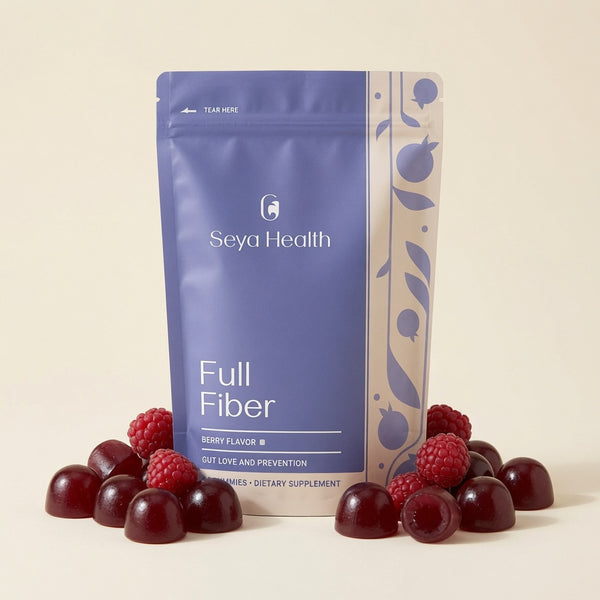
Seya Full Fiber
Most women fall short on fiber. Seya Full Fiber gives you 6 grams from three fibers in three small vegan gummies. Plant based, no gelatin, no sugar alcohols.
Shop Full Fiber