
Home/ The Journal/ fiber
fiber
Fiber and Menopause: Can It Ease Hot Flashes, and What to Eat in Perimenopause

Short version: The research on fiber and menopause is thinner than the internet makes it sound. No trial has ever tested fiber on its own against hot flashes. What has been tested is a whole-food, high-fiber, soy-containing way of eating, and in one 12-week trial it cut moderate-to-severe hot flashes by 84%. Fiber is one part of that plate. It is not a hot-flash drug.
- Hot flashes last a median of 7.4 years, per the SWAN study of 1,449 women.
- The average age of menopause in the US is 52, and most women start the transition between 45 and 55 (National Institute on Aging).
- In the WAVS trial, a low-fat plant-based diet plus ½ cup of cooked soybeans a day dropped total hot flashes 79% in 12 weeks. The control group dropped 49%.
- More than 90% of US women fall short of the fiber target, which is 25 g a day through age 50 and 21 g after.
- Where fiber's evidence is strongest at midlife: regularity. Not heat.
Last updated September 2026.
It is 3am and you are awake, soaked, kicking the duvet onto the floor.
By 9am you have already read six articles telling you to eat more fiber.
Here is the part those articles skip. Nobody has run the study you think they ran. There is no trial of fiber by itself against hot flashes. Not one.
That does not mean what you eat is irrelevant. It means the honest answer is smaller and more specific than the headline, and you deserve the real version.
Your body is not misbehaving. Estrogen is falling, and your temperature control is recalibrating around it. That is a mechanism, not a character flaw.
When does menopause actually start?
Most women begin the transition between 45 and 55. The average age of menopause in the US is 52.
Menopause itself is a single day, looking backward. You have reached it once you have gone 12 months with no period and no spotting. Everything before that is perimenopause.
Symptoms run 2 to 8 years for most women, though the range is wide and genetics, smoking, race, and ethnicity all shift it.
Two other terms matter, because plenty of women get told they are too young.
- Early menopause is menopause between 40 and 45. About 5% of women go through it naturally.
- Premature menopause is menopause before 40. Doctors also call it primary ovarian insufficiency.
So yes, you can be in perimenopause at 40. You can be in it at 33. It is less common, and it is real, and it deserves a blood test rather than a shrug. The HHS Office on Women's Health lays out both.
How long do hot flashes last?
Longer than almost anyone tells you.
SWAN followed 3,302 women across 7 US sites from 1996 to 2013. Among the 1,449 who had frequent hot flashes or night sweats, the median total duration was 7.4 years.
They did not stop at the last period, either. The median was another 4.5 years after it.
The spread is stark:
- Women whose flashes started while they were still premenopausal or early in the transition: median over 11.8 years.
- African American women: median 10.1 years, the longest of any group in the study.
- Women whose flashes started after menopause: median 3.4 years, the shortest.
A single flash runs 30 seconds to 10 minutes. They can come a few times a week or several times an hour.
If you have been quietly waiting this out for four years and wondering what is wrong with you, the answer is nothing. You are inside the median.
Fiber and menopause: what the research actually shows
The strongest diet trial in this space is WAVS, published in Menopause in 2021.
Researchers took 38 postmenopausal women who had 2 or more hot flashes a day. Half switched to a low-fat plant-based diet that included ½ cup (86 g) of cooked soybeans daily. Half changed nothing. Twelve weeks.
The results, tracked flash by flash in a phone app:
- Total hot flashes fell 79% in the diet group, 49% in the control group.
- Moderate-to-severe flashes fell 84% in the diet group, 42% in the control group.
- 10 of 17 women in the diet group, 59%, ended the study free of moderate and severe flashes.
Both between-group comparisons hit p = 0.01. Quality-of-life scores improved too.
That is a genuinely striking result. It is also 38 women for 12 weeks, and you cannot blind someone to their own dinner.
What the fiber studies cannot tell you yet
Here is the honest problem with WAVS. Three things changed at once: fat went down, soy went up, fiber went up. Nobody can pull those apart afterward.
The closest thing to a fiber-specific signal comes from the WHEL study, which tracked 2,198 women. Higher dietary fiber intake was associated with less severe hot flashes a year later. That is an observation inside a trial, not a test of fiber.
One small trial went closer. Researchers gave 60 menopausal women 100 g of prebiotic-rich yogurt or plain yogurt daily for 6 weeks. The prebiotic group scored lower on vasomotor symptoms, anxiety, and depression.
Sixty women. Six weeks. One site. Promising, and nowhere near enough.
Add it up and the honest verdict is this. A high-fiber, plant-heavy, soy-containing pattern has real evidence behind it for hot flashes. Fiber pulled out of that pattern and sold on its own does not.
What does your gut have to do with estrogen?
More than you would guess, and the story does not end where the marketing wants it to.
Your gut bacteria make an enzyme called beta-glucuronidase. It reactivates estrogen that your liver has already packaged for disposal, letting some of it back into circulation. Researchers call this loop the estrogen-gut microbiome axis.
Fiber changes that loop. In classic work from 1987, women eating a moderate-fat, high-fiber vegetarian diet excreted three times more estrogen in their stool than women on a high-fat, low-fiber Western diet. Their blood estrogen ran 15% to 20% lower.
Read that twice. More fiber, less circulating estrogen.
Hot flashes are driven by estrogen falling. So the tidy mechanism story people tell you, that fiber fixes flashes through your hormones, runs backward on its own evidence.
Anyone who skips this paragraph is selling you something.
What to eat in perimenopause
Build the plate the trials actually used. Beans, lentils, whole grains, vegetables, fruit, seeds, and soy as a food rather than a pill.
All figures below are grams of fiber per 100 g, from USDA FoodData Central.
| Food (cooked or raw as noted) | Fiber per 100 g | Worth knowing |
|---|---|---|
| Chia seeds, dried | 34.4 g | A 28 g scoop carries about 9.6 g |
| Flaxseed | 27.3 g | Grind it, or it passes through whole |
| Black beans, cooked | 8.7 g | The cheapest fiber in the store |
| Lentils, cooked | 7.9 g | No soaking, 20 minutes |
| Raspberries, raw | 6.5 g | Frozen counts |
| Soybeans, cooked | 6.0 g | The WAVS dose, ½ cup, was 86 g |
| Edamame, frozen, prepared | 5.2 g | Same bean, picked young |
That ½ cup of soybeans works out to roughly 5 g of fiber and 16 g of protein. It is one bowl, not a regimen.
Add fiber slowly and drink more water while you do, or you will trade one problem for gas and bloating. We walk through the ramp in high-fiber foods for women over 40.
How much fiber do you need after 40?
25 g a day through age 50. 21 g a day from 51 onward.
The number drops because the target is tied to calories, and calorie needs fall with age. Your gut does not suddenly need less.
Almost nobody hits either figure. More than 90% of US women fall short of the recommended intake, and the average gap is around 50% of the target.
So before you ask whether fiber helps your hot flashes, it is worth knowing you are probably running at half a day's worth. We break the gap down in why most women fall short on fiber.
What fiber does have solid evidence for at midlife is the thing nobody puts on a label: getting things moving again. Transit slows in perimenopause, and that is a separate, well-supported story we cover in perimenopause and constipation.
Where Seya fits, honestly
We make a fiber gummy. We are not going to tell you it does anything to your hot flashes, because the evidence for that does not exist.
3 gummies deliver 5,650 mg of dietary fiber, which is 5.65 g, or 16% of the Daily Value. The label prints the split: 4,500 mg of resistant tapioca fiber, 950 mg of prebiotic soluble fiber, 200 mg of cellulose, plus 80 mg of magnesium as magnesium citrate and 100 mg of ginger root.
What that can honestly claim is that it supports regularity. That 950 mg of prebiotic soluble fiber also sits below the doses used in prebiotic trials, and we are not going to round it up.
5.65 g is about a fifth of a 25 g day. It closes part of the gap. Food closes the rest.
This is education, not medical advice. Hot flashes have real medical options, and a clinician is the right person to walk you through them. Talk to one before starting any new supplement, especially if you take medication.
These statements have not been evaluated by the Food and Drug Administration. This product is not intended to diagnose, treat, cure, or prevent any disease.
Frequently asked questions
When does menopause typically start?
Most women begin the menopausal transition between ages 45 and 55, and the average age of menopause in the US is 52. Menopause is confirmed only in hindsight, after 12 full months with no period or spotting.
The years before that are perimenopause, and symptoms typically run 2 to 8 years. Smoking is linked to an earlier start and more severe symptoms.
Can you be in perimenopause or menopause at 40, or earlier, like 33?
Yes. Menopause between 40 and 45 is called early menopause, and about 5% of women go through it naturally. Menopause before 40 is called premature menopause, or primary ovarian insufficiency.
At 33 it is uncommon but documented. Causes include family history, smoking, chemotherapy or pelvic radiation, surgery to remove both ovaries, autoimmune conditions, and chromosomal differences such as Turner syndrome. If your periods stop early, ask for a blood test of estrogen and related hormones rather than waiting it out.
What foods should you eat during perimenopause?
Build meals around the pattern the trials used: beans, lentils, whole grains, vegetables, fruit, seeds, and whole soy foods. Per 100 g, black beans give 8.7 g of fiber, lentils 7.9 g, raspberries 6.5 g, cooked soybeans 6.0 g, and edamame 5.2 g, per USDA FoodData Central.
The WAVS trial paired a low-fat plant-based diet with ½ cup of cooked soybeans daily. Increase fiber gradually and drink more water alongside it, since a fast jump commonly causes gas and bloating.
Can fiber help you manage hot flashes?
The honest answer is that no trial has tested fiber alone against hot flashes, so there is no direct evidence for fiber as a hot-flash remedy. What has been tested is a whole-food, high-fiber, soy-containing diet, which reduced moderate-to-severe hot flashes by 84% over 12 weeks in a 38-woman trial.
A separate analysis of 2,198 women linked higher fiber intake to less severe symptoms a year later, but that is observational. Fiber's well-supported benefit at midlife is regularity, not heat.
How long do hot flashes last?
A single hot flash lasts 30 seconds to 10 minutes. The symptom as a whole lasts far longer: in the SWAN study of 1,449 women with frequent symptoms, the median total duration was 7.4 years, with a median 4.5 years continuing after the final period.
Women whose symptoms began before or early in the transition had a median duration over 11.8 years, and African American women reported the longest median at 10.1 years.
Does fiber affect estrogen levels?
Yes, and the direction surprises people. Gut bacteria produce beta-glucuronidase, an enzyme that reactivates estrogen so it can re-enter circulation. A high-fiber diet interrupts that loop.
In a 1987 study, women eating a high-fiber vegetarian diet excreted three times more estrogen in their stool than women on a high-fat, low-fiber diet, and their blood estrogen was 15% to 20% lower. Since hot flashes are driven by falling estrogen, that mechanism argues against the popular claim that fiber eases flashes through hormones.
Related reading
- How Much Fiber Do Women Actually Need? Grams by Age, and Why It's More Than You Think
- Leafy Greens for Period Bloating: The Fiber and Potassium That Ease Pre-Period Puffiness
Seya Full Fiber
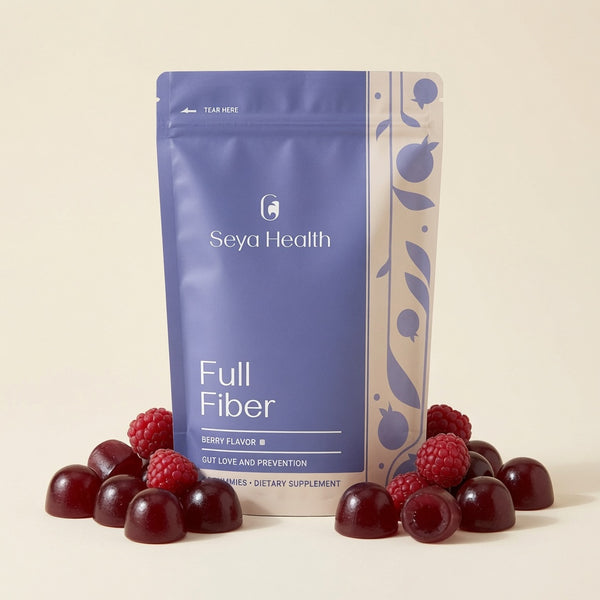
Getting enough fiber from food every day is hard. Seya Full Fiber is 6 grams from three fibers in one, in three small gummies, so you have a reliable daily floor. Plant based, no gelatin, no sugar alcohols, 60 gummies per pouch.
Shop Full FiberKeep reading
fiber
Can a Multivitamin Replace Vegetables? What Supplements Can't Do for Your Gut

constipation
The Best Way to Beat Constipation in Your 30s (and Where Fiber Gummies Fit)
fiber
The Gut-Skin Axis: Does Your Gut Health Affect Your Skin?
The gut-skin axis, explained: how your gut bacteria and blood sugar affect your skin, w...