

The short version: most pages answer "how long does perimenopause last" with one averaged number. The honest answer is a range, roughly 4 to 9 years, and where you land in it is set mostly by how old you were when it started.
- In SWAN, the median transition ran 4.37 years for the latest starters and 8.57 years for the earliest.
- Earlier onset predicted a longer run. Not a shorter one.
- Once you skip a period for 60 days or more, you are on average 1 to 3 years from your last one.
- Symptoms keep their own clock. Frequent hot flashes lasted a median 7.4 years, and 4.5 of those came after the final period.
- The average age of menopause in the US is 52, and you can only name it 12 months after the fact.
Last updated September 2026.
Your last cycle came 19 days early. The one before that skipped a month entirely.
You are not sure whether this is the beginning of something or just a strange year.
And the question underneath it is not really what is happening. It is how long this goes on.
Most articles hand you a single number. A single number is the wrong shape for this answer, and the research says so plainly.

How long does perimenopause last?
Between about 4 and 9 years for most women, and the spread is the real story.
Researchers followed 1,145 women in SWAN who filled out daily menstrual calendars from 1996 to 2006. They found the start of each woman's transition and measured forward to her final period.
The adjusted median came out at 4.37 years for the women who started latest. For the women who started earliest, it was 8.57 years.
That is roughly double, in the same study, using the same measuring stick.
The earlier it starts, the longer it runs
This is the part that surprises people, because it runs opposite to intuition.
You might assume an early start means an early finish. It does not. In that analysis, age at onset was the strongest thing shaping duration, and starting young went with a longer stretch, at p < 0.001.
So if yours has dragged on past what your friends describe, that is not evidence you are handling it badly or that something is wrong with you. It is usually evidence that yours started sooner.
It is a timeline, not a character flaw.
Two other findings from the same work. Smoking went with an earlier start. A higher body mass index went with a later start, though it did not change the length.
The timeline, stage by stage
Clinicians use a staging system called STRAW+10. It is worth knowing, because it turns a vague fog into markers you can actually spot.
| Stage | What marks the start | Typical length |
|---|---|---|
| Early transition | Two cycles in a row differ by 7 or more days | The long, variable part |
| Late transition | A first gap of 60 or more days with no period | 1 to 3 years on average |
| Final period | You can only name it 12 months later | One day, in hindsight |
| Early postmenopause | Begins at that final period | About 5 to 8 years |
Note what the first row actually asks of you. Not "irregular." A persistent 7-day difference between back-to-back cycles, recurring within 10 cycles of the first odd one.
The one signpost worth knowing
If you remember a single marker from this page, make it the 60-day gap.
The first time you go 60 days or longer without a period, you have entered the late transition. That stage is estimated to last 1 to 3 years on average before your final period arrives.
It is the closest thing to a countdown that exists here.
A blood test can support it. Follicle-stimulating hormone above 25 IU/L in a random draw is characteristic of this stage. One reading on its own is not decisive, though, because hormone levels swing hard during these years.
Symptoms run on a different clock
Here is where the staging and your lived experience come apart.
SWAN tracked 1,449 women with frequent hot flashes or night sweats over 17 years. The median total duration was 7.4 years.
Among the 881 women whose final period was directly observed, symptoms persisted a median 4.5 years after that period.
The onset pattern repeats itself here too. Women who were still premenopausal or newly perimenopausal when frequent symptoms began had a median total duration over 11.8 years, and 9.4 years of that came after their final period. Women whose symptoms started only once they were postmenopausal had a median of 3.4 years.
African American women reported the longest total duration, at a median 10.1 years.
So the transition can technically be over while you are still very much in it. We look at what helps with those specific symptoms in fiber and menopause hot flashes.
What your periods do in the middle of all this
They get strange, and more predictably strange than most women expect.
In 1,320 women keeping daily calendars, 77.7% recorded at least three separate episodes of a period lasting 10 days or longer.
Long bleeds, spotting, and heavy days are the ordinary texture of the transition rather than the exception.
That said, do not self-diagnose your way past something. Bleeding heavy enough to soak through an hour after hour, bleeding between periods, or any bleeding after a full year without one is a call to your clinician, not a thing to wait out. Fibroids and other causes are common at this age and worth ruling out.
Where your gut fits into the years
Digestion shifts across this stretch, and the honest version is more interesting than the simple one.
A survey of 14,570 people across 26 countries with gut-brain disorders compared women before and after menopause. Premenopausal women reported more constipation-related symptoms. Postmenopausal women reported more outlet problems, including needing manual help to pass a stool, at 25% versus 18%.
So it is not one line sloping downward. The character of the problem changes as you move through the stages.
What stays constant is that slowed, unpredictable digestion is a normal companion to these years, not a personal failure of discipline. We go deep on the mechanism in perimenopause and constipation.
What to actually do while the clock runs
Four things, and none of them require knowing your exact stage.
- Track your cycles. Dates only, nothing elaborate. You cannot spot a 7-day shift or a 60-day gap from memory.
- Get fiber to target. That is 25 g a day through age 50, and 21 g after. More than 90% of US women fall short of it.
- Keep moving. It acts on regularity, sleep, and the body composition changes of this stretch at the same time.
- Take symptoms to a clinician. Long duration is not something you are obligated to tough out alone. There are real options.
If you are raising fiber, do it gradually and drink more water alongside it, or you will trade one complaint for gas. The ramp is in high-fiber foods for women over 40. The body composition side is in losing weight in perimenopause.
Where Seya fits, honestly
We make a fiber gummy. It does not shorten your transition, and nothing does.
3 gummies deliver 5,650 mg of dietary fiber, which is 5.65 g, or 16% of the Daily Value. The label prints the full split: 4,500 mg of resistant tapioca fiber, 950 mg of prebiotic soluble fiber, 200 mg of cellulose, plus 80 mg of magnesium as magnesium citrate and 100 mg of ginger root.
What that honestly supports is regularity. It closes roughly a fifth of a 25 g fiber day. Food closes the rest.
This is education, not medical advice. Talk to a clinician about your own symptoms and before starting any new supplement, especially if you take medication.
These statements have not been evaluated by the Food and Drug Administration. This product is not intended to diagnose, treat, cure, or prevent any disease.
Frequently asked questions
How long does perimenopause last on average?
Roughly 4 to 9 years, depending on when it starts. In a SWAN analysis of 1,145 women keeping daily menstrual calendars, the adjusted median duration was 4.37 years among the latest starters and 8.57 years among the earliest, at p < 0.001.
Those are medians, so real women fall on both sides of them. Age at onset was the strongest factor shaping how long the transition ran.
What are the signs perimenopause is ending?
The clearest one is a gap of 60 days or longer without a period. Under the STRAW+10 staging system that marks the late transition, which is estimated to last 1 to 3 years on average before the final period.
Elevated follicle-stimulating hormone, above 25 IU/L in a random blood draw, is characteristic of the same stage. You can only confirm the final period itself after 12 months with no bleeding or spotting.
Can perimenopause last 10 years or more?
Yes, and it is not rare. In SWAN the earliest-onset quartile had a median transition of 8.57 years, so many individual women ran longer than that.
Symptoms can outlast the transition by years. Women who first reported frequent hot flashes while still premenopausal or newly perimenopausal had a median total symptom duration above 11.8 years.
Does perimenopause end when your periods stop?
Technically yes, but symptoms often do not. Menopause is defined as 12 consecutive months without a period, and the average age for that in the US is 52.
In SWAN, among 881 women with an observed final period, frequent hot flashes persisted a median 4.5 years afterward. Hormones themselves keep shifting for about 2 more years, and the whole early postmenopause stage runs roughly 5 to 8 years.
Why is my perimenopause lasting longer than my friends'?
Most often because yours started earlier. The SWAN calendar study found that earlier onset predicted a longer transition, nearly doubling the median between the youngest and oldest starting quartiles.
Smoking was linked to an earlier onset in the same analysis. Duration also varied by race and ethnicity, with African American women reporting the longest median symptom duration at 10.1 years.
How do I know if I have started perimenopause?
The first formal marker is menstrual, not hormonal. Early transition is defined by a persistent difference of 7 days or more between the lengths of consecutive cycles, recurring within 10 cycles of the first variable one.
That is why tracking dates matters. Most women begin the transition between ages 45 and 55, and a single hormone test is unreliable here because levels fluctuate sharply from month to month.
Related reading
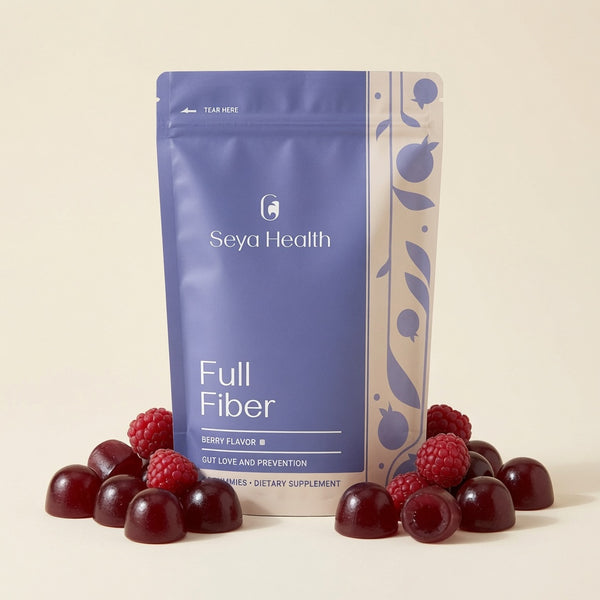
Seya Full Fiber
More than 90% of women fall short on fiber. Seya Full Fiber gives you 6 grams from three fibers in one, in three small gummies that feed the beneficial bacteria in your gut. Plant based, no gelatin, no sugar alcohols.
Shop Full FiberKeep reading

fiber
Can a Multivitamin Replace Vegetables? What Supplements Can't Do for Your Gut

constipation
The Best Way to Beat Constipation in Your 30s (and Where Fiber Gummies Fit)
fiber
The Gut-Skin Axis: Does Your Gut Health Affect Your Skin?
The gut-skin axis, explained: how your gut bacteria and blood sugar affect your skin, w...