
Home/ The Journal/ constipation
constipation
Gut motility, explained: how food moves through you, and why it stalls

Short version: Gut motility is how the muscles in your gut move food from one end to the other. In healthy people, that trip takes a median of about 28 hours, and the range is wide.
- Women tend to have slower colon transit than men, even after adjusting for diet and body size.
- Common things that slow it: some medicines, iron supplements, low fiber, and pelvic floor problems.
- Fiber helps many people, but 80% of people with true slow transit did not respond in one study of 149 patients.
- Blood in your stool, constant belly pain, or vomiting with constipation is a doctor call.
Last updated November 2026.
You eat the same as your partner. You drink the water. You still feel stuck by Thursday.
That can feel like you are doing something wrong.
Often, you're not. Your gut runs on muscle, nerves, and timing. And timing differs from person to person.
What is gut motility?
Gut motility is the movement of your digestive tract. Muscles in the gut wall squeeze, relax, and mix what you ate, then push it forward.
You will also hear the word peristalsis. That is the main wave inside motility. The NIDDK explains that the muscle behind the food "contracts and squeezes the food forward," on its guide to how the digestive system works.
So peristalsis moves food. Motility is the bigger job, and it includes the mixing too.
You do not steer most of this. Your nerves and hormones run it, and signals travel back and forth between your gut and your brain.
How long does food take to move through you?
About a day, for many people. A 2023 review in Gut puts the median whole-gut time at about 28 hours in healthy people. It also says that time varies a lot, both between people and within one person.
Here is the route.
| Stop | What the muscles do | When it stalls |
|---|---|---|
| Stomach | Grind food and push it into the small intestine | Fullness and nausea, as in gastroparesis |
| Small intestine | Mix food with digestive juices as nutrients are absorbed | Rare, but serious when it happens |
| Large intestine and colon | Move waste along as water is absorbed | Hard stool and fewer trips |
| Rectum | Holds stool until you go | Straining, or feeling unfinished |
Your stool gives you a rough read on speed. In a study of 66 volunteers, the Bristol stool scale shifted when researchers sped up or slowed down transit. Hard lumps tend to mean slow. Loose stool tends to mean fast.

Why is gut motility often slower in women?
Women tend to have slower transit, and no one has fully explained why. The Gut review says transit is shorter in men, even after adjusting for energy intake, diet, weight, and height. The biggest gap is in the lower part of the colon.
A small study of 12 women and 20 men on a set diet also found faster colon transit in men. Chronic constipation affects women up to twice as often as men.
So if your gut runs slower than your partner's, that may not be about your effort. It is a real difference, and research is still catching up to it.
What about your cycle? The evidence is mixed. That small study said the effect of menstrual hormones "must be small and of doubtful clinical significance." A 2026 review reports inconsistent results for the luteal phase. Your symptoms can still shift with your cycle. Hormones just may not be the whole story.
What slows gut motility down?
Medicines, supplements, and some health conditions are common causes. Age alone is a smaller one than you might expect.
- Medicines and supplements. The NIDDK's list of constipation causes includes iron supplements, narcotic pain medicines, some antacids, and diuretics.
- GLP-1 drugs. They slow stomach emptying. In a pooled analysis of 5 imaging studies with 247 people, the delay was about 36 minutes compared with placebo.
- Pelvic floor problems. The NIDDK notes these can delay emptying, especially in women. That is an exit problem more than a speed problem.
- Gut microbes. Some microbes make methane. In a meta-analysis of 1,277 people, methane on a breath test came with about 3.5 times the odds of constipation. That is a link, not proof of a cause.
- Chronic disease. A 2024 review on aging says motility "is largely unaltered by aging per se" in most of the gut. Constipation still rises with age, and conditions such as diabetes and Parkinson's disease bring motility problems of their own.
If a new medicine came right before the change, ask your prescriber. Do not stop it on your own. See our guide to medications that cause constipation.
What are gut motility disorders?
These are conditions where the gut's muscles or nerves do not move things along normally. Most slow days are not one of these. It still helps to know the names.
| Condition | Where | What to know |
|---|---|---|
| Gastroparesis | Stomach | About 40 in 100,000 women and 10 in 100,000 men |
| Slow transit constipation | Colon | Colon transit over 72 hours on testing, and it mostly affects women |
| IBS | Whole gut | Global rate of around 4%, and transit can run fast or slow |
| Chronic intestinal pseudo-obstruction | Mainly the intestines | Rare and serious, and it acts like a blockage with no physical blockage |
IBS is the one most people ask about. The NIDDK says that in some people with IBS, "food may move too slowly or too quickly through the digestive tract," per its IBS causes page. It calls IBS a problem of brain-gut interaction. Read more on fiber and IBS.
What helps slow gut motility?
Fiber, movement, and meal timing are the best places to start. None of them is a sure thing.
- Build fiber up slowly. In a 2022 meta-analysis of 16 trials, 66% of people with chronic constipation responded to fiber and 41% responded to control. The clearest gains came with more than 10 g a day. Adults need 22 to 34 grams a day, depending on age and sex.
- Move your body. A review of 9 trials with 680 people found about twice the rate of symptom improvement with exercise, mostly aerobic. The authors flag a high risk of bias, so treat that number loosely.
- Use the window after breakfast. The NIDDK says trying 15 to 45 minutes after breakfast may help, because eating helps your colon move stool.
Food comes first. Try these high-fiber foods for women. Seya's fiber gummy supports regularity. It covers part of your daily total, below the doses those trials used, so treat it as one piece.
When does fiber not help?
Fiber often falls short when transit is truly slow or the exit is the problem. In a study of 149 patients, 84% of them women, everyone took 15 to 30 g a day of plantago seed fiber for at least 6 weeks. 80% of those with slow transit did not respond. Neither did 63% of those with a defecation disorder. Among those with no problem on testing, 85% improved or became symptom free.
That study was not randomized, and it is old. Its message still helps. If you gave fiber a fair try and nothing changed, you did not fail. It may be the wrong tool for your kind of slow, and a doctor can test for that.
Age matters too. A 2025 review of 7 small trials in older adults found no clear gain in stool frequency, though people used fewer laxatives and enemas.
For the symptom side, read why constipation happens in women.
When should you see a doctor about gut motility?
Go if self-care has not worked, or if you have a family history of colon or rectal cancer. If you have constipation, the NIDDK says to go right away for bleeding from the rectum, blood in your stool, constant belly pain, vomiting, fever, lower back pain, not being able to pass gas, or weight loss you did not plan.
Fullness and nausea after small meals are also worth raising, especially if you have diabetes. Our guide on when bloating isn't normal has more on what to watch for.
Frequently asked questions
What is gut motility?
Gut motility is the movement of your digestive tract. Muscles in the gut wall squeeze to push food forward and mix it with digestive juices. Peristalsis is the main wave that moves food. Nerves and hormones help control the timing.
What is GI motility, and what happens when it speeds up or slows down?
GI motility is another name for gut motility. When it slows down, stool spends longer in the colon and tends to get harder. When it speeds up, stool tends to get looser. A change that lasts, or comes with pain or blood, is worth a doctor visit.
What factors speed up or slow down digestion in women?
Women tend to have slower colon transit than men, even after adjusting for diet and body size. Medicines, iron supplements, GLP-1 drugs, low fiber, and pelvic floor problems can slow things further. Meals and regular activity may help things move. Menstrual hormones seem to play a smaller role than many people assume.
How does the large intestine and colon work?
The large intestine absorbs water and turns liquid waste into stool. The colon is its longest part. It moves stool toward the rectum, and eating helps it do that. Slow movement through the colon is one cause of constipation.
What are motility disorders?
Motility disorders are conditions where the gut's muscles or nerves do not move contents normally. Examples include gastroparesis in the stomach, slow transit constipation in the colon, and chronic intestinal pseudo-obstruction, a rare condition that acts like a blockage when no blockage is there.
How is IBS related to gut motility?
IBS is a problem with how the brain and gut work together, and motility is one part of it. The NIDDK says food may move too slowly or too quickly in some people with IBS. Some people also feel pain from a normal amount of gas or stool.
What role do gut methanogens play in slow motility?
Methanogens are microbes that make methane in the gut. In a pooled analysis of 1,277 people, those with methane on a breath test had about 3.5 times the odds of constipation. That is a link. It does not prove that methane causes slow transit.
How does aging affect the intestine, and why do motility problems become more common with age?
A 2024 review found that basic gut motility stays largely unchanged by aging alone. Constipation still gets more common with age. Chronic diseases such as diabetes and Parkinson's disease bring motility problems of their own, and taking many medicines is also tied to constipation.
How does fiber help slow motility?
Fiber can improve stool form and how often you go. In a review of 16 trials, 66% of people with chronic constipation responded to fiber, compared with 41% on control, mostly at more than 10 g a day. True slow transit responds less well, so a doctor visit makes sense if fiber does nothing.
These statements have not been evaluated by the Food and Drug Administration. This product is not intended to diagnose, treat, cure, or prevent any disease. This article is educational and is not medical advice. Talk to your clinician about your own symptoms.
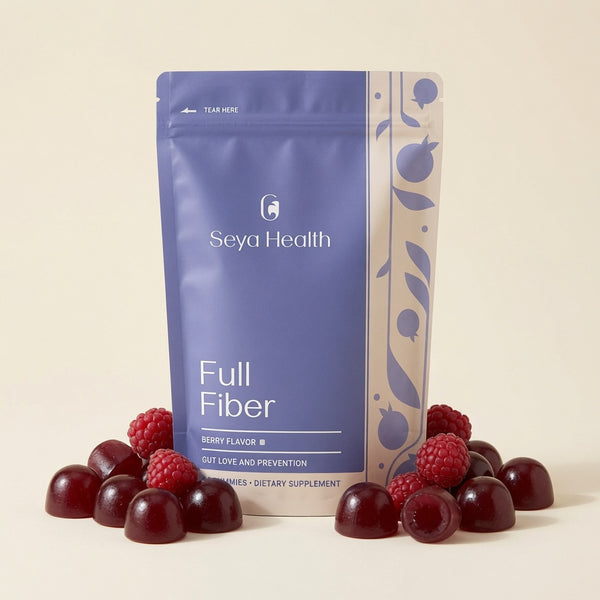
Seya Full Fiber
Most women fall short on fiber. Seya Full Fiber gives you 6 grams from three fibers in three small vegan gummies. Plant based, no gelatin, no sugar alcohols.
Shop Full FiberKeep reading

bone health
Best supplements for women over 40: what the evidence supports for heart, bones and muscles (and what's hype)

creatine
How long does creatine take to work? A realistic timeline for women

constipation