

Short version: The fiber and IBS question has one honest answer: type decides. Soluble roughage, the kind that turns to gel, tends to soothe a cranky bowel. Coarse wheat bran tends to backfire. More is not automatically better, and a rushed jump buys you gas. The FDA target is 28 g a day. Climb toward it slowly, drink water, and pick the gentle sort.
- Gut doctors say to use soluble, not insoluble, fiber for IBS symptoms.
- In one review, cutting fiber, not adding it, eased constipation for people who were overdoing it.
- Doses above 10 g a day worked best for constipation, and adding about 5 g a week keeps the bloating down.
Last updated August 2026.
You added roughage to feel better. Instead you feel more bloated, more stuck, or both.
So you start to wonder if the thing you were told to eat is the thing making you miserable.
Here is the honest answer on fiber and IBS. It can calm your insides or inflame them, and the type is what tips it either way. Soluble roughage, the kind that turns to a soft gel, usually soothes. Coarse bran usually scratches. The American College of Gastroenterology weighed the trials and put it plainly: use soluble, not insoluble, fiber for IBS symptoms, per its 2021 clinical guideline.
And volume is not the point. The FDA sets the Daily Value at 28 g a day, written into federal labeling rule 21 CFR 101.9. The rest of this page is how to reach that mark without the payback.
Fiber and IBS: does it help or hurt your gut?
Only the wrong kind hurts. And that is the part nobody spells out.
People with a sensitive bowel react to the two fiber families very differently. The gel-forming, soluble kind is gentle. The scratchy, insoluble kind can rub a touchy system the wrong way. That is why the ACG guideline draws the line at type, not amount, when it says to reach for soluble sources like psyllium and skip the bran.
Your subtype matters too. If constipation runs the show, that is IBS-C. If loose, urgent days dominate, that is IBS-D. The gel is friendlier to both, because it holds water, softens what is hard, and firms up what is loose.
So the bloat you have been blaming on yourself may not be a willpower story at all. For a lot of women it is a fiber-type mismatch. Too much coarse bulk, not enough gel. That is a signal to adjust, not a character flaw. We break down the two families in soluble vs insoluble fiber for a woman's gut.
Can having too much fiber cause constipation in women?
Yes. It sounds backward, and it is real.
Piling on bulk without enough fluid can pack the colon instead of clearing it. The mass gets dry and hard to move, and the very symptom you were chasing away gets worse.
One study made the point in the bluntest way possible. Researchers took people with stubborn, unexplained constipation and had them lower or stop their fiber intake. The ones who cut back had more frequent, easier movements and less bloating. The ones who stayed high saw no change at all. Less roughage, not more, was the fix for that group.
Read that carefully, though. It does not mean fiber is bad. It means a dry overload, especially of the coarse kind, can jam the works. The signal is not "eat none." The signal is "get the type and the water right."
What are the side effects of eating too much fiber?
Gas. Bloating. Cramping. A belly that feels tight and loud.
Here is the mechanism. When bulk reaches your colon, the bacteria living there ferment it, and that fermentation makes gas. A little is normal. A sudden flood is not. A review of how the body tolerates these carbs lists flatulence, distension, and abdominal pain as the usual complaints when intake climbs too fast.
The trigger is almost always speed, not evil. Your resident bacteria need a few days to adapt to a bigger load. Race past them and you pay in gas.
There is a food angle here too. Some plants are packed with fermentable sugars called FODMAPs, and for a reactive bowel those can be the real spark. Trimming them helped a large share of IBS patients feel better, roughly 76% versus 54% on a normal plate, in a meta-analysis of low-FODMAP trials. If gel-type fiber still bothers you, the culprit may be a high-FODMAP food riding alongside it, not the fiber itself.
How much fiber should you have to relieve constipation?
Aim for the 28 g target, but the dose that actually moved the needle in studies sits above 10 g a day of added fiber.
A 2022 review pooled the trials and found a clear pattern. About 66% of people responded to a fiber supplement, versus 41% on a dummy pill, and the wins showed up mainly at doses over 10 g a day. Psyllium, a soluble source, led the pack and lifted stool frequency by roughly three trips a week.
The catch is how you get there. Jump straight to a big dose and you trade constipation for gas.
So ramp. A steady rule is to add about 5 g a week and hold it for a few days before the next step up. Pair every gram with water, since the gel needs fluid to stay soft. Slow and wet beats fast and dry, every time. We walk through the mechanics in how fiber supplements work, and the after-40 version lives in perimenopause constipation relief.
What side should you lie on to relieve bloating?
Honestly, no single side is the magic one. What the evidence backs is being upright and moving.
In a controlled study, trapped gas cleared far better when people stood or sat than when they lay flat. At the one-hour mark, the upright group held back only about 13 mL of gas, while the lying-down group held about 146 mL, per research on how body posture affects gas transit. Gravity and a little motion do the work.
So when you are tight and gassy, the better move is to get up. A short walk, a few minutes on your feet, gentle motion through the hips. If you do lie down, roll and shift rather than staying frozen on one side.
The popular "lie on your left" tip is not wrong to try, but it is not the proven lever. Standing and walking is. For the eat-side of relief, see what fiber actually does in a woman's body.
Where Seya fits, honestly
Seya makes one product at launch. A fiber gummy.
Three vegan gummies deliver about 5 g of resistant tapioca fiber, a soluble, prebiotic-type fiber. That is the gentle, gel-leaning family, not the coarse bran that tends to aggravate a reactive bowel. It is honest to grade fiber's evidence a C at this dose, since 5 g is about half the 10 g the constipation studies leaned on. So we make one plain claim. It supports regularity.
It does not fix a medical condition, and it is not a full day of fiber on its own. It is one soluble-side nudge toward a target most women miss, added slowly, with water, the way the science says to do it.
If your symptoms are severe, persistent, or new, that is a reason to see a clinician, not to double your dose. IBS deserves a real diagnosis. The after-40 gut shifts are covered in fiber and gut health after 40.
This is education, not medical advice. Talk to your clinician before adding a supplement, especially if you have IBS or take daily medication.
These statements have not been evaluated by the Food and Drug Administration. This product is not intended to diagnose, treat, cure, or prevent any disease.
Frequently asked questions
Does fiber make IBS worse?
Only the wrong type tends to. Coarse insoluble fiber, like wheat bran, can aggravate a sensitive bowel, while soluble, gel-forming fiber usually soothes it. The American College of Gastroenterology's 2021 guideline advises using soluble, not insoluble, fiber for IBS symptoms. The gel holds water, softens hard stool, and helps firm up loose stool, so it suits both the constipation and diarrhea subtypes. Introduce it slowly and with plenty of water to avoid triggering gas.
Can having too much fiber cause constipation in women?
Yes. Adding a lot of bulk without enough fluid can pack the colon and make stool dry and hard to pass, which worsens the very problem you were trying to fix. In one study, people with stubborn constipation who lowered or stopped their fiber intake had more frequent, easier movements and less bloating, while those who stayed on a high-fiber diet saw no change. The lesson is not to avoid fiber, but to get the type and the water right and to build up gradually.
What are the side effects of eating too much fiber?
The common side effects are gas, bloating, cramping, and abdominal discomfort. They happen because gut bacteria ferment fiber in the colon and produce gas, and a review of carbohydrate tolerance lists flatulence, distension, and pain as the typical complaints when intake rises too fast. The usual cause is speed, not the fiber itself, since your gut bacteria need a few days to adapt. For a reactive bowel, high-FODMAP foods eaten alongside fiber can also be the trigger.
How much fiber should you have to relieve constipation?
Work toward the FDA Daily Value of 28 g a day, but the doses that helped most in studies were above 10 g a day of added fiber. A 2022 meta-analysis found about 66% of people responded to fiber versus 41% on placebo, with psyllium, a soluble source, working best and adding roughly three bowel movements a week. Get there gradually, adding about 5 g a week, and drink water with every dose so the gel stays soft.
What side should you lie on to relieve bloating?
No single side is proven to be best. The stronger evidence is for being upright and moving: in a controlled study, people cleared trapped gas far better standing or sitting than lying down, holding back about 13 mL of gas upright versus about 146 mL lying flat after an hour. So when you feel gassy and tight, stand up and take a short walk rather than staying still. If you do lie down, shift and roll gently instead of freezing on one side.
Related reading
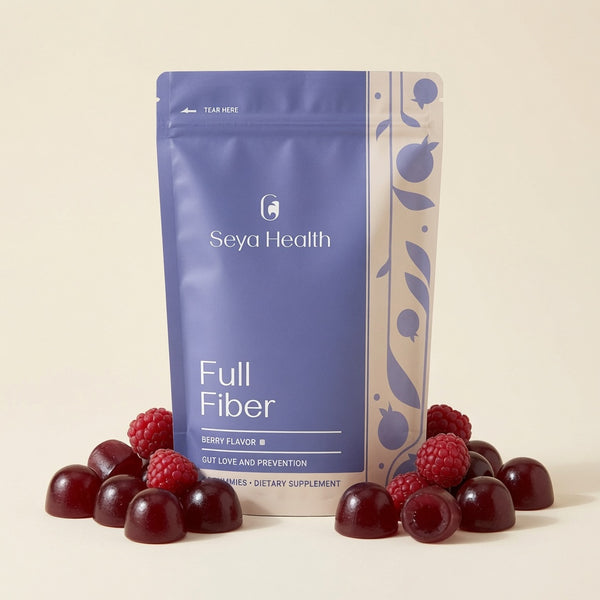
Seya Full Fiber
More than 90% of women fall short on fiber. Seya Full Fiber gives you 6 grams from three fibers in one, in three small gummies that feed the beneficial bacteria in your gut. Plant based, no gelatin, no sugar alcohols.
Shop Full FiberKeep reading
fiber
Can a Multivitamin Replace Vegetables? What Supplements Can't Do for Your Gut

constipation
The Best Way to Beat Constipation in Your 30s (and Where Fiber Gummies Fit)
fiber
The Gut-Skin Axis: Does Your Gut Health Affect Your Skin?
The gut-skin axis, explained: how your gut bacteria and blood sugar affect your skin, w...