
Home/ The Journal/ brain health
brain health
Is Sugar Addictive? What the Science on Your Brain's Reward System Says

Short version: Is sugar addictive? Not in the way drugs are, based on the human research so far. Food addiction is not an official diagnosis. Still, about 14% of adults meet the criteria on a food addiction survey, and the foods most tied to it mix refined carbs and fat, not plain sugar.
- Brain: sugar does trigger dopamine and opioid signals, the same reward system that drugs use.
- Rats: rats given sugar on and off can binge and show withdrawal signs. Rats with steady access mostly do not.
- People: a 2016 review found little evidence for sugar addiction in humans.
- Wanting vs. liking: dopamine drives the "wanting." That pull can grow even when the "liking" does not.
- Women: in a 2026 US survey of adults 50 to 80, 16.9% of women met the criteria, vs. 7.5% of men.
Last updated November 2026.
You said you would have one cookie. Then the sleeve was empty. It is easy to feel like sugar has a hold on you.
Headlines say sugar is "as addictive as cocaine." Other experts say that is a stretch. The truth sits in between, and it is more useful than either side.
Here is what the science on your brain's reward system really shows, where the evidence is strong, and where it is thin.
Is sugar addictive?
Not in the full sense that alcohol or nicotine are, based on the human evidence so far. A 2016 review of the animal and human research found "little evidence to support sugar addiction in humans," per Westwater et al., European Journal of Nutrition, 2016 (PMID 27372453).
But "not addictive like a drug" is not the same as "no effect." Sugar lights up your brain's reward system. Some people do lose control around certain foods. Researchers now study that as food addiction, or eating addiction.
The quick map below shows what each line of research found.
| Question | What studies found | Strength of evidence |
|---|---|---|
| Does sugar trigger dopamine? | Yes, in rats and people | Strong |
| Can rats get hooked on sugar? | Yes, with on-and-off access | Strong (in rats) |
| Is sugar alone addictive in people? | Little direct proof | Weak |
| Can eating feel addictive? | Yes, for about 14% of adults on surveys | Moderate |
| Which foods are most linked? | Processed foods with carbs plus fat | Moderate |
Ratings reflect the studies cited below. Many are small or done in animals.
How does sugar affect dopamine and the brain's reward pathways?
Sugar sets off the same reward circuits that drugs use. When you taste something sweet, your brain releases dopamine and natural opioids. A hub called the nucleus accumbens is a key part of that system.
In rats, sugar on a binge schedule changed dopamine and opioid receptors and raised dopamine release in the nucleus accumbens, per Avena, Rada, and Hoebel, Neuroscience and Biobehavioral Reviews, 2008 (PMID 17617461). Those are the same kinds of shifts seen with addictive drugs.
That sounds alarming, but context matters. Your reward system is built to respond to food. Dopamine also rises for music, a hug, or a good meal. A dopamine response alone does not make something addictive.
What is the difference between liking and wanting a food?
"Liking" is the pleasure you feel while eating. "Wanting" is the pull that makes you go get it. They feel like the same thing, but the brain runs them on different circuits.
Neuroscientist Kent Berridge mapped this split. "Liking" comes from tiny pleasure hotspots in the brain. "Wanting" runs on the much larger dopamine system, per Berridge, Physiology and Behavior, 2009 (PMID 19336238).
In addiction, the "wanting" can grow much stronger over time, often set off by cues, while the "liking" stays the same. That is the core of the incentive-sensitization theory, per Berridge and Robinson, American Psychologist, 2016 (PMID 27977239).
You may know this feeling. You see the candy bowl at work and want it badly. Then you eat it, and it is just fine. That gap between strong wanting and so-so liking is a clue that cues, not hunger, are steering you.

What evidence is there that sugar is addictive?
Most of the strong evidence comes from rats. In the Avena lab model, rats got sugar water on a daily on-and-off schedule. Over time they binged on it. When the sugar was taken away, they showed withdrawal-like signs. The review describes four signs of addiction in these rats: bingeing, withdrawal, craving, and cross-sensitization to drugs.
Another rat study made headlines. Given a choice between sweet water and cocaine, 94% of rats picked the sweet taste, per Lenoir et al., PLoS One, 2007 (PMID 17668074). The same choice held with saccharin, a sweetener with no calories, so the pull was the sweet taste itself.
Here is the catch. The 2016 review found these binge-like behaviors showed up mainly when sugar access was on and off. The authors said they likely come from that pattern of access to tasty food, not from the chemical effect of sugar itself. Rats are not people, and nobody eats sugar water alone.
Is sugar addiction scientifically recognized?
No. Neither sugar addiction nor food addiction is a diagnosis in the DSM-5, the main manual doctors use for mental health. A 2023 BMJ analysis notes that addiction to foods is "not included" in that manual, per Gearhardt et al., BMJ, 2023 (PMID 37813420).
Researchers measure it anyway. The Yale Food Addiction Scale asks about the same signs used for substance problems. That includes cravings, losing control, and eating despite harm, per Gearhardt, Corbin, and Brownell, Appetite, 2009 (PMID 19121351).
Using that scale, two big reviews covering 281 studies in 36 countries found that about 14% of adults and 12% of children met the criteria, the BMJ paper reports. That is close to the rate for alcohol addiction in adults.
Are women more likely to feel addicted to food?
The surveys say yes. A review of 25 studies found food addiction scores were higher in women, in adults over 35, and in people with overweight, per Pursey et al., Nutrients, 2014 (PMID 25338274).
A 2026 national survey of 2,038 US adults ages 50 to 80 found the same pattern, per Loch et al., Addiction, 2026 (PMID 41017504). 16.9% of women met the criteria for addiction to ultra-processed food, vs. 7.5% of men. The rate was highest, 21%, in women ages 50 to 64.
These are self-report surveys. They show who struggles most, not why. Hormones, stress, and the food world women grew up in may all play a part.
Is it the sugar or the food?
Mostly the food. Plain sugar is rarely the problem on its own. The foods people say they lose control over tend to be highly processed and high in both fat and fast carbs.
In two studies of 504 adults, processed foods higher in fat and glycemic load, like chocolate, ice cream, and pizza, were the ones most tied to addictive-like eating, per Schulte, Avena, and Gearhardt, PLoS One, 2015 (PMID 25692302).
Brain scans back this up. People were willing to pay more for foods that mixed fat and carbs than for foods with just one, even at the same calories. Reward areas of the brain lit up more, too, per DiFeliceantonio et al., Cell Metabolism, 2018 (PMID 29909968).
That is why some experts prefer the term "eating addiction." They argue the problem is a behavior, not one substance, per Hebebrand et al., Neuroscience and Biobehavioral Reviews, 2014 (PMID 25205078).
What helps if sugar feels hard to resist?
Start with the cues, since "wanting" is cue-driven. A candy dish on your desk is a cue. So is a snack aisle on your way home. Moving the cue out of sight is a simple first step.
Next, look at what drives your cravings. Short sleep, long gaps between meals, stress, and the days before your period all play a part. Our guide on why you crave sugar walks through each cause. For a step-by-step plan, see how to stop sugar cravings.
Meals with protein and fiber tend to digest more slowly and keep you full longer. See how fiber helps you feel full. Most women fall short on fiber. The target is about 25 g a day up to age 50, as our guide on how much fiber women need explains.
Seya Full Fiber is a vegan gummy with resistant tapioca fiber, about 6 g per serving, plus magnesium citrate and ginger root. It supports regularity and helps close part of your daily fiber gap. It is not a fix for cravings or food addiction. If you take a GLP-1, our piece on food noise may help, too.
These statements have not been evaluated by the Food and Drug Administration. This product is not intended to diagnose, treat, cure, or prevent any disease.
When should you talk to a doctor?
Talk to your doctor or a registered dietitian if eating often feels out of your control. Signs worth raising include:
- Eating large amounts in a short time and feeling unable to stop
- Eating in secret or feeling deep guilt afterward
- Trying again and again to cut back and not managing it
- Eating that gets in the way of work, sleep, or relationships
These can point to an eating disorder such as binge eating, which is common and responds to care. Help works better than willpower alone.
This is education, not medical advice.
Frequently asked questions
Is sugar addiction scientifically recognized?
No. Neither sugar addiction nor food addiction is a diagnosis in the DSM-5. Researchers still measure addictive-like eating with the Yale Food Addiction Scale, and about 14% of adults meet its criteria.
What evidence is there that sugar is addictive?
Mostly rat studies. Rats given sugar on and off can binge and show withdrawal signs, and 94% chose sweet water over cocaine in one study. A 2016 review found little evidence for sugar addiction in humans.
How does sugar affect dopamine and the brain's reward pathways?
Sweet taste releases dopamine and natural opioids in reward areas like the nucleus accumbens. Many pleasures do this too, so a dopamine response alone does not make a food addictive.
What is the difference between liking and wanting a food?
Liking is the pleasure while you eat. Wanting is the pull to go get it, driven by dopamine. In addiction, wanting can grow stronger while liking stays the same.
Is sugar as addictive as cocaine?
That claim comes from a rat study where 94% of rats chose sweet water over cocaine. Rat results do not carry over neatly to people, and human evidence for sugar addiction is weak.
Are women more prone to food addiction?
Surveys suggest so. In a 2026 US survey of adults 50 to 80, 16.9% of women met the criteria for ultra-processed food addiction, vs. 7.5% of men.
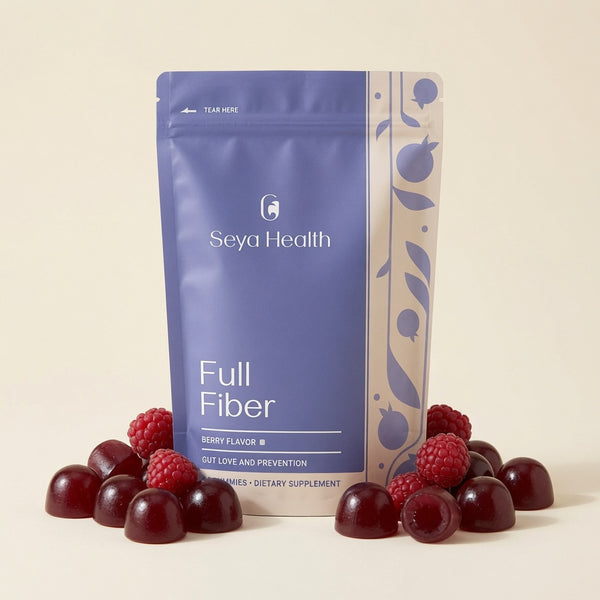
Seya Full Fiber
Most women fall short on fiber. Seya Full Fiber gives you 6 grams from three fibers in three small vegan gummies. Plant based, no gelatin, no sugar alcohols.
Shop Full FiberKeep reading

bone health
Best supplements for women over 40: what the evidence supports for heart, bones and muscles (and what's hype)

creatine
How long does creatine take to work? A realistic timeline for women

constipation