
Home/ The Journal/ digestive health
digestive health
Leaky Gut and the Gut Barrier: What the Science Actually Says (and How Fiber Helps)
Is leaky gut real? Increased intestinal permeability is real, but 'leaky gut syndrome' is oversold. Here is what the science supports, and why fiber and butyrate are the lever that helps.

Leaky gut is a nickname for increased intestinal permeability, when your gut lining lets more through than it should. The biology is real. But here is the honest part most articles skip: "leaky gut syndrome" is not an official medical diagnosis, and a lot of what you read about it is oversold. There is no pill that seals your gut overnight. What the science does support is simpler and cheaper. Feed your gut the fiber it needs to make butyrate, a compound that fuels and supports the gut lining. Most women fall short on fiber, so that is the lever worth pulling.
What "leaky gut" actually means
Your gut lining is thinner than you would guess. It is a single layer of cells, held tightly together by seals called tight junctions. That layer has a hard job. It has to let water and nutrients pass into your body while keeping bacteria and half-digested food out.1
When those seals loosen, the barrier becomes more permeable, so more slips through than should. That is what people are pointing at when they say "leaky gut." The technical name is increased intestinal permeability, and it is a normal thing to talk about in gut science.
Why the gut barrier matters
Think of this lining as your body's border control. On one side is the outside world, including everything you eat and the trillions of microbes living in your gut. On the other side is your bloodstream and the rest of you. A large share of your immune system sits right along this border, checking what tries to cross.
When the barrier is working, the good stuff gets in and the rest stays put. When it gets too permeable, your immune system can start reacting to things that were supposed to stay inside the gut, which is one reason increased permeability shows up alongside inflammatory conditions. So "support your gut barrier" is really shorthand for "support the whole system that keeps you well."
What's real, and what's hype
This is where you need a straight answer, because the internet does not give you one. Both things are true at the same time.
What is real: increased intestinal permeability is documented in certain conditions, including celiac disease, Crohn's disease and ulcerative colitis, and some cases of irritable bowel syndrome.1 The gut barrier is a genuine, measurable thing, and it can be affected.
What is oversold: the idea of "leaky gut syndrome" as a single diagnosis that explains fatigue, brain fog, extra weight, allergies, and nearly everything else. Mainstream medicine does not recognize that.2 As one way to put it, the biology is real but the internet's version oversells it. A leaky gut can happen; "leaky gut syndrome" as a catch-all is not an established diagnosis.
Part of why the science stays careful is that a leaky gut is hard to measure outside a research lab. There is no simple, reliable at-home test that tells you your barrier is "leaky," and the symptoms people pin on it, like bloating, tiredness, and brain fog, overlap with dozens of other things. So a quiz or a product that confidently diagnoses your leaky gut is selling you a certainty that does not exist yet.
Be skeptical of anything that promises to "seal" or "heal" your gut fast, especially an expensive kit. The moves that actually help are boring and evidence-based.
What can weaken the gut barrier
A few things are linked to a more permeable gut barrier:1
- A low-fiber diet and an out-of-balance gut community
- Heavy alcohol use
- Frequent use of certain painkillers, like regular aspirin or ibuprofen
- Ongoing, high stress
- Digestive conditions such as celiac disease and inflammatory bowel disease
Notice the first one. Of everything on that list, the lever most of us can actually move day to day is fiber, and it happens to be the one with the clearest mechanism behind it.
The gut barrier's favorite fuel: butyrate
Here is the part worth understanding, because it turns a scary buzzword into a simple plan.
When you eat fiber that ferments, your gut bacteria break it down and make short-chain fatty acids. One of them is called butyrate, and it is a big deal for your gut lining. Butyrate is the main fuel that the cells lining your colon run on.3 Well-fed lining cells do their job better.
Butyrate does something else too. It supports the tight-junction proteins that hold the barrier together, which helps keep the seals doing what they are supposed to do.4 So a gut community that is making plenty of butyrate is one of the best-supported ways to keep the barrier working well.5
There is one more reason variety counts. Different fibers feed different bacteria, and a broader mix of bacteria makes a broader mix of short-chain fatty acids. Butyrate also helps keep low-grade inflammation in the gut lining in check, which is part of how it supports the barrier rather than only fueling it. So the goal is not one magic fiber. It is enough fiber, from enough different sources, often enough.
This is the honest version of "gut repair." You do not fix your gut with a single pill. You feed the system that maintains itself, and fiber is what it runs on.
Why fiber is the lever, and why most women miss it
The catch is that butyrate only gets made if your bacteria have fiber to ferment, and most of us do not give them enough. Around 95% of Americans fall short of the daily fiber target, and the average adult eats only about 17 grams a day, roughly half of what is recommended.67 For women the gap is just as wide, with more than 90% falling short.
So for most women, the very bacteria that make the gut lining's favorite fuel are running on empty. Closing that gap is the practical move, and it beats any product that promises to seal your gut.
Variety helps here. Different fibers feed different bacteria, so a mix does more than any single source. To make the number real, 6 grams of fiber is about the same as half an avocado, or three quarters of a cup of chickpeas, or one medium pear.
How to support your gut barrier day to day
None of this is complicated. It is just consistent.
- Eat a range of fiber-rich foods: beans and lentils, oats, berries, leafy greens, ground flax, and cooked-then-cooled starches like potatoes and rice.
- Add fiber slowly and drink plenty of water, so your gut can adjust without the gas.
- Take care of the basics that show up on the barrier list too: sleep, stress, and going easy on alcohol and unnecessary painkillers.
If getting enough fiber every day is the part that never quite happens, that is the gap a daily fiber supplement is built to close. Seya Full Fiber gives you 6 grams of fiber from three fibers in one: a soluble tapioca fiber, a prebiotic fiber, and cellulose. The fermentable fibers feed the beneficial bacteria in your gut and support the short-chain fatty acid production we have been talking about, including butyrate. It is plant based with no gelatin, has no sugar alcohols, and comes as 60 gummies per pouch.
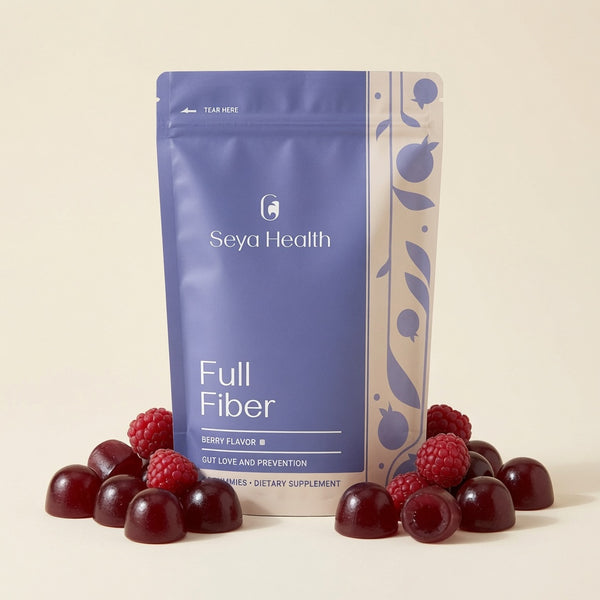
Seya Full Fiber
Three fibers in one, 6 grams per serving, to feed the bacteria that make butyrate and support a healthy gut. Plant based, no gelatin, no sugar alcohols.
Shop Full FiberWant the fuller picture? Start with how much fiber women need per day, see how fiber and probiotics compare in fiber vs probiotics, and if bloating is your main issue, read fiber and IBS. Your gut also has a say in your hormones, which we cover in estrogen dominance and your gut.
When to see a doctor
Because "leaky gut syndrome" is not an official diagnosis, do not use it as a reason to put yourself on a strict elimination diet or an expensive "gut repair" stack. If you have ongoing symptoms like diarrhea, belly pain, blood in your stool, unexplained weight loss, or severe fatigue, see a doctor who can test for the real conditions behind them, such as celiac disease, inflammatory bowel disease, or IBS. Fiber and steady daily habits support a healthy gut. They are not a substitute for care when something is wrong.
Frequently asked questions
Is leaky gut real?
Increased intestinal permeability, the actual thing behind the nickname, is real and is documented in conditions like celiac disease and inflammatory bowel disease.1 But "leaky gut syndrome" as a single catch-all diagnosis is not recognized by mainstream medicine.2
Can fiber heal leaky gut?
Fiber does not "heal" or "seal" your gut, and you should be wary of anything that says it will. What fiber does is feed the bacteria that make butyrate, which fuels and supports the gut lining.3 That is support for a healthy process, not a cure.
What is butyrate?
It is a short-chain fatty acid your gut bacteria make when they ferment fiber. It is the main fuel for the cells lining your colon and it supports the barrier's tight junctions.4
What foods support the gut barrier?
Varied, fiber-rich foods: beans and lentils, oats, berries, leafy greens, ground flax, and cooked-then-cooled starches. Variety matters because different fibers feed different bacteria.
Should I take a "leaky gut" supplement?
Be skeptical of products that promise to seal or heal your gut. The better-supported move is to feed your gut enough fiber every day, and to see a doctor about symptoms that stick around.
Sources
- 1 Cleveland Clinic. Leaky Gut Syndrome: Symptoms, Diet, Tests & Treatment.
- 2 Nebraska Medicine. Is leaky gut syndrome real?
- 3 Frontiers in Immunology (2019). Short-Chain Fatty Acids, Gut Epithelial and Immune Regulation.
- 4 Acute Effects of Butyrate on Tight Junction Protein Expression in Human Colonic Tissues. PMC (2020).
- 5 Leaky Gut: Effect of Dietary Fiber and Fats on Microbiome and Intestinal Barrier. PMC (2021).
- 6 American Society for Nutrition. Most Americans are not getting enough fiber in our diets.
- 7 USDA Economic Research Service. Dietary fiber consumption data.
This article is general information, not medical advice. "Leaky gut syndrome" is not an official medical diagnosis. Seya Full Fiber is a dietary supplement and is not intended to diagnose, treat, cure, or prevent any disease. Talk to your healthcare provider about ongoing digestive symptoms before making changes.
Keep reading
fiber
Can a Multivitamin Replace Vegetables? What Supplements Can't Do for Your Gut

constipation
The Best Way to Beat Constipation in Your 30s (and Where Fiber Gummies Fit)
fiber
The Gut-Skin Axis: Does Your Gut Health Affect Your Skin?
The gut-skin axis, explained: how your gut bacteria and blood sugar affect your skin, w...