Home/ The Journal/ exercise
exercise
Menopause belly: how strength training and exercise help (and whether 150 minutes a week is enough)

Short version: Menopause belly exercise works best as a mix: aerobic activity most days plus strength training at least 2 days a week. The US guideline is 150 to 300 minutes of moderate activity a week. In a 12-month trial of 400 women after menopause, 300 minutes cut more body fat than 150.
- 150 minutes a week is the floor, not the ceiling. It helps, and more helped more in the trial.
- Aerobic exercise has the strongest record for deep belly fat. In a review of 35 trials, it reduced visceral fat and strength training on its own did not.
- Strength training still earns its place. A newer review of 54 trials found it lowered body fat and visceral fat, and it builds the muscle that uses blood sugar.
- You cannot spot-reduce. Crunches build muscle under the fat, not burn the fat on top.
Last updated October 2026.
You walk most days. Your weight has barely moved. But your waistband is tighter than it was two years ago, and your middle feels like it belongs to someone else.
That is a real change, and exercise is one of the few levers with good evidence behind it. The question is which kind, and how much.
Why does menopause change where you store fat?
Fat moves to the middle as estrogen falls, and your body burns a little less at rest.
A team at the Pennington Biomedical Research Center followed 156 women for 4 years with yearly body scans. All the women gained some fat under the skin as they aged. Only the women who reached menopause had a significant rise in visceral fat, the deeper fat around the organs. Their energy use during sleep also fell more, and the share of fat they used for fuel dropped by 32%.
The authors also noted that physical activity fell about 2 years before menopause and stayed low. You can read the study of visceral fat across the menopausal transition.
That last detail matters. Part of the shift is hormones you cannot control. Part of it is movement you can. Our guide to menopause belly covers the full list of causes. This article stays on exercise.
What is the difference between visceral and subcutaneous fat?
Subcutaneous fat sits just under the skin. It is the soft layer you can pinch. Visceral fat sits deeper, packed around the liver, gut, and other organs.
The two respond to exercise a little differently, which is why the studies below report them apart. Visceral fat is the one doctors watch most closely, because it is tied to blood sugar and heart health.
A tape measure is a simple home check. The NHLBI says a waist of more than 35 inches in women counts as abdominal obesity, one of the markers of metabolic syndrome.
| Type of belly fat | Where it sits | Why it matters |
|---|---|---|
| Subcutaneous | Just under the skin | Mostly fit and comfort; less tied to metabolic risk |
| Visceral | Deep, around the organs | Linked to blood sugar and heart health; rises after menopause |
How is belly fat linked to metabolic syndrome?
A large waist is one of the 5 conditions doctors check for metabolic syndrome.
The NHLBI says you may have metabolic syndrome if you have 3 or more of these: a large waistline, high blood pressure, high blood sugar, high triglycerides, and low HDL cholesterol. It adds that extra fat in the stomach area is a bigger risk factor for heart disease than extra fat in other parts of the body. The full criteria are on the NHLBI page on how metabolic syndrome is diagnosed.
Exercise touches several of those markers at once, which is one reason it gets so much attention after 50. A waist measurement is not a diagnosis. If yours is climbing, a routine checkup with blood work will tell you more.
Does 150 minutes of exercise a week help menopause belly?
Yes. And in one large trial, 300 minutes helped more.
The US Physical Activity Guidelines ask adults for 150 to 300 minutes of moderate aerobic activity a week, like brisk walking. They also ask for muscle-strengthening activity at least 2 days a week. That is from the HHS summary of the Physical Activity Guidelines for Americans.
Walking alone can make a difference. In a 12-month trial of 173 inactive women aged 50 to 75, the exercise group averaged 176 minutes a week, mostly walking. Compared with a stretching group, they lost 1.4 kg of weight and 1.0% of body fat, and their fat under the belly skin went down. Women who exercised longer lost more fat. See the JAMA trial of exercise in postmenopausal women.
Is 150 minutes a week enough, or should you aim for 300?
150 is a solid start. If you can build toward 300, the evidence says you will likely lose more fat.
The Breast Cancer and Exercise Trial in Alberta tested this head to head. It randomized 400 inactive women after menopause to 150 or 300 minutes a week of moderate to vigorous aerobic exercise for 12 months. They were asked not to change their diet. In practice, the groups logged about 137 and 254 minutes a week.
The higher dose cut total body fat by 1.0 percentage point more. It also shrank fat under the belly skin and the waist-to-hip ratio more. Weight and deep visceral fat did not differ between the two groups, and some gains were larger in women with obesity. Details are in the JAMA Oncology trial of 300 vs 150 minutes a week.
So the honest answer is this. More minutes helped, but even double the dose did not empty out visceral fat in a year. Expect slow change measured in months.

Does strength training reduce belly fat after menopause?
It helps, mostly by building muscle and trimming overall fat. Aerobic exercise has the stronger record for visceral fat.
A 2012 review in Obesity Reviews pooled 35 randomized trials that scanned belly fat. Aerobic exercise reduced visceral fat compared with no exercise. Progressive resistance training on its own did not show a significant effect. The authors said aerobic exercise is central for programs aimed at visceral fat. Read the meta-analysis of aerobic vs resistance training on visceral fat.
A newer and larger review in Sports Medicine pooled 54 trials in healthy adults. Against no exercise, resistance training lowered body fat by 1.46 percentage points and fat mass by 0.55 kg. It also reduced visceral fat, and the effect was similar for women and men. See the 2022 meta-analysis of resistance training and body fat.
Put together, do both. Walk or cycle most days for the deep fat. Lift 2 or more days for muscle, strength, and bone.
Can building muscle improve your metabolism?
A little, and it protects the muscle you would otherwise lose.
A review in Current Sports Medicine Reports says inactive adults lose 3% to 8% of their muscle per decade, along with a drop in resting metabolic rate. It reports that 10 weeks of resistance training may add 1.4 kg of lean weight, raise resting metabolic rate by 7%, and cut 1.8 kg of fat. Those are averages from training studies, not a promise for any one person. See Resistance training is medicine.
Muscle loss with age has a name, sarcopenia. Our guide to signs of muscle loss in women explains how to spot it early, and creatine for menopause covers what the research shows about pairing it with lifting.
How does exercise help muscles take up glucose?
Working muscle pulls sugar out of your blood, partly without needing insulin.
Glucose enters muscle through a door called GLUT4. When a muscle contracts, GLUT4 moves from inside the cell to its surface, so more glucose can get in. Over weeks, training also makes muscle build more GLUT4. A 2013 review in Physiological Reviews calls exercise training the most potent stimulus for raising muscle GLUT4. Read the review of exercise, GLUT4, and muscle glucose uptake.
This is why a short walk after a meal and a couple of strength sessions a week both count. Blood sugar handling tends to get touchier at midlife, and more muscle gives that sugar somewhere to go.
What does a balanced, healthy diet look like in midlife?
Plenty of plants, enough protein, and enough fiber, with exercise doing the heavy lifting alongside it.
The NIDDK says adults need 22 to 34 grams of fiber a day depending on age and sex, and it advises adding fiber a little at a time. Its page on eating, diet, and nutrition covers the basics.
Fiber and movement also showed up together in a 5-year study that scanned belly fat in 1,114 adults. For each 10 grams more soluble fiber a day, visceral fat built up 3.7% more slowly. Moderately active people had a 7.4% slower rate of visceral fat gain than less active people. It was an observational study, so it shows a link, not proof. See the IRAS Family Study of lifestyle and abdominal fat.
Start with food, like the options in high-fiber foods for women. Seya's fiber gummy supports regularity and can help close the gap on busy days. It does not burn belly fat. For the bigger weight picture, see losing weight in perimenopause.
A simple menopause belly exercise plan for your week
Pick a plan you can keep for 6 months. That beats a hard plan you quit in 3 weeks.
- Walk briskly 30 minutes, 5 days a week. That is 150 minutes. Add 10 minutes a session every few weeks if it feels good.
- Strength train 2 days a week. Squats, lunges, push-ups against a counter, rows with a band or light weights. Work the big muscle groups.
- Move after meals. A 10-minute walk gives working muscle a chance to use the sugar from the meal.
- Measure your waist once a month, not your weight every day. Muscle gain can hide fat loss on the scale.
Check with your clinician before you start if you have heart disease, joint problems, or have been inactive for a long time.
Frequently asked questions
What is the difference between visceral and subcutaneous fat?
Subcutaneous fat sits just under the skin and is the part you can pinch. Visceral fat sits deeper, around the organs, and is more closely linked to blood sugar and heart health. In a 4-year study of 156 women, only those who reached menopause had a significant rise in visceral fat.
How is abdominal fat linked to metabolic syndrome?
A large waist is one of 5 markers of metabolic syndrome, along with high blood pressure, high blood sugar, high triglycerides, and low HDL cholesterol. The NHLBI counts a waist over 35 inches in women as abdominal obesity. Having 3 or more of the 5 markers points to metabolic syndrome.
Can increasing muscle mass improve your metabolism?
Somewhat. Inactive adults lose 3% to 8% of muscle per decade, and resting metabolic rate drops with it. A review reports that 10 weeks of resistance training may add 1.4 kg of lean weight and raise resting metabolic rate by 7%. Results vary from person to person.
How does exercise help muscles take up glucose?
When muscle contracts, glucose transporters called GLUT4 move to the cell surface and let more sugar in, partly without insulin. Regular training also makes muscle build more GLUT4. That is why both walking and strength work can help blood sugar handling.
Does 150 minutes of exercise a week actually help menopause belly?
Yes. In a 12-month trial of 173 women aged 50 to 75, about 176 minutes a week of mostly walking lowered weight, body fat, and fat under the belly skin. In a second trial of 400 women, 300 minutes a week lowered total fat by 1.0 percentage point more than 150 minutes.
What does a balanced, healthy diet look like in midlife?
Build meals around vegetables, fruit, whole grains, beans, and protein, and get 22 to 34 grams of fiber a day, as the NIDDK advises. Add fiber slowly and drink enough fluid. Diet supports exercise, but no food or supplement targets belly fat directly.
These statements have not been evaluated by the Food and Drug Administration. This product is not intended to diagnose, treat, cure, or prevent any disease. This article is educational and is not medical advice. Talk to your clinician before starting a new exercise program.
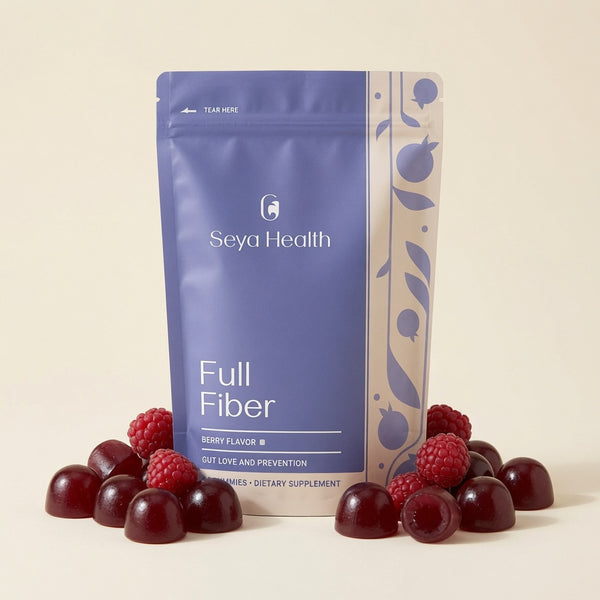
Seya Full Fiber
Most women fall short on fiber. Seya Full Fiber gives you 6 grams from three fibers in three small vegan gummies. Plant based, no gelatin, no sugar alcohols.
Shop Full Fiber