
Home/ The Journal/ fiber
fiber
Menopause Belly: Why It Happens and What Actually Helps
The menopause belly is real and hormone-driven. Why fat shifts to your middle, why you cannot spot-reduce it, and how fiber, blood sugar, and your gut fit into what actually helps.

The menopause belly is real, and it is not a willpower problem. As estrogen drops, your body starts storing fat around your middle instead of your hips and thighs, and it does this even when your weight barely changes. You cannot spot-reduce it, and no food or supplement melts it away. What helps is the boring, real stuff: strength and protein, sleep, less stress, and steadier blood sugar. Fiber is a quiet part of that picture, and most women in this stage are getting about half of what they need.
The menopause belly is real
If your body suddenly seems to keep everything in the middle, you are not imagining it, and you are not doing anything wrong. This is one of the most common changes women notice in their 40s and 50s. The same jeans fit differently. The scale might barely move, but your waistband tells a different story.
Doctors have a plain name for it, and there is a clear reason it happens. So before we talk about what helps, let us be honest about what is actually going on, because the "eat less, move more" advice you have heard your whole life does not fully explain this one.
What is actually happening
The short version: your hormones change where your body stores fat.
Before menopause, higher estrogen tends to send fat to your hips and thighs. As estrogen falls during perimenopause and menopause, that pattern flips, and fat starts collecting around your abdomen instead.1 Studies that followed women through the transition found a clear rise in belly fat, including the deeper kind, tied to the hormonal shift rather than to eating more.2 To learn where you are in that timeline, see how doctors tell if you are in perimenopause.
Two kinds of belly fat
There are two different things going on under the surface, and they are worth telling apart:
- Subcutaneous fat sits just under the skin. It is the soft part you can pinch, the "muffin top" over your waistband. It is mostly a comfort and confidence thing.
- Visceral fat is deeper. It wraps around the organs inside your abdomen, and it is the more active kind. This is the one linked with things like blood sugar and heart health, so it is worth caring about for reasons beyond how your clothes fit.1
It is not only estrogen
A few other things pile on at the same time, which is why the middle feels so stubborn:
- Muscle loss. We naturally lose muscle as we age, and muscle is what burns energy at rest. Less muscle means a slower engine.
- Blood sugar gets touchier. The body handles carbohydrates less smoothly after 40. This shift toward insulin resistance is a big part of why fat parks itself in the middle.3
- Sleep and stress. Poor sleep and high stress raise cortisol, and cortisol nudges the body to hold onto belly fat. Menopause tends to wreck sleep at exactly the wrong time.1
The honest part: you cannot spot-reduce it
Let us get this out of the way, because the internet will not. There is no food, no gummy, no tea, and no ab exercise that targets belly fat specifically. Crunches build the muscle under the fat, they do not remove the fat on top of it. Anything promising to "melt menopause belly" is selling you something.
What actually moves the needle is the unglamorous set: building muscle with a little strength training, eating enough protein, protecting your sleep, managing stress, and keeping your blood sugar steady. It works over months, not days. For the bigger picture on midlife weight, see losing weight in perimenopause.
You cannot target belly fat. But you can work on the things that quietly drive it, and your gut is one of them.
The lever nobody talks about: your gut
Here is where most menopause-belly advice stops short. It will tell you to "eat more fiber and vegetables" in a single line, then move on. But the gut is doing real work behind the scenes on two of the exact drivers we just named, and it is worth understanding why.
1. Fiber steadies blood sugar
Remember that blood sugar gets touchier after 40, and that insulin resistance is a big part of the menopause middle. This is where soluble fiber earns its place. Soluble fiber slows how fast carbohydrate reaches your bloodstream, which softens the sharp spikes and crashes that push the body to store fat and leave you reaching for a snack an hour later.4
There is a striking piece of research here. In a five-year study, for every extra 10 grams of soluble fiber people ate per day, the rate they accumulated visceral belly fat was about 3.7% slower.5 Read that carefully: it is a slower rate of gain, not a magic melt. But in a stage of life where the deck is stacked toward gaining in the middle, slowing that down is exactly the kind of quiet win that adds up. We go deeper on this in fiber and blood sugar for women over 40.
2. Fiber feeds the gut bacteria involved in estrogen
This part surprises people. Your gut bacteria play a role in how your body processes estrogen. There is a specific group of them, nicknamed the estrobolome, that helps determine how much estrogen gets recycled back into your body versus cleared out.6 Fermentable fiber is the food those bacteria live on. Feed them well, and you support the machinery that keeps estrogen metabolism running the way it should.
To be clear about what this means and what it does not: supporting these bacteria is a mechanism, not a hormone treatment. Fiber does not balance, replace, or restore your hormones, and no supplement should claim it does. It simply supports the gut side of a system your hormones run through. We explain the full loop in estrogen and your gut.
The fiber gap hits hardest right here
So fiber quietly touches blood sugar and estrogen metabolism, the two things most tied to the menopause middle. Now the uncomfortable part.
More than 90% of women do not get enough fiber, and the average adult eats only about 15 to 17 grams a day, roughly half of what is recommended.7 Menopause experts often suggest aiming for the higher end of the range, around 25 to 35 grams or more. That means the women who could benefit most from fiber, right in the thick of the transition, tend to have the biggest gap to close. Nobody sat us down and explained this. To find your own target, see how much fiber women need per day, and for why the shortfall is so common, the fiber gap in women.
The belly bloat that is not actually fat
One more thing, because it gets lumped in with menopause belly and it is really a separate problem. A lot of what looks like belly at this stage is bloating and distension, not fat. Digestion tends to slow down in midlife, and when things move through more slowly, there is more volume sitting around to puff you out by the afternoon.
Fiber helps here too, but through movement, not roughage. The fermentable fibers that feed your gut bacteria support steadier transit, so there is less backed-up volume for a bloated belly to build on. The catch is that adding fiber too fast can cause gas at first, so the how matters, which we get to next. For the full picture on why the belly puffs up, read the balloon effect.
How to close the gap without wrecking your stomach
The goal is not to "max out" fiber. It is to close your gap steadily and comfortably. Here is the gentle version that actually sticks:
- Food first, and go slow. Add about 5 grams of fiber every few days rather than all at once, so your gut can adjust. To picture a serving, 6 grams of fiber is about half an avocado, or three quarters of a cup of chickpeas, or one medium pear.
- Drink water. Fiber needs water to do its job. Think of it as the other half of the dose.
- Mix your sources. Beans, oats, berries, greens, and flax feed different bacteria, so variety does more than one big source.
- Stay steady. A normal amount every day beats a giant salad on Monday that leaves you bloated through Wednesday.
Where a daily fiber supplement fits
Real life gets busy, and hitting your fiber target from food alone every single day is hard, especially when your appetite and routine are already shifting. A measured daily fiber is a simple floor under your intake: a known amount you can count on, and an easy way to raise your fiber slowly instead of guessing.
Seya Full Fiber gives you 6 grams of fiber from three fibers in one, in three small gummies. The fermentable fibers feed the beneficial bacteria in your gut, including the ones involved in estrogen metabolism, and the soluble fiber supports healthy blood sugar already within the normal range. It is plant based with no gelatin, no sugar alcohols, and 60 gummies per pouch. On the sugar question, a fair one to ask: it uses 3 grams of real sugar rather than sugar alcohols, because sugar alcohols are a common cause of the exact gas and bloating a fiber product is supposed to help. It will not melt your belly, and nothing will. It is a steady, known way to help close the gap that sits underneath so much of this.
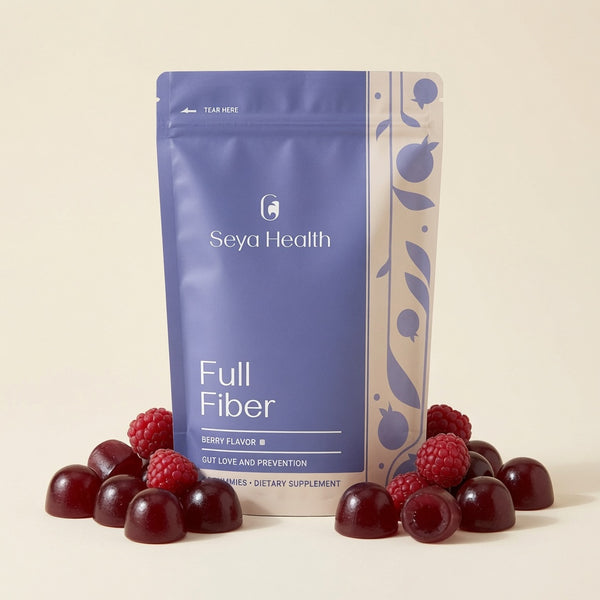
Seya Full Fiber
6 grams of fiber in three gummies. Feeds your gut bacteria and supports healthy blood sugar already within the normal range. Three fibers in one, plant based, no gelatin, no sugar alcohols.
Shop Full FiberThe honest bottom line
The menopause belly is a real, hormone-driven change, not a sign you failed. You cannot target it, and the fixes that work are the steady ones: muscle, protein, sleep, less stress, and steadier blood sugar. Fiber is not the whole answer, but it is a genuinely useful and badly overlooked part of it, working on your blood sugar and the gut bacteria involved in estrogen at the same time. Most women are only getting half the fiber they need, so for a lot of us, closing that gap is the most obvious win still on the table.
Frequently asked questions
Does fiber help with menopause belly?
Not by melting fat, because no food or supplement can spot-reduce belly fat. But fiber helps in two quieter ways that matter here: higher soluble-fiber intake is linked with a slower rate of gaining visceral belly fat, and fiber supports steady blood sugar, which is part of why fat parks in the middle after 40.5 Think of it as one supporting lever alongside strength training, protein, and sleep.
How much fiber do women in menopause need?
Most adults do well at roughly 25 to 38 grams a day, and menopause experts often suggest aiming for the higher end. Most women get about half of that, so the practical goal is closing your gap, not maxing out.7
Will more fiber help menopause bloating?
It can, over time, because fiber supports steadier digestion and there is then less backed-up volume to puff you out. But adding it too fast is the classic cause of gas and bloating, so build up slowly by about 5 grams every few days and drink plenty of water.
What is the best way to start?
Go gradual. Add roughly 5 grams of fiber every few days, drink water with it, mix your sources across the day, and stay consistent. A measured daily fiber like Seya Full Fiber makes it easy to raise your intake in small, known steps instead of guessing.
Does fiber fix menopause hormones?
No. Fiber does not balance, replace, or restore hormones, and anything that claims to should be treated with suspicion. What it does is support the gut bacteria involved in estrogen metabolism and help keep blood sugar steady. For hormone concerns, talk with your doctor about your full set of options.
Sources
- 1 Mayo Clinic. Menopause weight gain: Stop the middle age spread.
- 2 Lovejoy JC, et al. Increased visceral fat and decreased energy expenditure during the menopausal transition. International Journal of Obesity. 2008. PubMed.
- 3 Carr MC. The emergence of the metabolic syndrome with menopause. Journal of Clinical Endocrinology & Metabolism. 2003. PubMed.
- 4 Harvard T.H. Chan School of Public Health, The Nutrition Source. Fiber.
- 5 Wake Forest Baptist Medical Center (Hairston KG, et al.). Soluble fiber strikes a blow to belly fat (IRAS Family Study, Obesity).
- 6 Baker JM, Al-Nakkash L, Herbst-Kralovetz MM. Estrogen-gut microbiome axis: Physiological and clinical implications. Maturitas. 2017. PubMed.
- 7 American Society for Nutrition. Most Americans are not getting enough fiber in our diets.
This article is general information, not medical advice. Seya Full Fiber is a dietary supplement and is not intended to diagnose, treat, cure, or prevent any disease. Menopause affects everyone differently. If you have questions about weight, hormones, or a medical condition, or take medications, talk to your healthcare provider before making changes.
Keep reading

fiber
Can a Multivitamin Replace Vegetables? What Supplements Can't Do for Your Gut

constipation
The Best Way to Beat Constipation in Your 30s (and Where Fiber Gummies Fit)
fiber
The Gut-Skin Axis: Does Your Gut Health Affect Your Skin?
The gut-skin axis, explained: how your gut bacteria and blood sugar affect your skin, w...