
Home/ The Journal/ constipation
constipation
How to Relieve Perimenopause Constipation: Fiber, Diet, and Natural Remedies

Short version: Perimenopause constipation relief comes down to four unglamorous levers, run daily for about a month. Fiber at a real dose. Fluid alongside it. Movement most days. Then patience, because the trial data counts results in weeks, not mornings.
- Adults need 22 to 34 grams of fiber a day. Most women land closer to 15.
- In 16 pooled randomized trials covering 1,251 adults, 66% responded to fiber and 41% responded to control.
- That benefit showed up above 10 grams a day, held for at least 4 weeks.
- Drinking 2 liters of water on top of a 25-gram fiber diet beat the same diet with casual drinking, in a 117-patient trial.
Last updated August 2026.
You know what to do. Eat more fiber. Drink more water. Move.
You have probably done all three, for a week, and quit when nothing happened.
Here is the part nobody tells you. Perimenopause constipation relief runs on a clock measured in weeks. The studies that show fiber working ran for 4 weeks or longer. One good week of salad was never going to be enough, and quitting on day 6 is not a willpower problem. You were judging the plan on the wrong timeline.
So this is the plan on the right timeline. What to take, how much, how fast to add it, and how long before you get to decide whether it worked.
What actually works for perimenopause constipation relief?
Four things, stacked, and none of them are exciting.
Fiber at a dose that clears the bar. Fluid to go with it. Daily movement. And a set time to sit, so your gut can rely on a rhythm.
Everything else is decoration until those four are steady. If you want the reason your gut slowed down in the first place, that is why perimenopause slows your gut at midlife. This piece is only about what to do next.
One caveat up front. None of this changes your hormones. It changes the mechanical side of the problem, which happens to be the side you can actually move.
How much fiber, and how fast should you add it?
The target is 22 to 34 grams a day. That is the range the National Institute of Diabetes and Digestive and Kidney Diseases sets for adults, by age and sex.
Most women eat around 15. So the gap is real, and it is roughly 10 to 15 grams wide.
Do not close it in a weekend.
"Be sure to add fiber to your diet a little at a time so your body gets used to the change." — NIDDK
A workable ramp looks like this. Add about 5 grams a day for a week. Hold there. Add another 5 the following week. Hold again. Keep going until you are inside the range.
Four weeks to arrive, not four days. Jumping from 15 grams to 30 overnight buys you gas and bloating, and then you blame fiber and stop.
What dose does the research actually support?
More than most people take, for longer than most people last.
A 2022 review in The American Journal of Clinical Nutrition pooled 16 randomized controlled trials and 1,251 adults with chronic constipation. Of the people on fiber, 311 of 473 responded. Of the people on control, 134 of 329 responded. That is 66% against 41%, a risk ratio of 1.48.
The authors were specific about what made it work: doses above 10 grams a day, held for at least 4 weeks. Read the full analysis in the AJCN meta-analysis of fiber supplementation for chronic constipation.
Two things follow from that. Under 10 grams of added fiber, the evidence thins out. Under 4 weeks, you have not run the experiment yet.
Why does water decide whether the fiber works?
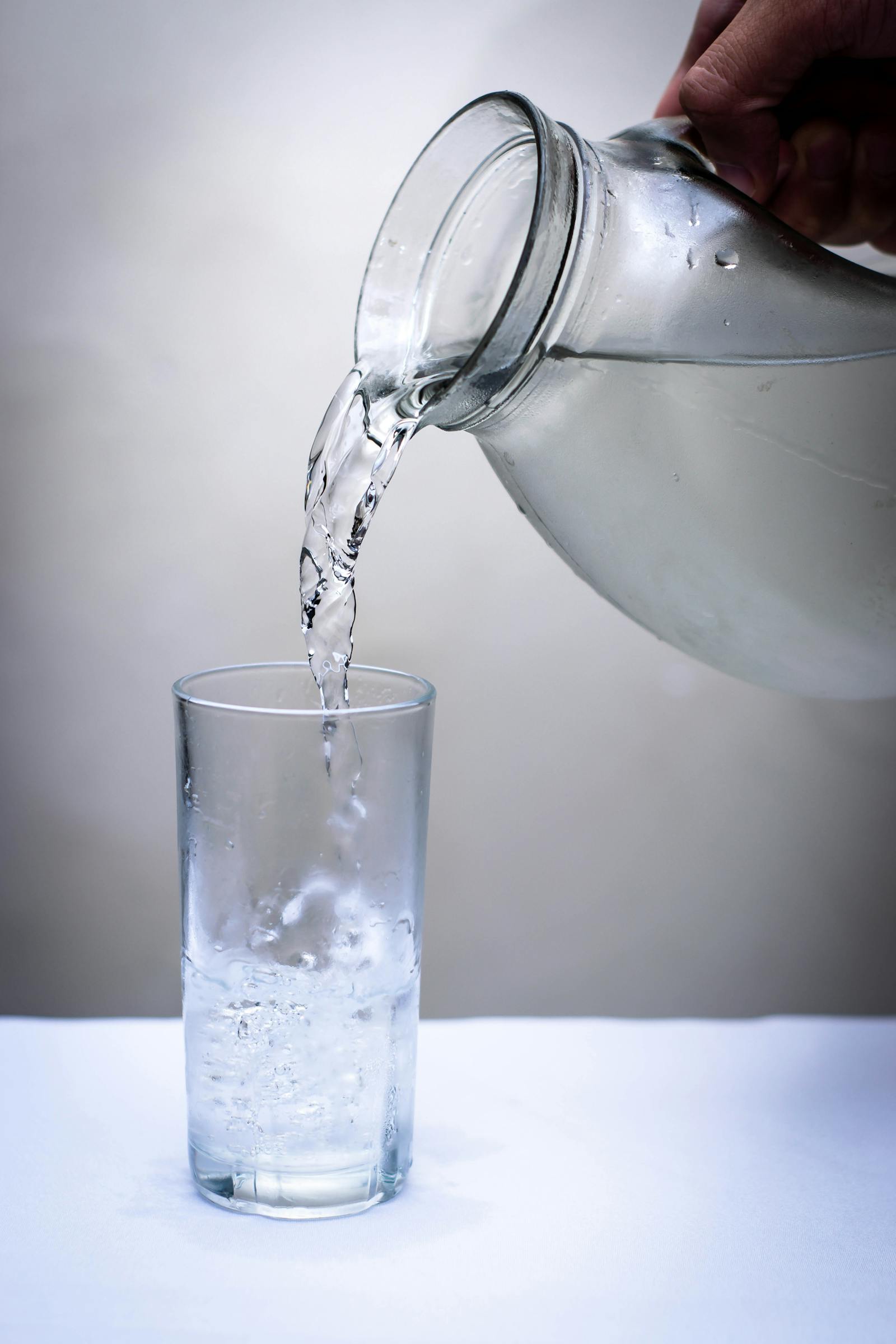
Because fiber needs fluid to hold onto. Dry fiber in a slow gut is a brick.
This was tested directly. Researchers put 117 adults with chronic constipation on a standard diet of about 25 grams of fiber a day for two months. One group drank whatever they normally drank, averaging 1.1 liters. The other group was told to drink 2 liters of mineral water daily and hit 2.1.
Both groups improved. The 2-liter group improved more, in stool frequency and in how often they reached for a laxative. The study is indexed as Anti et al., water supplementation and high-fiber diet in functional constipation.
So the rule is simple. Every time you raise your fiber, raise your fluid with it. Around 1.5 to 2 liters a day is the range that trial supports.
Does moving your body help?
Yes, modestly, and the effect is real enough to have been pooled.
A 2019 systematic review in Scandinavian Journal of Gastroenterology combined 9 randomized controlled trials and 680 participants. Exercise improved constipation symptoms with a relative risk of 1.97, with a 95% confidence interval of 1.19 to 3.27. Most of the trials used ordinary aerobic movement: walking, Qigong, general physical activity. See Gao et al., exercise therapy in patients with constipation.
Be honest about the quality. The authors flagged high heterogeneity and a high risk of bias across those trials. This is a supporting lever, not the headline.
Practically: a daily walk. Not a training block. If you are already tracking your cycle, timing movement to your cycle is a reasonable place to start.
What does the first month look like, week by week?
Here is the whole plan on one screen.
| Week | Fiber | Fluid | Movement |
|---|---|---|---|
| 1 | Add about 5 grams over baseline | Add 1 extra glass per meal | 10 minute walk daily |
| 2 | Add another 5 grams | Aim for 1.5 liters | 15 to 20 minutes daily |
| 3 | Reach the low end of 22 to 34 grams | Aim for 2 liters | 20 minutes daily |
| 4 | Hold steady, no jumps | Hold at 2 liters | Hold, then judge results |
Do not change three variables at once and then wonder which one worked. Ramp the fiber, keep the fluid glued to it, keep the walk boring and daily.
Sit at the same time each day, ideally after a meal, and give it 10 unhurried minutes. And when your body signals, go. Postponing the urge is how a slow gut gets slower.
For where the food comes from, we keep a full list of high-fiber foods for women and the sources most likely to close the gap.
How long before you can call it?
Four weeks at the full dose. That is the number the trials used, so that is the number you get to judge on.
Expect stool consistency to soften before frequency changes. Expect a few days of extra gas during each ramp step, fading as your gut adapts. Expect nothing dramatic on day 3.
If you have run 4 honest weeks at 22 grams or more, with 2 liters of fluid and daily movement, and nothing has shifted, stop iterating on your own. That is information, and it belongs in front of a clinician.
When should you see a doctor?
Sooner than most women do. Common is not the same as fine.
Book the appointment if this is new and has lasted more than a few weeks. Book it for blood in your stool, vomiting, unexplained weight change, or pain that wakes you at night. Book it if a full month of the plan above changes nothing.
Constipation is also a listed side effect of a long list of everyday medications, including some prescribed around midlife. Worth checking rather than guessing.
Seya sells one thing, and we will scope it honestly. 3 vegan gummies with resistant tapioca fiber deliver about 5 grams. That is a daily habit that helps you close the gap, and it sits below the 10-gram threshold where the trial effect appears, so we say it supports regularity and we stop there. It will not move your estrogen. It is not a substitute for medical care.
These statements have not been evaluated by the Food and Drug Administration. This product is not intended to diagnose, treat, cure, or prevent any disease.
Related reading: our daily fiber gummy for women and more from the Seya journal.
Frequently asked questions
What is the fastest way to relieve perimenopause constipation naturally?
There is no honest overnight answer, and that is the useful part. The quickest reliable route is a steady ramp: add roughly 5 grams of fiber a week until you sit inside the 22 to 34 gram range the NIDDK recommends, drink 1.5 to 2 liters of fluid daily alongside it, and walk most days.
In a pooled analysis of 16 randomized trials and 1,251 adults, 66% of participants responded to fiber versus 41% on control. The effect required doses above 10 grams a day, sustained for at least 4 weeks.
What diet helps relieve constipation during perimenopause?
A plant-forward diet built to hit 22 to 34 grams of fiber a day, with fluid to match. The NIDDK points to whole grains, legumes, fruit with the skin on, vegetables, and nuts. Nothing about that list is perimenopause-specific, which is the point: your gut got slower, so the same food rules now need to be followed more deliberately than they did at 30.
Can eating too much fiber be a bad thing?
Adding it too fast can be. A sudden jump from 15 grams to 30 grams typically produces gas, bloating, and cramping, which is why the NIDDK advises adding fiber "a little at a time so your body gets used to the change." Fiber added without extra fluid can also make stool harder rather than softer. Ramp over about 4 weeks and drink more as you go.
How long does fiber take to relieve constipation?
Judge it at 4 weeks, not 4 days. The 2022 meta-analysis in The American Journal of Clinical Nutrition found the benefit of fiber supplementation emerged at doses above 10 grams a day sustained for at least 4 weeks. Stool consistency usually softens before frequency changes.
Does exercise help constipation in perimenopause?
It helps as a supporting lever. A 2019 systematic review of 9 randomized trials and 680 participants found exercise improved constipation symptoms with a relative risk of 1.97, 95% CI 1.19 to 3.27, mostly using ordinary aerobic activity like walking. The authors noted high heterogeneity and a high risk of bias, so treat daily movement as a genuine helper rather than the main lever.
When should perimenopause constipation be checked by a doctor?
See a clinician if the change is new and has lasted more than a few weeks, if there is blood in your stool, vomiting, unexplained weight change, or pain that wakes you at night, or if 4 weeks of adequate fiber, fluid, and movement produce no change. Constipation is also a side effect of many common medications, which is worth reviewing rather than assuming.
Related reading
Seya Full Fiber
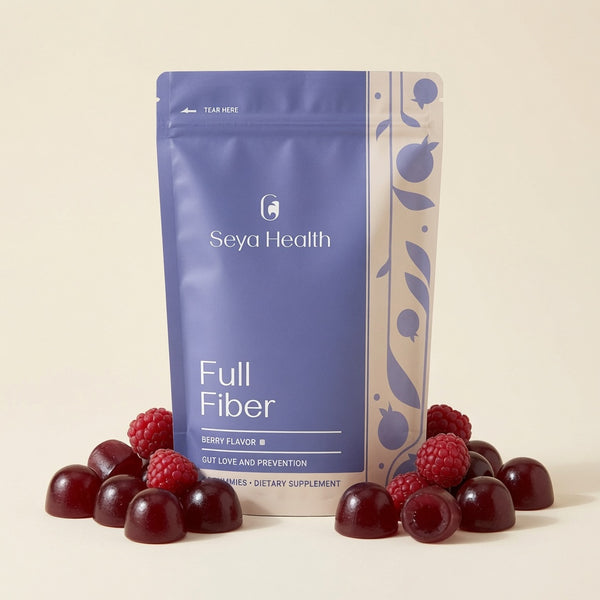
Getting enough fiber from food every day is hard. Seya Full Fiber is 6 grams from three fibers in one, in three small gummies, so you have a reliable daily floor. Plant based, no gelatin, no sugar alcohols, 60 gummies per pouch.
Shop Full FiberKeep reading

fiber
Can a Multivitamin Replace Vegetables? What Supplements Can't Do for Your Gut

constipation
The Best Way to Beat Constipation in Your 30s (and Where Fiber Gummies Fit)
fiber
The Gut-Skin Axis: Does Your Gut Health Affect Your Skin?
The gut-skin axis, explained: how your gut bacteria and blood sugar affect your skin, w...