
Home/ The Journal/ acid reflux
acid reflux
The Low Acid Paradox: Is Low Stomach Acid Causing Your Heartburn?
We’ve been conditioned to believe that any burning sensation or indigestion is the result of too much stomach acid. But for many women, the opposite is true. Hypochlorhydria, or low stomach acid, is a common but frequently misdiagnosed condition that can leave your digestion at a standstill.

Short version: Low stomach acid is a real condition. It is rarely the reason your chest burns. In 366 people whose heartburn ignored acid blockers, careful testing found true reflux in only 78 of them, or 21%.
- Up to 70% of people with heartburn have a normal-looking food pipe when a doctor looks inside.
- Real low stomach acid comes from gastritis, an H. pylori infection, or years on acid blockers. Not from stress burning out your "digestive fire."
- Women get more burn with less visible damage. In a study of 10,837 people, 623 of the 733 erosion cases were men.
Last updated July 2026.
The low stomach acid heartburn theory is the internet's favorite plot twist. The claim goes like this: your chest burns because you make too little acid, not too much.
Here is the honest version. Low stomach acid is real and measurable. It has real causes. It is just very rarely the thing lighting up your chest.
And the finding buried under the myth is far more useful than the myth. For most people, heartburn was never a question of how strong the acid is.
You have probably already decided this is your fault. The late dinner. The second coffee. The stress you failed to manage. That burn is a signal, not a verdict on how well you are running your life. And in most cases it is not even a signal about acid.
Is low stomach acid heartburn real, or a myth?
Both, in different parts. Low stomach acid is a real diagnosis. Doctors call it hypochlorhydria. What has not held up is the popular story attached to it: that weak acid lets food ferment, and the gas pushes acid up.
That mechanism sounds tidy. It is not what reflux research measures. The 2022 American College of Gastroenterology guideline on reflux disease, written by Katz and colleagues, builds its whole model around a valve that opens at the wrong time. Not around an acid meter reading low.
So keep the instinct. Drop the mechanism.
What actually causes the burn?
A valve. There is a ring of muscle where your food pipe meets your stomach. It is supposed to stay shut. When it relaxes at the wrong moment, stomach contents move up and your chest burns.
The NIH's digestive disease institute puts the cause on that valve becoming weak or relaxing when it should not. Body weight, pregnancy, smoking, and some medicines all pull on it.
Amount of acid barely enters the picture. Plenty of people burn with completely ordinary acid levels. Their nerves are simply reading a normal event as pain.
We break the mechanics down further in what heartburn actually is.
Why do acid blockers fail for so many people?
Because a drug that lowers acid cannot help a problem that was never about acid.
Roughly 30% to 40% of people on acid blockers still report symptoms. The ACG guideline says the part almost nobody repeats.
"Although it is claimed that 30%–40% of patients treated with PPIs for GERD have persistent “GERD symptoms”, in many cases, those PPI-resistant symptoms are mistakenly assumed to be caused by reflux." — Katz and colleagues, American Journal of Gastroenterology (2022)
A second body of work puts numbers on it. The 2020 AGA clinical practice update on functional heartburn reports on 366 patients whose heartburn shrugged off acid blockers. Full workup found genuine drug-resistant reflux in 78 of them, or 21%. Another 99, or 27%, had functional heartburn. A further 23, or 6%, had a different problem in the food pipe entirely.
Never stop a prescribed acid blocker on your own. Bring these numbers to your prescriber and ask what your own testing shows.
Three problems that feel identical from the inside
When a scope comes back clean, doctors sort heartburn into three buckets. One study followed 329 such patients off acid blockers and split them this way.
| What it is | What testing shows | Share of these patients |
|---|---|---|
| Non-erosive reflux disease | Acid exposure above normal, no visible damage | 40% |
| Reflux hypersensitivity | Normal acid exposure; ordinary refluxes still hurt | 36% |
| Functional heartburn | Normal acid exposure; pain not tied to reflux at all | 24% |
Two of those three buckets, 60% of the group, involve normal acid exposure. Figures from a 2018 review of functional heartburn, which also reports that up to 70% of people with heartburn have a normal scope.

What really causes low stomach acid?
Damage to the acid-making lining, an infection, or long-term acid suppression. Those are the documented causes. Stress is not on the list, and neither is simply getting older.
A 2025 review of gastric secretion and aging is direct about it.
"In studies where adjustment for histology was performed, age had no independent effect on gastric acid secretion." — Age-Related Decline of Gastric Secretion: Facts and Controversies
The same review notes that acid output stays normal in older people whose stomach lining is healthy. What drives the decline is chronic atrophic gastritis, H. pylori infection, and widespread use of acid blockers.
That matters for you in one plain way. Real low acid is a clinical finding, confirmed by a clinician. It is not something a kitchen experiment can tell you, and the at-home versions circulating online are not diagnostic.
Why women get more burn with less damage
Because the visible injury and the felt symptom split along sex lines.
Japanese researchers scoped 10,837 people. Of those, 733, or 6.8%, had visible erosion in the food pipe. Another 1,722, or 15.9%, had reflux symptoms with no erosion at all. Men made up 623 of the 733 erosion cases, or 85%. Women were 769 of the 1,722 non-erosive cases, per Minatsuki and colleagues in PLoS One.
A 2016 review of sex differences in reflux disease reaches the same place: both functional heartburn and non-erosive reflux are more common in women than in men. It also found symptom-impact scores running higher in the no-damage group, 9.2 versus 6.5.
So when your scope comes back clean, hear the real finding. Your burn is genuine and your food pipe is intact. Those two facts do not cancel each other out, and the second one is good news.
Where does fiber actually fit?
At the edges, honestly. Fiber has one small, real study behind it for reflux, and we are not going to inflate it.
In 2018, Morozov and colleagues in the World Journal of Gastroenterology gave 36 people with non-erosive reflux and low fiber intake, under 20 g a day, 5 g of a soluble fiber three times daily for 10 days. Resting pressure at the valve went up. Reflux episodes went down. Weekly heartburn episodes dropped.
Thirty-six people. Ten days. No placebo group. That is a promising signal at grade C, not proof, and it says nothing about acid strength.
The wider gap is easier to defend. More than 90% of US women fall short of the recommended fiber intake, roughly a 50% shortfall, per an analysis in Nutrients (2021). That is the shortfall behind the fiber gap in women, and how much fiber women need per day gives you the target.
Seya's job here is to stay narrow. Our 3 vegan gummies carry about 5 g of soluble fiber from resistant tapioca fiber, an ingredient we name. Under DSHEA that supports regularity, which is exactly what we claim and all we claim. It is a daily fiber habit. It is not a reflux remedy, and it does not replace what your doctor finds. For what to eat when the burn shows up, see the best foods and drinks for heartburn relief.
When should you see a doctor about heartburn?
Some symptoms mean stop reading and get care. This part is not a judgment call.
Get medical help right away for chest pain, especially chest pain with exertion, sweating, or breathlessness. Heartburn and a heart attack can feel the same from the inside, and women's cardiac symptoms are missed more often.
Book an appointment promptly for any of these, per the NIH's digestive disease institute:
- Trouble swallowing, or pain when you swallow.
- Dropping weight without trying, or losing your appetite.
- Vomit with blood in it, or vomit that looks like coffee grounds.
- Stool that is black and tarry, or has blood in it.
- Persistent vomiting, or heartburn more than twice a week for weeks.
The ACG guideline puts the same short list first for endoscopy: trouble swallowing, dropping weight without trying, and bleeding. If you have been on acid blockers for years, that is also worth a conversation with your prescriber, not a solo decision.
These statements have not been evaluated by the Food and Drug Administration. This product is not intended to diagnose, treat, cure, or prevent any disease.
Frequently asked questions
Can low stomach acid cause heartburn?
There is no good evidence that it does. Low stomach acid, or hypochlorhydria, is a real condition with real causes, but the popular idea that weak acid ferments food and forces the valve open has not been demonstrated in reflux research. The 2022 American College of Gastroenterology guideline explains heartburn through a valve that relaxes at the wrong time, and through nerves that read normal reflux as pain.
How do you know if your heartburn is not acid?
The strongest clue is that acid blockers do not help. About 30% to 40% of people on them still have symptoms. In 366 patients referred for heartburn that failed acid blockers, full testing showed the heartburn was genuinely reflux-related in only 78, or 21%, while 99, or 27%, had functional heartburn. Only testing can sort this out, so ask your doctor what your own results show.
What causes low stomach acid?
Chronic atrophic gastritis, H. pylori infection, autoimmune damage to the stomach lining, and long-term use of acid-blocking medicine. Age by itself is not a cause. A 2025 review found that once researchers adjusted for the state of the stomach lining, age had no independent effect on acid output. Older people with a healthy lining keep making normal amounts of acid.
Why do women get heartburn without damage to the esophagus?
Women are more likely to have non-erosive reflux and functional heartburn, while men are more likely to have visible erosion. In a study of 10,837 people, 623 of the 733 erosion cases, or 85%, were men. Women's symptom-impact scores tend to run higher even with no damage, at 9.2 versus 6.5 in one comparison. A clean scope does not mean the burn is imagined.
Does fiber help with heartburn?
The evidence is thin and early. One 2018 study of 36 people with non-erosive reflux found that 5 g of a soluble fiber three times a day for 10 days raised valve pressure and cut reflux episodes. That is one small, short, placebo-free study. Fiber supports regularity, and more than 90% of US women fall short of the recommended intake, but fiber is not a remedy for reflux.
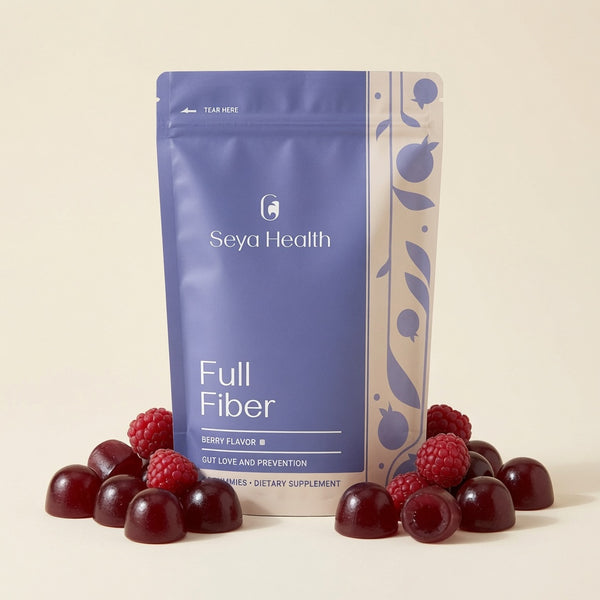
Seya Full Fiber
More than 90% of women fall short on fiber. Seya Full Fiber gives you 6 grams from three fibers in one, in three small gummies that feed the beneficial bacteria in your gut. Plant based, no gelatin, no sugar alcohols.
Shop Full FiberKeep reading
fiber
Can a Multivitamin Replace Vegetables? What Supplements Can't Do for Your Gut

constipation
The Best Way to Beat Constipation in Your 30s (and Where Fiber Gummies Fit)

fiber
The Gut-Skin Axis: Does Your Gut Health Affect Your Skin?
The gut-skin axis, explained: how your gut bacteria and blood sugar affect your skin, w...