
Home/ The Journal/ acid reflux
acid reflux
What Is Heartburn? Why It Happens, and What Actually Helps
It starts as a mild warmth in your upper stomach and quickly climbs into your chest—a sharp, acidic, and incredibly uncomfortable sensation. Despite its name, heartburn has nothing to do with your heart. Instead, it is your digestive system sending out a distress signal.

Short version: what is heartburn? Stomach acid moving the wrong way. A ring of muscle at the top of your stomach relaxes when it should stay shut, and acid touches a pipe that has no lining built for it. It is a valve problem, not a willpower problem.
- Occasional reflux is normal. Symptoms 2 or more days a week point toward GERD, a condition worth naming with a clinician.
- Heartburn shows up in 43.8% of pregnancies overall, and in 55.9% during the third trimester.
- Women report reflux symptoms more often and more severely than men; men get more of the tissue damage.
- On GLP-1 medications, reflux risk ran 27% higher than on a comparison drug class over 3 years.
- In 1 small trial, adding 15g of psyllium a day cut the share of people with heartburn from 93.3% to 40% in 10 days.
Last updated August 2026.
It starts small. A warmth under the breastbone about 20 minutes after dinner.
Then it climbs.
Most people file this under something they did wrong. The late meal. The second glass. The lying down.
Some of that matters. None of it is the actual cause.
What is heartburn?
Heartburn is the burning feeling in the middle of your chest when stomach contents come back up into your esophagus.
It has nothing to do with your heart. The nerve wiring just runs close enough that your brain reads it there.
The medical name for the backflow is gastroesophageal reflux. The National Institute of Diabetes and Digestive and Kidney Diseases lists heartburn and regurgitation as the two main symptoms, along with chest pain, nausea, trouble swallowing, and a cough or hoarseness that will not clear.
Everyone refluxes sometimes. When it turns frequent or starts damaging tissue, it gets a different name: GERD.

What is actually happening in your chest?
One muscle is doing a bad job.
At the bottom of your esophagus sits a ring called the lower esophageal sphincter. It opens to let food through, then clamps shut.
When it relaxes at the wrong moment, or when pressure from below overwhelms it, stomach contents travel up.
Your stomach has a thick lining built for acid. Your esophagus does not. That mismatch is the whole sensation.
NIDDK names the things that weaken or relax that ring: carrying extra body weight, pregnancy, smoking or secondhand smoke, and a hiatal hernia. Several common medicines do it too, including calcium channel blockers, some asthma medicines, NSAIDs, and tricyclic antidepressants.
Read that list again. Almost none of it is a choice you made at dinner.
Why do women get heartburn differently?
Same valve, different pattern.
Reviews of sex differences in reflux disease find that women report symptoms more often and more severely, and that non-erosive reflux disease is more common in women. Men carry more of the visible damage: erosive esophagitis, Barrett's esophagus, and esophageal cancer skew male.
So a woman is more likely to feel it badly and less likely to have a scope find something. That gap is real, and it is one reason women get told it is stress.
Prevalence also climbs with age in women, and the rise tracks with menopause. You can read the sex-difference literature in this review of sex and gender differences in gastroesophageal reflux disease.
If your reflux started in your forties and nothing about your eating changed, that timing is a known pattern, not a coincidence.
What if you are pregnant?
Then the odds are close to a coin flip, and it is mechanical.
A 2025 meta-analysis pooled 21 studies covering 9,497 pregnant participants. Heartburn showed up in 43.8% of them, rising from 26.1% in the first trimester to 55.9% in the third. Compared with non-pregnant controls, the odds of reflux symptoms were 8.37 times higher.
Hormonal changes relax the valve. A growing uterus raises the pressure underneath it. Both push the same direction.
Pregnancy changes what is safe to take, including supplements. Bring any product to your obstetric provider before you start it.
What about GLP-1 medications?
They slow the stomach down, and a slower stomach refluxes more.
A 2025 population study followed 24,708 people starting a GLP-1 medication and 89,096 starting a different diabetes drug class. Over 3 years, the GLP-1 group had a 27% higher risk of reflux disease (RR 1.27, 95% CI 1.14 to 1.42) and a 55% higher risk of its complications.
In absolute terms that is roughly 0.7 extra cases per 100 people over 3 years. Small per person, real across a population.
The mechanism is delayed gastric emptying: food sits longer, so there is more to come back up. It is the same slowdown behind the constipation side of GLP-1s, which we cover in the GLP-1 constipation guide.
This is worth raising with your prescriber. It is not a reason to stop a medication on your own.
Does fiber help heartburn?
There is one honest study, and it is small. Here is exactly what it found and what it does not prove.
Researchers took 36 people with non-erosive reflux disease who were eating under 20g of fiber a day. For 10 days they added psyllium, 5g three times daily, on top of the usual diet. 30 completed the study.
The share reporting heartburn fell from 93.3% to 40%. Symptom scores dropped from 10.9 to 6.0. Minimum resting pressure at the valve rose from 5.41 to 11.3 mmHg, and total reflux events fell from 67.9 to 42.4 a day. The full paper is Morozov, Isakov, and Konovalova, 2018.
Now the limits, because they matter more than the headline. 30 people. 10 days. No placebo group. One specific fiber, psyllium, at 15g a day.
Seya's fiber gummy is not that. It carries about 5g of resistant tapioca fiber, a third of the dose in that trial and a different ingredient. We say what the evidence lets us say: it supports regularity. We do not claim it does anything for reflux.
If your daily fiber is low, closing that gap is worth doing on its own terms. Start with the fiber gap.
What does the evidence actually support?
The American College of Gastroenterology graded the lifestyle options in its 2022 guideline. Most of them rest on low-quality evidence, and the guideline says so.
| What to change | How strongly it is recommended | Quality of evidence |
|---|---|---|
| Losing excess body weight if you carry it | Strong | Moderate |
| No meals within 2 to 3 hours of bed | Conditional | Low |
| Raising the head of the bed for night symptoms | Conditional | Low |
| Stopping tobacco | Conditional | Low |
| Avoiding your own trigger foods | Conditional | Low |
Notice what is missing: a blanket ban on coffee, citrus, and spice. The ACG guideline says to cut the foods that reliably set off your symptoms, and leave the rest alone.
We went through the food side in the best foods and drinks for heartburn relief. And if antacids never seem to do much, read the low acid paradox.
When to stop reading and call someone
Chest pain is the one symptom you do not get to self-diagnose.
Call emergency services if the pain is crushing or squeezing rather than burning, or if it spreads to your jaw, neck, back, or arm, or if it comes with shortness of breath, sweating, or feeling faint.
Book a clinician if you are reaching for antacids more than twice a week, if food feels stuck going down, if you are vomiting repeatedly, if you see blood, or if your weight is dropping without you trying.
None of that is being dramatic. It is the list NIDDK publishes.
Frequently asked questions
What is heartburn a symptom of?
It is the main symptom of gastroesophageal reflux, meaning stomach contents traveling back up into the esophagus. Occasional reflux is normal and happens to everyone. When it turns frequent, or starts damaging the lining, clinicians call it GERD. Heartburn can also point elsewhere, including heart problems, which is why crushing or radiating chest pain needs emergency care rather than an antacid.
What is the difference between heartburn and GERD?
Heartburn is the sensation. GERD is the chronic condition underneath it. NIDDK describes GER as the reflux itself, something many people experience once in a while, and GERD as what may develop when the lower esophageal sphincter is weak or relaxes when it should not. A common practical line is symptoms twice a week or more, or symptoms that persist despite over-the-counter medicines and lifestyle changes.
Why do I get heartburn at night?
Gravity stops helping the moment you lie flat, so acid pools against the valve instead of draining away. The 2022 ACG guideline suggests avoiding meals within 2 to 3 hours of bed and raising the head of the bed for nighttime symptoms, both as conditional recommendations based on low-quality evidence. Raising the head of the bed means propping the frame or using a wedge; stacking pillows bends you at the waist and can raise abdominal pressure instead.
Does fiber help with acid reflux?
The evidence is one small study, and it is worth reading honestly. In 2018, researchers gave 36 people with non-erosive reflux disease and low fiber intake 5g of psyllium three times a day for 10 days. Among the 30 who finished, the share with heartburn fell from 93.3% to 40%, and minimum resting valve pressure rose from 5.41 to 11.3 mmHg.
There was no placebo group, the trial was short, and the dose was 15g a day of one specific fiber. That is not evidence that any fiber product eases reflux.
Is heartburn worse for women?
Women report reflux symptoms more frequently and more severely, and non-erosive reflux disease is more common in women. Men have higher rates of the visible tissue damage, including erosive esophagitis and Barrett's esophagus. Prevalence in women also rises with age and tracks with menopause. Pregnancy is the sharpest example: pooled data across 21 studies puts heartburn at 43.8% of pregnancies and 55.9% in the third trimester.
Do GLP-1 medications cause heartburn?
They raise the risk. A 2025 study of 24,708 GLP-1 starters and 89,096 people on a comparison drug class found a 27% higher relative risk of reflux disease over 3 years, and a 55% higher risk of complications. The likely mechanism is delayed gastric emptying, the same slowdown that causes constipation on these medications. Raise it with the prescriber who manages your dose rather than stopping on your own.
These statements have not been evaluated by the Food and Drug Administration. This product is not intended to diagnose, treat, cure, or prevent any disease. This article is educational and is not medical advice. Talk to your clinician about your own situation.
Related reading
- How Much Fiber Do Women Actually Need? Grams by Age, and Why It's More Than You Think
- Menopause Belly: Why It Happens and What Actually Helps
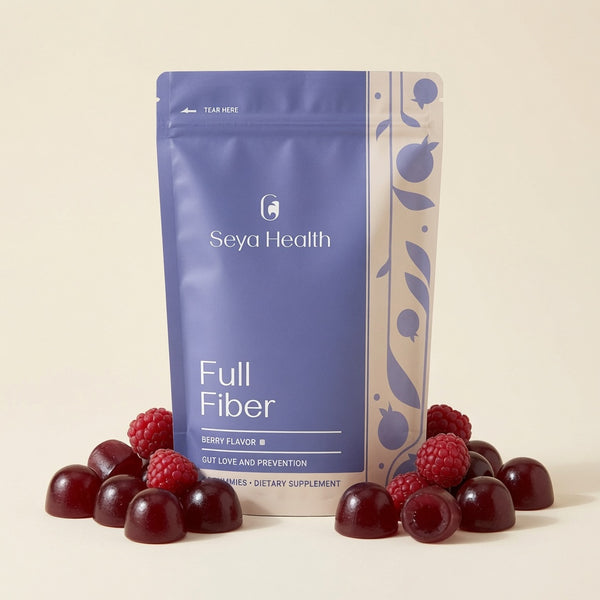
Seya Full Fiber
More than 90% of women fall short on fiber. Seya Full Fiber gives you 6 grams from three fibers in one, in three small gummies that feed the beneficial bacteria in your gut. Plant based, no gelatin, no sugar alcohols.
Shop Full FiberKeep reading
fiber
Can a Multivitamin Replace Vegetables? What Supplements Can't Do for Your Gut

constipation
The Best Way to Beat Constipation in Your 30s (and Where Fiber Gummies Fit)
fiber
The Gut-Skin Axis: Does Your Gut Health Affect Your Skin?
The gut-skin axis, explained: how your gut bacteria and blood sugar affect your skin, w...