
Home/ The Journal/ bristol stool scale
bristol stool scale
What Does Healthy Poop Look Like? Decoding Your Daily "Status Report"
It’s the one health check we all perform daily, yet we almost never talk about it. Checking the toilet before you flush isn't just a quirk—it’s a vital way to monitor your internal health. Your stool is a direct "status report" from your digestive system, offering clues about your hydration, fiber intake, and even your stress levels.

Short version: What does healthy poop look like? Soft, formed, and easy to pass. On the Bristol stool scale that is a type 3 or a type 4. Shape tells you more than frequency does, and it is the one signal you can act on.
- The Bristol scale sorts stool into 7 types. Types 3 and 4 are the target.
- In the study that validated it, 66 volunteers showed stool form tracked gut transit time better than how often they went.
- Constipation has a clinical line: fewer than 3 bowel movements a week.
- Adults need 22 to 34g of fiber a day. Most women eat closer to 15.
- Blood in your stool, black stool, or pain that wakes you up are doctor calls, not diet fixes.
Last updated August 2026.
You look. Everybody looks.
Then you flush and get on with your day, because nobody taught you what you were looking at.
So here is the read, using the same scale a gastroenterologist uses. None of this is a verdict on how well you are taking care of yourself. It is a status report, and it changes on a timescale of days.
What does healthy poop look like?
Smooth, soft, sausage-shaped, and out in under a minute without straining.
Medium to dark brown is the usual color. That brown comes from bile pigment breaking down on the way through.
Size and shape matter more than you would think. A stool that holds together in one or two pieces has spent about the right amount of time in your colon. Hard pellets spent too long. Liquid spent too little.
Everything else on this page is a variation on that one idea.
What is the Bristol stool scale?
A 7-point chart that turns a vague question into a number.
Two Bristol researchers, Stephen Lewis and Ken Heaton, published it in 1997 after tracking 66 volunteers. They gave people senna to speed the gut up and loperamide to slow it down, then measured what came out.
Stool form tracked whole-gut transit time at r = -0.54. When they looked at change over time, form predicted the shift better than frequency or volume did, at r = -0.65. You can read the original in Lewis and Heaton's stool form scale paper in the Scandinavian Journal of Gastroenterology.
Translation: the shape is the better signal. Counting trips to the bathroom is the worse one.
| Type | What it looks like | What it means |
|---|---|---|
| 1 | Separate hard lumps, like nuts | Slow transit, hard to pass |
| 2 | Lumpy, sausage-shaped | Slow transit |
| 3 | Sausage with cracks on the surface | Target range |
| 4 | Smooth, soft, snake-like | Target range |
| 5 | Soft blobs with clear edges | Trending fast |
| 6 | Mushy, ragged edges | Fast transit |
| 7 | Liquid, no solid pieces | Very fast transit |
How often should you go?
There is no daily quota. There is a floor.
The National Institute of Diabetes and Digestive and Kidney Diseases draws the line at fewer than 3 bowel movements a week. Below that, plus hard or painful stools, is constipation.
Above the floor, your own pattern is the benchmark. Three times a day can be normal. Once every other day can be normal.
What matters is a change. Going from daily to twice a week, and staying there for a month, is worth a look. We unpacked the mechanics in why your system hits a standstill.

What does the color mean?
Most color swings are food. A few are not.
- Medium to dark brown. The usual range.
- Green. Often a fast trip through, so bile did not finish changing color. Also spinach, kale, and food dye.
- Yellow and greasy. Can point to fat that did not get absorbed. Worth mentioning if it repeats.
- Pale or clay-colored. Can mean bile is not reaching your gut. Get it checked.
- Black and tarry, or bright red. Can mean bleeding higher up or lower down.
Beets and iron pills turn things red or black and fool everyone. Still, the NIDDK lists blood in your stool among the signs to see a doctor about right away, and the safe move is a phone call rather than a guess. Its overview of gastrointestinal bleeding symptoms covers what to watch.
Does floating or sinking matter?
A little. Less than the internet says.
Floating usually means gas trapped in the stool, which is a normal byproduct of your gut bacteria fermenting fiber. One floater after a big bean dinner is not a finding.
Persistent floating that is also pale, greasy, and hard to flush is a different pattern, and that one belongs to your clinician.
The same goes for smell. It is supposed to smell. A sudden, sustained change in odor alongside other symptoms is the part worth reporting.
What changes on a GLP-1?
Your timeline stretches, so your stool gets drier.
GLP-1 medications slow how fast your stomach empties. That is part of how they work. Food and stool sit longer, your colon pulls out more water, and you land at a type 1 or 2 instead of a 4.
A 2024 review in the Journal of Clinical Endocrinology and Metabolism found the slowing is real but uneven. Long-acting drugs like semaglutide and liraglutide showed the effect fading over weeks of use, and it did not appear in every person. The authors also flagged that symptoms alone are a poor guide to what is actually happening, in their review of delayed gastric emptying with GLP-1 receptor agonists and tirzepatide.
So do not read your own constipation as proof the drug is broken, or as proof you are doing it wrong. It is a known mechanical effect. We wrote the playbook in how to relieve GLP-1 constipation.
How do you actually get to a type 4?
Three levers, run for a month.
Fiber, at a dose that clears the bar. A 2022 meta-analysis in The American Journal of Clinical Nutrition pooled 16 randomized trials and 1,251 adults with chronic constipation. 66% responded to fiber against 41% on control. The effect showed up above 10g a day, held for at least 4 weeks. The full paper is the AJCN meta-analysis of fiber supplementation for chronic constipation.
Fluid alongside it. Fiber pulls water in. Add fiber without adding drinks and you can make stool harder instead of softer.
Movement, most days. Ordinary walking counts.
Ramp the fiber slowly, about 5g a week, until you sit inside the 22 to 34g range the NIDDK sets for adults. Jumping straight there buys you gas and bloating. Food first: start with the best high-fiber foods for women. Seya's fiber gummy supports regularity and is built to cover the gap your week leaves behind.
When should you call a doctor?
Some of this is not a fiber conversation.
The NIDDK says to seek care right away for bleeding from your rectum, blood in your stool, constant abdominal pain, inability to pass gas, vomiting, fever, lower back pain, or losing weight without trying.
Add two more: a habit change that sticks for over a month, and stools that stay pencil-thin.
Bring a family history of colorectal cancer into that conversation too. None of that is alarmist. It is just the short list of things a chart cannot answer.
Frequently asked questions
What does healthy poop look like on the Bristol scale?
Type 3 or type 4. A type 3 is sausage-shaped with cracks on the surface. A type 4 is smooth and soft, like a snake. Both pass without straining and hold their shape. Types 1 and 2 are hard and lumpy and signal slow transit. Types 5 through 7 are increasingly loose and signal fast transit. Lewis and Heaton's 1997 validation study of 66 volunteers found stool form correlated with whole-gut transit time at r = -0.54.
How many times a day should you poop?
There is no correct number. Anywhere from 3 times a day to 3 times a week falls inside the normal range for healthy adults, and your own baseline matters more than the average. The NIDDK defines constipation as fewer than 3 bowel movements a week, usually alongside hard, dry, or painful stools. A sustained change from your own pattern is more informative than any single count.
What color should healthy poop be?
Medium to dark brown, from bile pigment breaking down in transit. Green often just means a fast trip through, or leafy greens and food dye. Pale or clay-colored stool can mean bile is not reaching the gut, and black tarry or bright red stool can mean bleeding. The NIDDK lists blood in the stool among the signs that warrant seeing a doctor right away, so route those to a clinician rather than to a search engine.
Should healthy poop sink or float?
Sinking is typical, and an occasional floater is not a problem. Floating usually reflects gas produced when gut bacteria ferment fiber, which is normal. The pattern worth reporting is stool that consistently floats while also being pale, greasy, and difficult to flush, which can point toward fat that is not being absorbed.
Why is my poop hard on a GLP-1 medication?
These drugs slow gastric emptying, so stool spends longer in the colon and more water gets pulled out of it. A 2024 review in the Journal of Clinical Endocrinology and Metabolism reported that the slowing is genuine but varies widely between people, and tends to fade over weeks with long-acting drugs like semaglutide and liraglutide. The same review noted that symptoms are an unreliable measure of the underlying delay. Steady fiber, fluid, and movement are the levers that address the mechanical side.
How long does it take to change your stool consistency?
Judge it at 4 weeks. The 2022 AJCN meta-analysis of 16 randomized trials found the benefit of fiber emerged at doses above 10g a day sustained for at least 4 weeks, with 66% of people responding versus 41% on control. Consistency usually softens before frequency shifts, so the shape of things is the first place to look for progress.
These statements have not been evaluated by the Food and Drug Administration. This product is not intended to diagnose, treat, cure, or prevent any disease. This article is educational and is not medical advice. Talk to your clinician about your own symptoms.
Related reading
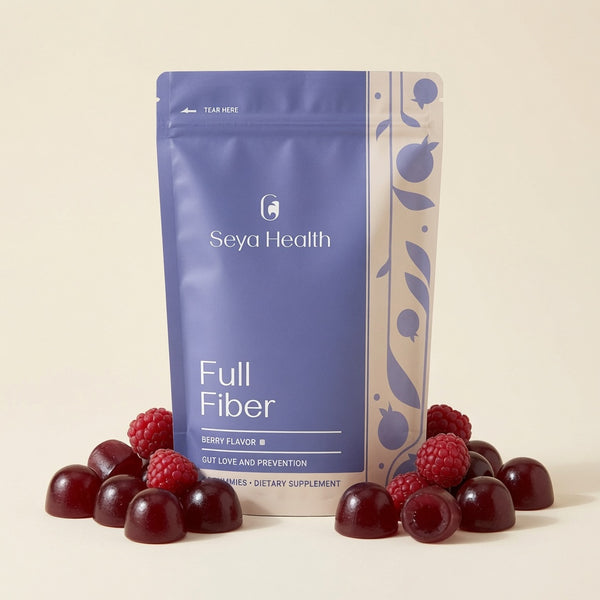
Seya Full Fiber
Getting enough fiber from food every day is hard. Seya Full Fiber is 6 grams from three fibers in one, in three small gummies, so you have a reliable daily floor. Plant based, no gelatin, no sugar alcohols, 60 gummies per pouch.
Shop Full FiberKeep reading

fiber
Can a Multivitamin Replace Vegetables? What Supplements Can't Do for Your Gut

constipation
The Best Way to Beat Constipation in Your 30s (and Where Fiber Gummies Fit)
fiber
The Gut-Skin Axis: Does Your Gut Health Affect Your Skin?
The gut-skin axis, explained: how your gut bacteria and blood sugar affect your skin, w...