Home/ The Journal/ estrobolome
estrobolome
The estrobolome: how your gut bacteria help regulate estrogen

Short version: The estrobolome is the group of gut bacteria that can process estrogen. Some of them make an enzyme that switches used estrogen back on, so your body can reabsorb it. In a 2019 lab study, scientists tested 35 of these gut enzymes, and some of them reactivated estrogen.
- It is real biology: the enzyme step has been shown in the lab.
- Human data is early: most studies are small and only show links, not cause.
- Menopause changes it: a study of 2,300 people found a less diverse gut after menopause.
- No quick reset: no product has been shown to "reset" the estrobolome.
Last updated November 2026.
You keep seeing the word estrobolome next to talk of hormones, gut health, and menopause. It sounds like a buzzword. It is not. It names a real step in how your body handles estrogen. But a lot of what you read about it goes further than the science does.
This guide covers what the estrobolome is, how it works, and what studies in people actually show. If you want the practical side, such as which foods help, see our guide on how to support your estrobolome.
What is the estrobolome?
The estrobolome is the set of gut bacteria, and their genes, that can break down or change estrogen. It is not an organ. It is a job that some of your gut microbes do.
The word first showed up in a 2011 review on the microbiome and cancer. The authors used it to describe how gut microbes might affect hormones far from the gut. See Plottel and Blaser (Cell Host Microbe, 2011).
Estrogen does a lot in the female body. It shapes your cycle, helps keep bones strong, and affects your heart, brain, and skin. So how much estrogen stays in your blood matters, and your gut has a say in it.
How gut bacteria turn estrogen back on
Think of it as a recycling loop. Here is how it runs, one step at a time:
- Your liver tags used estrogen. It attaches a small sugar-like tag to it. The tag marks it for removal.
- The tagged estrogen goes to your gut. It travels in bile into your intestines.
- Some bacteria cut the tag off. They use an enzyme called beta-glucuronidase, often shortened to GUS.
- The free estrogen can be reabsorbed. Once untagged, it can pass back into your blood instead of leaving in your stool.
Scientists call this loop enterohepatic circulation. It just means the trip between your liver and your gut.
The key step has been tested in the lab. In 2019, researchers tested 35 GUS enzymes from human gut bacteria. Certain types turned tagged estrone and estradiol, two main forms of estrogen, back into their active forms. They also found that the estrobolome likely involves many enzymes, not just one. See Ervin et al. (J Biol Chem, 2019).

Is the estrobolome real?
Yes, the biology is real. One of the oldest clues came from antibiotics. In 1977, three pregnant women took the antibiotic ampicillin. Their blood levels of tagged estrogens dropped for a few days. Killing off gut bacteria changed how estrogen moved through the body. See Adlercreutz et al. (1977).
What is still open is how much the estrobolome matters for your health day to day. That part rests on human studies, and those are smaller and messier than the headlines suggest.
What human studies show so far
Here are the main studies in people, with what they found and how much weight they can carry.
| Study | Who | What it found | How strong |
|---|---|---|---|
| Flores, 2012 | 51 adults | In men and postmenopausal women, a more diverse gut went with higher estrogen in urine | Small, one point in time |
| Fuhrman, 2014 | 60 women aged 55 to 69 | A more diverse gut went with a different pattern of estrogen breakdown products | Small, one point in time |
| Goedert, 2015 | 48 women with breast cancer, 48 without | Women with cancer had a less diverse gut | Pilot, cannot show cause |
| Peters, 2022 | 2,300 adults | After menopause, the gut was less diverse and had less of the estrogen-recycling enzyme | Large, but one point in time |
| Larnder, 2025 | Review of cancer studies | Results were mixed and often did not line up | Review |
The diversity link: what the small studies found
Gut diversity and estrogen. In the 2012 study, 51 people gave urine and stool samples. In men and postmenopausal women, estrogen in urine was strongly tied to how diverse their gut bacteria were. See Flores et al. (J Transl Med, 2012).
The breakdown pattern. A 2014 study of 60 healthy postmenopausal women found that women with a more diverse gut broke down estrogen into a different mix of products. Researchers have tied this mix to breast cancer risk in older work, but they said it needs more study. See Fuhrman et al. (J Clin Endocrinol Metab, 2014).
The big catch: almost all of these studies take one snapshot. They show that two things go together. They cannot show that gut bacteria cause a change in your hormones.
How the estrobolome changes in perimenopause and menopause
Before menopause, your ovaries make most of your estrogen. After menopause, they make very little. That changes the picture in your gut too.
The largest study so far looked at stool from 2,300 people: 295 women before menopause, 1,027 after, and 978 men. Women after menopause tended to have a less diverse gut. Their gut looked more like men's. They also had less of the bacterial beta-glucuronidase that recycles hormones. See Peters et al. (mSystems, 2022).
You may read that estrogen recycling runs high after menopause. This large study found the opposite pattern for the recycling enzyme. The same study tied the menopause gut changes to worse heart and blood sugar markers. That fits what doctors already know: heart risk rises after menopause.
If you want to know how digestion shifts in these years, see menopause and your gut.
The estrobolome and breast cancer risk
This is where the estrobolome gets the most attention, so it helps to be careful. Estrogen can drive the growth of some breast cancers. So scientists asked whether gut bacteria that change estrogen levels could change risk.
A 2015 pilot study compared 48 postmenopausal women with breast cancer to 48 without. The women with cancer had less diverse gut bacteria. Each step up in diversity went with about half the odds of cancer. The authors said it is not known whether this affects risk. See Goedert et al. (J Natl Cancer Inst, 2015).
A 2025 review pulled together the case studies. The findings were mixed. Only two bacteria, E. coli and Roseburia inulinivorans, stood out in a way that fit the estrobolome idea. The authors said broad changes across the gut may matter more than any single estrogen pathway. See Larnder et al. (Int J Cancer, 2025).
Bottom line: no one can yet tell you that changing your gut bacteria changes your cancer risk. Talk to your doctor about screening and your own risk.
Other conditions researchers are studying
A 2017 review linked the estrogen-gut connection to a long list of conditions. These include obesity, PCOS, endometriosis, heart disease, and changes in memory and thinking. See Baker et al. (Maturitas, 2017).
A link in a review is a reason to keep studying, not proof. For most of these, the human evidence that the estrobolome plays a part is thin.
Can you reset your estrobolome?
No product has been shown to reset the estrobolome. You will see gut tests, cleanses, and supplements sold with that promise. None of them has trial data showing it changes estrogen in women.
What has the most support is plain food. In a 1982 study, vegetarian women ate 28 g of fiber a day, versus 12 g for the others. Their stool showed less beta-glucuronidase activity, and they passed more estrogen out. See Goldin et al. (N Engl J Med, 1982).
We walk through the fiber trials, flaxseed, and probiotics in how to support your estrobolome. If you came here because of symptoms like heavy periods or tender breasts, read estrogen dominance and the gut.
Where Seya fits, honestly
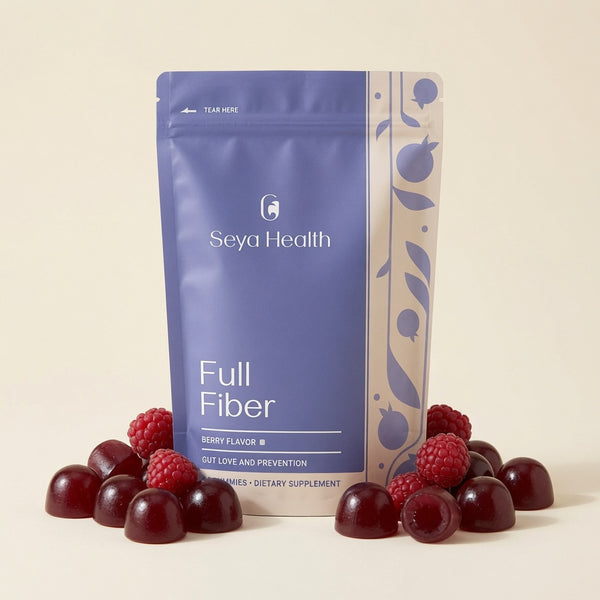
We make a vegan fiber gummy. Three gummies give you about 6 g of fiber. It supports regularity.*
None of the estrobolome studies above tested our gummy. We do not claim it changes your estrogen or your gut bacteria. It can help close part of your daily fiber gap. For more on fiber after 40, see fiber and gut health after 40.
Our creatine gummy is coming January 2027. It is not on sale yet.
*These statements have not been evaluated by the Food and Drug Administration. This product is not intended to diagnose, treat, cure, or prevent any disease.
Frequently asked questions
What is the estrobolome?
It is the group of gut bacteria and their genes that can process estrogen. Some of them make an enzyme that turns used estrogen back on, so your body can reabsorb it.
Is the estrobolome a real thing?
Yes. Lab work in 2019 showed gut bacterial enzymes can reactivate estrogen. How much it matters for health in people is still being studied.
How do gut bacteria turn estrogen back into its active form?
Your liver tags used estrogen for removal and sends it to your gut. Some bacteria cut that tag off with an enzyme called beta-glucuronidase. The freed estrogen can then pass back into your blood.
How does the estrobolome change in menopause?
In a study of 2,300 people, women after menopause had a less diverse gut and less of the estrogen-recycling enzyme than women before menopause.
Can probiotics increase estrogen?
No trial has shown that probiotics raise or lower estrogen levels in women. Claims that they do go beyond the evidence.
Can fiber support a healthy estrobolome?
Fiber has the best evidence of any food choice. In a 1982 study, women eating 28 g of fiber a day had less of the recycling enzyme in their stool than women eating 12 g.
Seya Full Fiber
Most women fall short on fiber. Seya Full Fiber gives you 6 grams from three fibers in three small vegan gummies. Plant based, no gelatin, no sugar alcohols.
Shop Full Fiber