Does creatine prevent muscle loss as you age? Not on its own. Creatine does not stop age-related muscle loss. But paired with strength training, it can help you build back more. In 22 trials of 721 older adults who lifted 2 to 3 days a week, creatine added about 1.37 kg more lean mass than lifting alone (Chilibeck, 2017).
- Creatine alone: little to no effect. A 2-year trial of 3 g a day in 200 older women found no muscle gain.
- Lifting alone: the proven base. It is what slows muscle loss.
- Lifting plus creatine: a small extra boost in strength and muscle.
- Also key: enough protein, about 1.0 to 1.2 g per kg of body weight a day after 65.
Last updated November 2026.
Most of us notice it in small ways first. A jar lid that will not budge. A grocery bag that feels heavier. Getting up from a low couch takes a push from your hands.
That is age-related muscle loss. It is normal, it is gradual, and you have more say over it than you might think.
Creatine gets a lot of buzz as the fix. The real answer is more useful than the hype. Creatine does not prevent muscle loss by itself. It helps you get more out of the one thing that does work. Here is what the trials show.

Does creatine prevent muscle loss?
No supplement can stop aging muscle on its own, and creatine is no exception. What it can do is help your muscles respond to training.
Creatine tops up a fast energy store in your muscles. With more of it, you can often push out an extra rep or two. Over months, those extra reps add up to a bit more muscle and strength.
That is why almost every positive trial in older adults pairs creatine with lifting. Take away the lifting and most of the benefit goes with it.
How fast do you lose muscle as you age?
Slowly at first, then faster. In a scan study of 468 adults aged 18 to 88, the drop in total muscle became clear around age 50. Most of it came from the legs (Janssen, 2000).
Strength fades faster than size. A review of long-term studies found that at age 75, women lose about 0.64 to 0.70% of their muscle each year. They lose strength at 2.5 to 3% a year (Mitchell, 2012).
That gap matters. Doctors now see low strength as the key sign of sarcopenia, the medical name for serious age-related muscle loss (Cruz-Jentoft, 2019). So the goal is not just to keep muscle. It is to keep it strong.
Does creatine slow muscle loss without exercise?
Barely, if at all. The longest trial gave 200 older women with thin bones either 3 g of creatine a day or a placebo for 2 years. Creatine did not add lean mass or improve muscle function (Sales, 2020).
A smaller trial hints at a tiny effect. Over 24 weeks, older women on creatine alone held their arm and leg muscle steady (+0.3%), while the placebo group lost a little (-1.2%). Their leg strength barely moved, though (Gualano, 2014).
So if you hoped to take a scoop and skip the gym, the evidence says no. If you cannot exercise at all, talk to your doctor about what you can do. Creatine alone is not a plan.
Prevent, slow, or rebuild? One trial shows the difference
The Gualano trial is useful because it tested all four options side by side. Sixty older women spent 24 weeks in one of four groups.
| Group | Arm and leg muscle | Leg press strength |
|---|---|---|
| Placebo, no lifting | -1.2% | +2.4% |
| Creatine, no lifting | +0.3% | +3.7% |
| Placebo plus lifting | -0.2% | +15% |
| Creatine plus lifting | +1.31% | +19.9% |
Source: Gualano, 2014. The jump in strength comes from lifting. Creatine plus lifting was the only group to clearly gain muscle, and the only group to beat all others on bench press (+10%).
Read it this way. Doing nothing lets muscle slip. Lifting holds the line and builds strength. Creatine on top helps you rebuild a little more.
What do the big reviews say about creatine and lifting?
They agree on the direction, and they are honest about the size. The 2017 review of 22 trials found more lean mass (+1.37 kg) and better chest and leg press strength with creatine (Chilibeck, 2017).
An earlier review of 357 older adults also found people did better on a 30-second chair stand test. That test tracks a real skill: getting up from a chair (Devries and Phillips, 2014).
The newest review is more cautious. It pooled 11 trials in adults 60 and older. Creatine gave a small strength boost, with moderate certainty. The gains in muscle mass and daily function did not reach statistical significance (Yao, 2026).
The fair summary: a small, real strength bonus, as long as you train. For the full grade of each benefit, see creatine for older adults.
How does creatine affect muscle breakdown?
Muscle is always being built and broken down. With age, the balance tips toward breakdown.
One study tested whether creatine shifts that balance. In young men, a week of creatine cut a marker of protein breakdown by about 20%. It did not change muscle building, and it had no effect in women (Parise, 2001).
That is a hint, not proof, and it was not done in older adults. The clearer path is still energy for training. More reps, over more weeks, means more muscle.
Does creatine help muscle atrophy after an injury?
It does not seem to stop the loss, but it may speed the comeback. When young men loaded creatine and then wore a leg cast for 7 days, they lost thigh muscle just as fast as the placebo group (Backx, 2017).
The rebuild looked different. In another trial, 2 weeks in a cast cut thigh muscle by about 10% in both groups. During 10 weeks of rehab, the creatine group regained size and power faster (Hespel, 2001).
Both studies were in young adults. Still, the pattern fits the rest of the evidence. Creatine helps most when muscles are working. For what happens when you stop taking it, see do you lose muscle when you stop taking creatine.
What actually protects muscle as you age?
Here is the order we would put things in, based on the strength of the evidence.
- Strength training, 2 to 3 days a week. Every trial above used it. It is the base everything else builds on. Bands, body weight, and machines all count.
- Enough protein. Experts advise at least 1.0 to 1.2 g per kg of body weight a day after 65, and 1.2 g or more if you are active. People with severe kidney disease are an exception (Bauer, 2013).
- Creatine as an add-on. Useful once the first two are in place. Not a stand-in for them.
If you are also trying to lose weight, the plan shifts a bit. Our guide to creatine after 50 while losing weight covers that case.
How much creatine do older adults take in trials?
Most trials use creatine monohydrate. The common daily dose for adults is 3 to 5 g, or about 0.1 g per kg of body weight (Antonio, 2021).
Dose may matter for older adults. In one review, doses over 5 g a day helped leg press strength. But that edge faded once loading studies were set aside. Taking creatine only on training days also worked (Forbes, 2021).
Recall the 2-year trial that found nothing: it used 3 g a day and no lifting. For tips on choosing a product, see the best creatine for older adults.
Is creatine safe for older adults?
In healthy people, creatine has a long safety record. Studies have run for years at normal doses without serious problems (Kreider, 2017).
Creatine can raise creatinine, a kidney lab value, without harming the kidneys. Tell your doctor you take it before blood work. Check with your doctor first if you have kidney disease or take several medicines. Our page on whether creatine is safe for women goes deeper.
Where Seya fits, honestly
Seya sells one product today: a fiber gummy that supports regularity. Our creatine gummy is coming January 2027. It is not on sale yet, and we will not share its dose, price, or ingredients until the formula is final.
We wrote this so you can weigh any creatine on the evidence. Creatine supports muscle strength when paired with resistance training. It is not a treatment for sarcopenia or any disease. This is education, not medical advice. Talk to a qualified clinician before you start any supplement.
These statements have not been evaluated by the Food and Drug Administration. This product is not intended to diagnose, treat, cure, or prevent any disease.
Frequently asked questions
Does creatine prevent muscle loss?
Not on its own. In a 2-year trial, 3 g a day without exercise did not add muscle in older women. Paired with strength training, creatine adds about 1.37 kg more lean mass than training alone.
Does creatine help muscle atrophy?
It does not seem to stop atrophy while a limb is in a cast. But in one trial, people on creatine regained muscle size and power faster during rehab.
Does creatine slow muscle loss?
Only a little without exercise, and not in every trial. With strength training it helps you build back muscle and strength, which is how age-related loss is slowed.
Can creatine reduce muscle loss in older adults?
Yes, alongside lifting. Reviews of older adults who trained 2 to 3 days a week found more lean mass and strength with creatine than with training alone. The extra gain is small.
Will creatine prevent muscle loss if I do not exercise?
Probably not. The best long-term trial without exercise found no gain in muscle or function. Strength training is the part that matters most.
How fast do you lose muscle as you age?
At age 75, women lose about 0.64 to 0.70% of their muscle a year and 2.5 to 3% of their strength. Loss usually becomes noticeable around age 50, mostly in the legs.
How much creatine should older adults take?
Most studies use 3 to 5 g of creatine monohydrate a day. Some trials in older adults used more. Ask your doctor first if you have kidney concerns.
What is the best way to protect muscle as you age?
Strength training 2 to 3 days a week, plus enough protein. Creatine can add a small extra boost on top of those two.
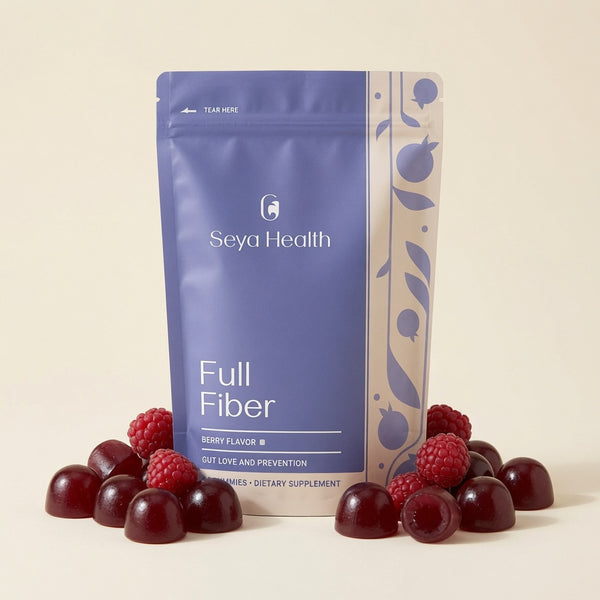
Seya Full Fiber
Most women fall short on fiber. Seya Full Fiber gives you 6 grams from three fibers in three small vegan gummies. Plant based, no gelatin, no sugar alcohols.
Shop Full Fiber