Home/ The Journal/ bloating
bloating
Menopause bloating: the foods that help (fiber) and the ones that make it worse

The short version: the best menopause bloating foods are oats, kiwifruit, yogurt, and home-cooked meals with less salt. The worst are fizzy drinks, sugar-free sweets, big servings of beans or cabbage, and salty food.
- In a trial of 412 adults, a high-salt diet raised the risk of bloating by 27%, on any diet.
- Kiwifruit beat psyllium for regular trips to the bathroom in a 2024 review of 23 studies.
- Fiber helps, but adding a lot at once can cause more gas. Go slow.
- You don't need to cut whole food groups. Portion size and timing do most of the work.
Last updated November 2026.
You eat the same lunch you've eaten for ten years.
By 3pm your waistband is tight. By dinner you feel like a balloon.
Nothing on your plate changed. Your hormones did.
The good news is that food is one of the easiest levers to pull. Some foods calm a bloated belly. Others reliably make it worse. Here's the list, with the reason behind each one.

Why does menopause make bloating worse?
Because your gut runs on the same hormones that are falling.
Most women start the menopause transition between ages 45 and 55. The average age of menopause in the US is 52. You reach it after a full year with no period.
Estrogen and progesterone drop a lot along the way. Those shifts can change how your gut moves and how much gas you notice.
In one study of 228 women, 48% of postmenopausal women reported extra gas. The study is small and old, but it matches what many women feel.
The full hormone story is in perimenopause bloating. The wider gut picture is in menopause digestive problems. This page is about the plate.
What are the best menopause bloating foods?
Foods that keep things moving without a big gas load. Here are six with real research behind them.
| Food | Why it helps | What the research shows |
|---|---|---|
| Kiwifruit | Soft fiber plus water; keeps stools regular | +0.36 bowel movements a week vs psyllium (review of 23 studies) |
| Oats | Beta-glucan, a soluble fiber that forms a gel | 3.5 g a day lowered LDL cholesterol (58 trials) |
| Prunes | Fiber plus sorbitol; draws water into the gut | 80 g a day: 6.8 vs 5.4 stools a week (120 adults), but more gas |
| Yogurt and hard cheese | Less lactose than milk | Many people handle 12 g of lactose, about 1 cup of milk (NIDDK) |
| Fermented foods | Feed a more varied gut | Raised gut bacteria variety over 17 weeks (36 adults) |
| Rye bread | More fiber than white bread | +0.43 bowel movements a week vs white bread |
Why do kiwifruit, prunes, and fermented foods stand out?
Kiwifruit is the standout. A 2024 review from King's College London pooled 23 studies of 1,714 people with chronic constipation. Fruit led to more bowel movements than psyllium, a common fiber supplement. Kiwifruit was the main driver, in 7 of the studies.
Prunes work, with a catch. In a 4-week trial of 120 adults, 80 g of prunes a day raised stool weight and frequency. Gas went up too. If gas is your main problem, start with a small handful and build up.
Fermented foods are a longer game. In a Stanford study, adults who ate more yogurt, kefir, kimchi, and similar foods for 17 weeks had more varied gut bacteria. It was small, 18 people per group, and it measured bacteria, not bloating.
Want more ideas? See soluble fiber foods and high-fiber foods for women over 40.
Which menopause bloating foods make it worse?
Foods that add gas, add air, or hold water.
The NIDDK, part of the National Institutes of Health, lists the usual gas makers. These carbs aren't fully digested, so gut bacteria break them down and make gas.
- Some fruit and juice: apples, peaches, pears, and fruit juice.
- Cabbage-family vegetables: broccoli, cauliflower, collard greens, kale.
- Beans, peas, and lentils.
- Milk products: milk, ice cream, and for some, yogurt.
- Whole wheat.
- Drinks with high-fructose corn syrup: soda, sports drinks, energy drinks.
- Sugar-free candy and gum with sweeteners that end in "-ol": sorbitol, mannitol, xylitol, erythritol, maltitol.
- High-fat meals, which can increase bloating.
Then there's air. NIDDK notes that you swallow more air when you drink fizzy drinks, chew gum, or eat too fast.
And there's salt. In the DASH-Sodium trial, 412 adults ate set diets for 30 days at a time. A high-salt diet raised the risk of bloating by 27%. That held on both the standard diet and the healthy one. Salty takeout, deli meat, and canned soup are the big sources.
Notice that many "bad" foods on this list are good for you. Beans, kale, and whole wheat aren't the enemy. The dose is. A deeper trigger list lives in foods to avoid when bloated.
Is fiber the problem or the fix?
Both. It depends on how fast you add it.
The same DASH-Sodium trial tested a high-fiber diet with 32 g a day against a low-fiber diet with 11 g. The high-fiber diet raised the risk of bloating by 41%. Cutting salt eased part of that.
One more detail stands out. The fiber effect on bloating was bigger in men than in women.
So fiber isn't a bloat food by nature. A sudden jump is. Adults need about 22 to 34 g of fiber a day. US women average about 15 g. Closing that gap over a few weeks, not a few days, gives your gut bacteria time to adjust.
Two simple rules. Add a little fiber at a time. Drink more water as you go. More on that in can you eat too much fiber?
What are the health benefits of oats?
Oats bring a soluble fiber called beta-glucan. In the gut it turns into a thick gel.
That gel is gentle on a bloated belly compared with rough bran. It also does work beyond your gut. A review of 58 trials with 3,974 people found that about 3.5 g of oat beta-glucan a day lowered LDL, the "bad" cholesterol, by 0.19 mmol/L. That's a modest drop, but it adds up with other habits.
Plain rolled or steel-cut oats are the simplest pick. Flavored packets often add sugar.
How does soluble fiber affect blood sugar?
It slows how fast sugar from a meal reaches your blood.
The same gel that makes oats thick slows digestion. A review of 28 trial comparisons in 1,394 people with type 2 diabetes tested viscous (gel-forming) fiber at about 13 g a day. It lowered HbA1c, a 3-month blood sugar marker, by 0.58 points. Fasting blood sugar fell too.
That was in people with diabetes, on top of their usual care. It doesn't mean fiber replaces medicine. It does mean oats, beans, and psyllium pull more weight than they get credit for. More in fiber and blood sugar after 40.
Does curcumin help with bloating?
Maybe for indigestion. The bloating evidence is thin.
Curcumin is the main compound in turmeric. In a 2023 Thai trial, 206 people with functional dyspepsia, a type of ongoing indigestion, took curcumin, omeprazole (an acid reducer), or both for 28 days. Symptoms improved about the same in all three groups.
Two limits. There was no placebo group, and indigestion isn't the same as gas bloating. The dose was also high: two 250 mg capsules, four times a day.
Safety matters here. The NCCIH says regular turmeric or curcumin is likely safe for up to 2 or 3 months, but it can cause acid reflux and stomach upset. Liver damage has been reported with some "high-absorption" curcumin products. Turmeric in your cooking is a different, much smaller amount. Ask your doctor before a supplement, especially if you take medicine.
What's an easy swap list?
Small swaps beat big cuts. Try one or two at a time for a week each.
| Instead of | Try | Why |
|---|---|---|
| Soda or sparkling water | Still water or warm tea | Less swallowed air |
| Sugar-free gum or candy | A piece of fruit | No "-ol" sweeteners, less air |
| An apple or pear | A kiwifruit or two | Fewer gas-making carbs, strong regularity data |
| A glass of milk | Yogurt or lactose-free milk | Less lactose per serving |
| A big bowl of beans | A half cup, more often | Smaller gas load, same fiber over the week |
| Salty takeout | A home-cooked meal with less salt | High salt raised bloating risk 27% |
A food diary helps. Write down what you ate and how you felt 2 to 4 hours later. Patterns show up fast.
When is bloating a warning sign?
When it's new, it lasts, and it comes with other changes.
See a doctor if bloating shows up most days for a few weeks, or comes with feeling full fast, pelvic or belly pain, blood in your stool, or weight loss you can't explain. Ovarian cancer can cause bloating, and about 7 in 10 new cases are in women 55 and older, per the National Cancer Institute's SEER data. The National Cancer Institute's guide lists the signs. Our checklist is in bloating after 50: when to see a doctor.
Where does a fiber gummy fit?
As a small, steady add-on to a food-first plate. Not as the plan.
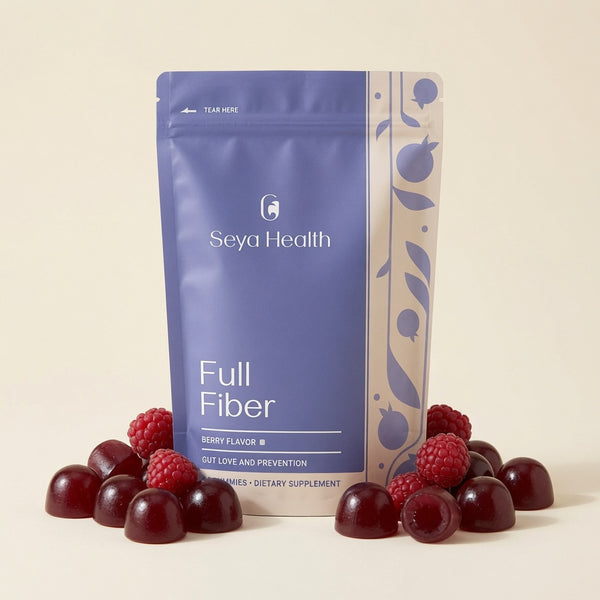
We make a fiber gummy, so here are the numbers. 3 Seya gummies give you 5,650 mg of dietary fiber. That's 5.65 g, or 16% of the Daily Value. It's 4,500 mg of resistant tapioca fiber, 950 mg of prebiotic soluble fiber, and 200 mg of cellulose, plus 80 mg of magnesium as magnesium citrate and 100 mg of ginger root.
The honest limit: most fiber trials that worked used more fiber than this. A gummy can help close part of the gap and support regularity. Kiwifruit, oats, beans, and vegetables should still do most of the work. If you're new to fiber, the same slow-start rule applies to gummies.
This is education, not medical advice. Talk to a clinician about new gut symptoms, and before starting any supplement, especially if you take medication or use hormone therapy.
These statements have not been evaluated by the Food and Drug Administration. This product is not intended to diagnose, treat, cure, or prevent any disease.
Frequently asked questions
What is menopause, and why does it bring bloating?
Menopause is the point when you've gone a full year without a period. The average age in the US is 52. Estrogen and progesterone fall, and both affect how your gut moves and handles gas. In one study, 48% of postmenopausal women reported extra gas.
What are the stages of menopause?
Perimenopause is the transition, often starting between 45 and 55, when periods get irregular. Menopause is one full year without a period. Postmenopause is every year after that. Bloating can show up in any stage.
What foods help menopause bloating?
Kiwifruit, oats, yogurt, rye bread, and fermented foods, plus meals with less salt. Kiwifruit beat psyllium for regularity in a 2024 review of 23 studies. Prunes help regularity too but can add gas.
What foods make menopause bloating worse?
Fizzy drinks, sugar-free gum and candy, large servings of beans or cabbage-family vegetables, milk if you're sensitive to lactose, high-fat meals, and salty food. In a trial of 412 adults, high salt raised bloating risk by 27%.
What are the health benefits of oats?
Oats contain beta-glucan, a soluble fiber that forms a gel in the gut. A review of 58 trials found about 3.5 g of oat beta-glucan a day lowered LDL cholesterol by 0.19 mmol/L.
How does soluble fiber affect blood sugar?
Gel-forming soluble fiber slows digestion, so sugar enters your blood more slowly. In people with type 2 diabetes, about 13 g a day lowered HbA1c by 0.58 points across 28 trial comparisons.
Does curcumin help with bloating?
The evidence is thin. A 2023 trial found curcumin helped indigestion about as much as omeprazole, but it had no placebo group and didn't test gas bloating. Curcumin supplements can cause reflux, and liver damage has been reported with some high-absorption forms.
Seya Full Fiber
Most women fall short on fiber. Seya Full Fiber gives you 6 grams from three fibers in three small vegan gummies. Plant based, no gelatin, no sugar alcohols.
Shop Full Fiber