
Home/ The Journal/ bone health
bone health
Women aren't smaller men: how strength training should really differ for women (per Dr. Stacy Sims' research)

Short version: Women aren't smaller men, but the core of strength training is the same. In a review of 10 studies, women and men on the same program gained muscle at similar relative rates. The real differences are your starting point, your upper body, and your life stage.
- Same rules: lift on 2 or more days a week, and add load over time.
- Women gained more relative upper-body strength than men across 17 pooled studies, so do not skip it.
- Training by cycle phase has weak support. Dr. Stacy Sims says so too.
- After menopause, heavy supervised lifting raised spine density 2.9% in one 8-month trial.
Last updated November 2026.
You picked up the pink dumbbells. You did 3 sets of 15. You were told that was the women's version.
It never was. It was a guess.
So here is the honest split: what really differs for women, and what is just a slogan with a nice ring to it.
Why do people say women aren't smaller men?
Because the advice was built on men and passed down to women. The line was made famous by Dr. Stacy Sims, an exercise physiologist and author of the book ROAR.
"[A]lmost all the stuff you know with exercise and nutrition has been based on male data and generalized to women." Dr. Stacy Sims, on Dr. Mark Hyman's podcast
She has a point. A 2014 review on fatigue names the habit of studying more males than females as a reason we still understand sex differences so poorly. We dug into that wider gap in why women's health is decades behind.
But "the research skipped you" and "you need a different program" are 2 separate claims. The first is well supported. The second is where it gets interesting.
How should strength training differ for women?
Less than the slogan implies. The best direct test is a 2020 meta-analysis of men and women, young to middle-aged, on the same programs.
| Outcome | Studies | Result |
|---|---|---|
| Muscle growth | 10 | No significant difference |
| Lower-body strength | 23 | No significant difference |
| Upper-body strength | 17 | Larger relative gain in women |
So your muscle does not need a special women's rulebook. It needs a load heavy enough to matter.
The gap shows up elsewhere. Women have about 70% of men's lean mass and about 60% of their upper-body mass, per a 2025 review of women's resistance training. Those are averages. They set your starting line, not your limit.
That gives you 3 changes worth making:
- Train your upper body on purpose. It starts furthest behind and has responded best. Rows, presses, and pull-downs earn their place.
- Try shorter rests on smaller moves. In a review of fatigue research, women generally tired less than men in sustained holds at the same relative effort. The finding depends on the task, so test it. The 2025 review still advises at least 2 to 3 minutes for heavy lifts.
- Pick your load for you. Use your own strength as the guide, not a chart or a color.
Should you train by your menstrual cycle?
The evidence does not support a rule. This one surprises people, because it is often credited to Dr. Sims. Asked about phase-based training, she pushed back.
"[T]here's not enough robust evidence," Dr. Sims told Dr. Hyman, adding that "there's no such thing as a twenty eight day menstrual cycle."
The data agree. A meta-analysis of 78 studies found performance might dip a trivial amount early in the cycle, with study quality rated low. Its authors said no general guideline could be formed and advised a personal approach. A 2023 umbrella review called it premature to say that short-term hormone swings appreciably change strength or muscle gains.
So you did not ruin anything by squatting on day 2. Feel flat? Go lighter that day. That is listening to your body, and it does not need an app.
Does lifting heavy make women bulky?
Not by accident. Men have more than 15 times the circulating testosterone of women, per a 2018 review in Endocrine Reviews, and muscle mass tracks that hormone. Women still gain at similar relative rates, but from a smaller base.
Fear of looking "too bulky" has long kept women away from strength work, the 2025 review notes. You also set the program, so you can change it whenever you like.
The bigger risk is the opposite one. Only about 1 in 4 US adults meet the aerobic and muscle-strengthening guidelines, per Healthy People 2030.

How heavy should women lift, and how often?
Start at 2 days a week, then build. The US Physical Activity Guidelines ask adults for muscle-strengthening work of moderate or greater intensity, for all major muscle groups, on 2 or more days a week.
Dr. Sims aims higher. She described "heavy loads, 80% of what you think you can do, five or six reps" to Dr. Hyman. On Rich Roll's podcast, she called 2 heavy lifting sessions plus 2 hard interval sessions a week "great." That is her coaching view. It is not a tested women's minimum, and it is a target, not a day-1 plan.
If you are new, try this:
- Weeks 1 to 4: Learn a squat, hinge, push, and pull at a weight you could lift 12 to 15 times.
- Weeks 5 to 8: Add weight until 8 to 10 reps feels hard.
- After that: If your form holds, try some sets of 5 or 6.
Treat this as our suggested on-ramp, not a studied protocol. A coach can check your form in one session.
What changes for women after 40 and menopause?
The case for heavier work gets stronger, and bones become part of the reason.
The LIFTMOR trial tested this directly in 101 postmenopausal women with low bone mass, average age 65. One group did 30 minutes of supervised lifting and impact work, twice weekly, for 8 months, with loads above 85% of their 1-rep max. The other group did low-intensity home exercise.
| Measure | Heavy lifting | Home exercise |
|---|---|---|
| Spine bone density | +2.9% | -1.2% |
| Hip (femoral neck) density | +0.3% | -1.9% |
| Height | +0.2 cm | -0.2 cm |
A follow-up analysis found no increase in spine fracture risk from the training. Still, keep this in proportion. It was one supervised trial, and a 2025 review says we do not yet know how long the gain lasts or how safe it is after a recent fracture. If you have low bone density, talk to your doctor first and do not copy this alone.
Going further: see the signs of muscle loss, how exercise affects menopause belly, and sleep, muscle, and fiber after 40. Curious about supplements? We cover the evidence on creatine for women. Seya's creatine gummy is coming January 2027. Lifting does the heavy work either way.
Frequently asked questions
How should women's workouts differ from men's?
Less than most advice suggests. The basics are the same: lift on 2 or more days a week, and add load over time. What should differ is the starting point, the upper-body focus, and your life stage. Trials found similar relative muscle growth in men and women on the same program.
What is the main difference in fitness for women versus men?
Starting size. Women have about 70% of men's lean mass and about 60% of their upper-body mass, on average. Men also have more than 15 times the circulating testosterone. How fast you improve from your own starting point is much closer.
Does strength training make women too muscular?
Very unlikely by accident. Men have more than 15 times women's circulating testosterone, and muscle mass tracks it. Women do grow at similar relative rates, but from a smaller base. You also control the program, so you can change it if you gain more than you want.
What are the key benefits of exercise for women over 40?
Stronger muscles, better function, and support for bones. A 2025 review reports 1% to 3% gains in bone density from resistance training in some studies. Dr. Sims also names the brain and bones as midlife reasons to lift.
How do you get fit after menopause?
Start with 2 strength days a week and build the load slowly. In the LIFTMOR trial, women with low bone mass, average age 65, trained twice weekly for 8 months with supervision. Their spine density rose 2.9%. Ask your doctor first if you have low bone density.
Can you exercise during menstruation?
Yes. Performance may dip a little in the first days, but the effect in a review of 78 studies was trivial. If you have painful periods, exercise may help. A 2026 review of 29 studies found less pain, though the evidence was low certainty. Go by how you feel.
These statements have not been evaluated by the Food and Drug Administration. This product is not intended to diagnose, treat, cure, or prevent any disease. This article is educational and is not medical advice. Talk to your clinician before starting a new exercise program, especially if you have low bone density, an injury, or a health condition.
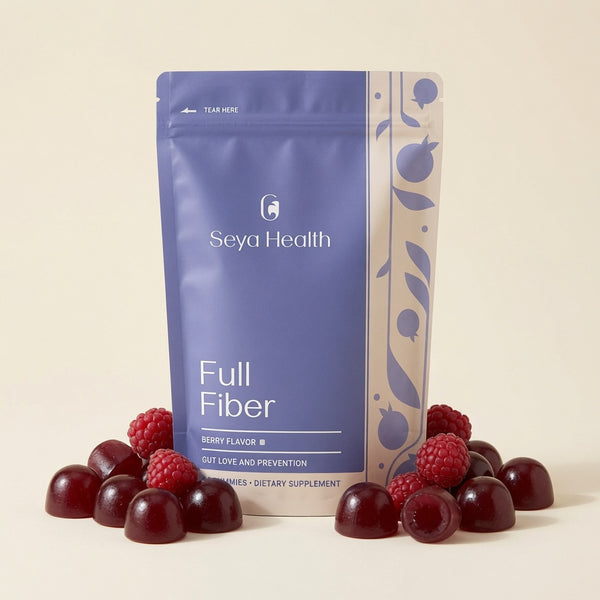
Seya Full Fiber
Most women fall short on fiber. Seya Full Fiber gives you 6 grams from three fibers in three small vegan gummies. Plant based, no gelatin, no sugar alcohols.
Shop Full FiberKeep reading

bone health
Best supplements for women over 40: what the evidence supports for heart, bones and muscles (and what's hype)

creatine
How long does creatine take to work? A realistic timeline for women

constipation