
Home/ The Journal/ comparisons
comparisons
The best fiber supplement for constipation: psyllium, powders, and gummies compared

Short version: The best fiber supplement for constipation is psyllium husk. In a 2022 review of 16 trials, 66% of people on fiber got better, vs 41% on control. Psyllium was one of only two fibers that clearly helped. The catch: it took more than 10 g a day, for at least 4 weeks.
- Best proof: psyllium powder or capsules.
- Food option that beat psyllium in one trial: prunes.
- Not a fiber, but well studied: magnesium oxide.
- Gummies: easy to take, but lower doses and less trial data. That includes ours.
Last updated November 2026. We make Seya, a tapioca-fiber gummy, so weigh our picks with that in mind.
You are stuck. You have tried more water and more salad. Now you are in the store aisle, looking at a wall of tubs, capsules, and gummies.
They all say "fiber." They do not all do the same job.
We sorted the main options by one question: what does the research say about constipation? Not cholesterol, not appetite. Just this. Here is what we found, including where our own gummy ranks.
What counts as constipation?
Doctors usually mean fewer than three bowel movements a week. Per the NIDDK, stools may also be hard, dry, or lumpy, and hard or painful to pass. You may feel like you didn't finish.
Common causes include low fiber, too little fluid, less movement, travel, pregnancy, and some medicines. Iron pills, opioids, and some antacids are on that list. Our guide to medications that cause constipation goes through them.
See a doctor if you have blood in your stool, weight loss you can't explain, or pain that won't quit. The Metamucil label also says to ask a doctor first if a sudden change in bowel habits has lasted 2 weeks. Fiber is for the everyday kind of stuck, not for warning signs.
The best fiber supplement for constipation, compared
Here is the short list. "Evidence" means trials in people with constipation, not lab studies or claims on the box.
| Option | Example | Per serving | Evidence for constipation | Main downside |
|---|---|---|---|---|
| Psyllium husk | Metamucil powder, store brands | About 3.4 g husk | Strongest of the fibers | Thick gel, needs water |
| Methylcellulose | Citrucel | 2 g per tablespoon | Some, much less than psyllium | Low dose per scoop |
| Wheat dextrin | Benefiber | 3 g per 2 tsp | Limited | Ferments, weak bulking |
| Inulin gummies | Metamucil Fiber Gummies | 5 g per 3 gummies | Limited | Gas |
| Tapioca-fiber gummy | Seya Full Fiber | About 6 g per 3 gummies | Limited, grade C | Under the studied dose |
| Prunes | Dried plums, 50 g twice a day | 6 g fiber a day | Beat psyllium in one trial | Calories and sugar |
| Magnesium oxide | OTC tablets | Varies | Good, in a placebo trial | Check first if you have kidney disease |
Label figures come from the Metamucil and Citrucel DailyMed labels and the NIH label database for Benefiber and Metamucil gummies. Formulas change, so check the bottle you buy.
Does fiber actually help constipation?
Yes, but the dose and the type both matter a lot.
The best summary is a 2022 meta-analysis in the American Journal of Clinical Nutrition. It pooled 16 randomized trials with 1,251 adults who had chronic constipation. Of the people taking fiber, 311 of 473 got better. On control, 134 of 329 did.
Three details stand out:
- Type: psyllium and pectin had clear effects. Other fibers did not reach that bar.
- Dose: results showed up with more than 10 g of fiber a day.
- Time: stool frequency improved with 4 weeks or more, not a few days.
Gas was more common on fiber, too. That is the trade-off.
The 2023 AGA and ACG guideline on chronic constipation agrees, carefully. It gives fiber a conditional recommendation based on low-certainty evidence. It gives stronger backing to polyethylene glycol, the drug in MiraLAX. So fiber is a sound first step, not a sure thing.
Why is psyllium the top pick?
Because of how it behaves in your colon.
A 2017 review by fiber researcher Johnson McRorie explains it well. Only two kinds of fiber have a real laxative effect. One is coarse insoluble fiber, like wheat bran, which nudges the gut wall. The other is gel-forming soluble fiber, like psyllium, which holds onto water. Both have to resist being eaten by gut bacteria, so they make it to your stool intact.
Psyllium does that. Its gel keeps stool soft and bulky. Fibers that ferment fast, like inulin and wheat dextrin, mostly get used up before the end of the colon. The review says they do not give a laxative effect.
Psyllium also beat a common stool softener head to head. In a 1998 double-blind trial of 170 adults, psyllium twice a day raised stool water and stool weight more than docusate. By week 2, people on psyllium had 3.5 bowel movements a week, vs 2.9 on docusate.
For more on gel vs non-gel fibers, see how fiber supplements work.
What about Citrucel and Benefiber?
Both are fine products. Neither has psyllium's track record for constipation.
Citrucel uses methylcellulose. It is a non-fermenting fiber. But one tablespoon gives 2 g of fiber. To reach the 10 g range from the trials, you would need several scoops a day.
Benefiber uses wheat dextrin. It dissolves clear and has no taste, which people love. But it is a fast-fermenting fiber. Per the McRorie review, that type does not bulk stool the way a gel does.
If you picked one of these and it isn't working after a few weeks, the fiber type may be the reason. Our Metamucil alternatives guide compares the labels in more detail.

Are prunes better than a fiber supplement?
In one trial, yes. It is a fair option if you would rather eat food than take a powder.
A 2011 randomized crossover trial tested 40 adults with constipation, 37 of them women. Each person spent 3 weeks on prunes and 3 weeks on psyllium. Both gave 6 g of fiber a day. Prunes meant 50 g twice a day.
Prunes won on complete bowel movements and stool softness. Straining and overall relief were about the same. Both were well tolerated.
The trial was small and short, so treat it as one good data point. The trade-off with prunes is calories and natural sugar. Our guide to foods that ease constipation covers kiwi, prunes, and more.
Is magnesium better than fiber for constipation?
It works in a different way, and it has good trial data.
Magnesium oxide is an osmotic. It draws water into the bowel. In a 2021 placebo-controlled trial of 90 adults, 93% of them women, 1.5 g of magnesium oxide a day for 28 days helped 68.3% of people. Placebo helped 11.7%. Senna, a stimulant laxative, helped 69.2%.
The AGA and ACG guideline gives magnesium oxide a conditional recommendation, like fiber. It is not right for everyone. If you have ever had kidney disease, MedlinePlus says to tell your doctor before you take a magnesium laxative.
Fiber and magnesium are not either-or. Many people use fiber every day and keep magnesium for slow weeks. Our magnesium citrate guide explains forms and timing.
Do probiotics help constipation?
Some strains may. The evidence is thinner and depends on the strain.
A 2014 meta-analysis pooled 14 randomized trials with 1,182 adults. On average, probiotics sped up gut transit by 12.4 hours and added 1.3 bowel movements a week. The clearest results were for Bifidobacterium lactis. The authors called for more trials before firm advice.
The AGA and ACG constipation guideline did not include probiotics. So if you try one, pick a product that names the strain, give it 4 weeks, and judge it on your own results.
Do fiber gummies relieve constipation?
They help you add fiber. They are not the strongest tool for constipation.
Here is the honest math. Most fiber gummies give 4 to 6 g per serving. The trials that worked used more than 10 g a day. And most gummies use fermentable fibers like inulin, not psyllium. That includes Metamucil's own gummies.
That doesn't make gummies useless. Fiber you take every day beats fiber you skip. If powders make you gag, a gummy plus fiber-rich food can close a real part of your gap. Just set your hopes to "supports regularity," not "fast fix."
For brand-by-brand labels, see our fiber gummy comparison.
How do you start fiber without more bloating?
Go slow. Sudden fiber is the main reason people quit.
- Week 1: start with about half the label serving once a day.
- Week 2: move to the full serving if your gut feels okay.
- Water: take each dose with a full glass. The Metamucil label warns that taking it without enough fluid can cause choking.
- Timing: take fiber 2 or more hours before or after other medicines, as the Metamucil label advises.
- Judge at 4 weeks: that is how long the trials ran before results showed.
Some gas in the first week or two is normal. Pain, vomiting, or no bowel movement for several days is not. Call your doctor.
Where does Seya fit, honestly?
Seya Full Fiber is a vegan gummy. Three gummies give about 6 g of fiber: 4,500 mg of resistant tapioca fiber, 950 mg of prebiotic soluble fiber, and 200 mg of cellulose. It also has 80 mg of magnesium and 100 mg of ginger root.
On constipation evidence alone, it is not our top pick. Psyllium is. We would rather tell you that than oversell. At this dose, the fair claim is that our gummy supports regularity and helps fill your daily fiber gap. It suits people who want a daily habit with no gel and no sugar alcohol. If that is you, here is our fiber gummy. If you want the most proof per dollar, buy psyllium.
This is education, not medical advice.
These statements have not been evaluated by the Food and Drug Administration. This product is not intended to diagnose, treat, cure, or prevent any disease.
Frequently asked questions
Which type of fiber is best for constipation?
Gel-forming soluble fiber, mainly psyllium. A 2022 meta-analysis of 16 trials found psyllium and pectin were the fibers with clear effects. It took more than 10 g a day for at least 4 weeks. Fast-fermenting fibers like inulin and wheat dextrin bulk stool much less.
What is a randomized controlled trial, and why does it matter?
It is a study where people are split by chance into groups. One group gets the fiber, another gets a placebo or a different option. Because chance decides who gets what, the trial can show whether the fiber caused the change. Label claims and reviews from buyers can't do that.
Does the type of fiber matter for blood sugar?
Yes. Thick, gel-forming fibers like psyllium and oat beta-glucan can slow how fast sugar is absorbed. Thin fibers like inulin and wheat dextrin do not have that effect, per a 2017 review. Our post on fiber gummies and blood sugar goes deeper.
Is fiber used for constipation or diarrhea?
Both, in the case of psyllium. Its gel holds water, so it softens hard stool. It can also firm up loose stool by soaking up extra water. That is why a 2017 review describes psyllium as normalizing stool form, for both constipation and diarrhea.
Should you increase fiber for constipation?
Usually, yes, and slowly. Only about 5% of Americans meet fiber advice, per a 2017 review. Add a few grams a week, drink water with each dose, and give it about 4 weeks. If you still have trouble, or have warning signs like blood in your stool, see a doctor.
Does tapioca fiber help you poop?
It adds fiber, but it has little trial data for constipation. Resistant tapioca fiber is fermented by gut bacteria, so it acts more like a prebiotic than a bulking gel. It can support regularity as part of your daily fiber. For the strongest constipation results, psyllium has more proof.
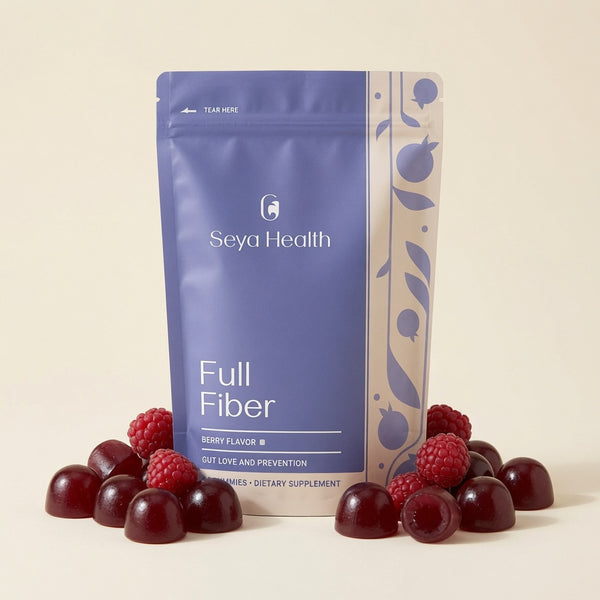
Seya Full Fiber
Most women fall short on fiber. Seya Full Fiber gives you 6 grams from three fibers in three small vegan gummies. Plant based, no gelatin, no sugar alcohols.
Shop Full FiberKeep reading

bone health
Best supplements for women over 40: what the evidence supports for heart, bones and muscles (and what's hype)

creatine
How long does creatine take to work? A realistic timeline for women

constipation