
Home/ The Journal/ fiber
fiber
Fiber Supplements for Women Over 40: How They Work and How to Choose One

Short version: Fiber supplements for women over 40 work by adding the fiber your food left out. The gap is bigger than you think. Women need about 25 g of fiber a day, and more than 90% of US women fall short. Not every supplement does the same job, so the fiber type and the dose matter more than the label.
- Women need about 25 g of fiber a day, dropping to about 21 g after 50, per the National Academies. More than 90% of US women miss it.
- Gel-forming soluble fiber, like psyllium, has the strongest clinical evidence. Fermentable prebiotic fiber, like resistant tapioca, feeds gut bacteria and supports regularity.
- What to look for: a named fiber, a real dose you can read on the label, and a format you will actually take every day.
Last updated August 2026.
You keep hearing you should take fiber. Nobody tells you which one, or why.
So here is the plain version. Fiber supplements for women over 40 work by adding the fiber your food left out. And the gap is wide. Women need about 25 g of fiber a day, yet more than 90% of US women fall short, most of them by roughly half, per Thompson, Nutrients, 2021 (PMID 34836289).
That gap is not a willpower problem. It is a math problem, and math you can fix on purpose.
This guide covers how these supplements work, whether you need one after 40, and how to pick one without wasting money.
How do fiber supplements work?
They replace fiber your diet is short on, then do one of two jobs in your gut.
The first job is physical. Soluble fiber pulls in water and forms a gel. That gel slows how fast food leaves your stomach, which steadies blood sugar and keeps you full longer. As the National Library of Medicine puts it plainly:
"Soluble fiber attracts water and turns to gel during digestion. This slows digestion." — MedlinePlus, National Library of Medicine
The second job is fermentation. Some fibers pass through undigested and reach the colon, where your gut bacteria eat them and make short-chain fatty acids that feed the gut lining, per Wong et al., Journal of Clinical Gastroenterology, 2006 (PMID 16633129). That is what "prebiotic" means. We go deeper on the mechanism in how fiber supplements actually work.
One supplement can do one job well, or both a little. That is the whole reason type matters.
Are fiber supplements for women over 40 worth it?
For most women, yes, but as a backstop to food, not a replacement for it.
Here is what changes after 40. Digestion slows, hormones shift toward perimenopause, and constipation and bloat get more common. At the same time your fiber target barely moves. It sits near 25 g a day in your 40s and about 21 g after 50, because the goal is tied to calories, per the National Academies.
If you already hit 25 g from food, you do not need a supplement. Almost no one does. A supplement earns its place on the days the food falls short, which for most women is most days.
And when the label promises more than regularity, be skeptical. That pull toward the fridge or the scale is a signal, not a character flaw, and no gummy erases it.
What are the main types of fiber, and which does what?
Three buckets. They are not interchangeable, and the label rarely explains the difference.
| Fiber type | How it works | Best for |
|---|---|---|
| Gel-forming soluble (psyllium, beta-glucan) | Forms a thick gel, slows digestion | Cholesterol, blood sugar, stool form |
| Fermentable prebiotic (resistant tapioca, inulin) | Feeds gut bacteria, makes short-chain fatty acids | Regularity, gut health |
| Insoluble (wheat bran) | Adds bulk, speeds transit | Moving things along |
Read that middle row twice. Resistant tapioca, the fiber in Seya's gummy, is a fermentable prebiotic. It supports regularity and feeds your gut bacteria. It is not the gel-forming type studied for cholesterol.
Being honest about that is the point. A supplement that names its fiber lets you match it to your goal. For the soluble side of this split, see soluble vs insoluble fiber for a woman's gut.
How do you choose a good fiber supplement?
Ignore the front of the package. Judge four things on the back.
- A named fiber. The label should say the actual ingredient, like resistant tapioca fiber or psyllium husk. "Proprietary blend" hides the dose.
- A dose you can read. Look for the grams of fiber per serving. If you cannot find the number, that is your answer.
- A format you will take daily. The best fiber is the one you do not quit. A gummy you enjoy beats a gritty powder you skip.
- Third-party testing. A supplement tested by an outside lab tells you what is really in the bottle.
Notice what is not on that list. Not the color, not the marketing, not whether it says it was made for women. What matters is the fiber, the dose, and whether you keep taking it. For a format-by-format look, see the best fiber gummies for women.
Which soluble fiber has the most evidence?
Psyllium, by a wide margin, for the cholesterol and blood-sugar side of fiber.
The clinical reason comes down to physics. A gel-forming fiber that stays intact through the gut does the most measurable work. As fiber researcher Johnson McRorie writes in Nutrition Today:
"Only a soluble, gel-forming, nonfermented fiber ... provides all of the health benefits typically associated with a fiber supplement." — McRorie, Nutrition Today, 2015
For regularity specifically, the picture is broader. In a meta-analysis of fiber for chronic constipation, 66% of people responded to fiber versus 41% on control, with psyllium doses above 10 g a day over at least 4 weeks working best, per van der Schoot et al., American Journal of Clinical Nutrition, 2022 (PMID 35816465).
For heart numbers, the bar is set by the US FDA, which lets foods claim a lower risk of heart disease only at 7 g or more of soluble fiber a day. We cover that in flaxseed vs psyllium for perimenopause.
Where Seya fits, honestly
Seya sells one product. A vegan fiber gummy.
It delivers about 5 g of fiber a day from resistant tapioca fiber, a fermentable prebiotic. That is a real slice of a 25 g target, and at that dose the honest claim is that it supports regularity. Nothing louder. It is not a gel-forming psyllium dose, and we will not pretend it is.
What Seya is built for is the gap. Three gummies you will actually take, a named fiber you can read on the label, and a dose we print instead of hide. For more on the ingredient, see resistant tapioca starch vs other starches.
Start low, go up slowly, and drink water as you climb. Any new fiber can make you gassy for a few days while your gut bacteria adjust. That is fermentation doing its job, not a sign something is wrong.
This is education, not medical advice. Talk to a qualified clinician before starting a fiber supplement, especially if you have a gut condition or take medication that affects digestion.
These statements have not been evaluated by the Food and Drug Administration. This product is not intended to diagnose, treat, cure, or prevent any disease.
Frequently asked questions
How do fiber supplements work?
Fiber supplements work by adding fiber your diet is missing, then doing one of two jobs. Soluble fiber pulls in water and forms a gel that slows digestion, which steadies blood sugar and keeps you full. Fermentable prebiotic fiber passes to the colon, where gut bacteria eat it and make short-chain fatty acids that feed the gut lining and support regularity. Some fibers do one job, some do a bit of both, which is why the fiber type on the label matters.
Should women over 40 take a fiber supplement regularly?
Most women benefit from one as a daily backstop, because more than 90% of US women fall short of the roughly 25 g daily target, and the gap widens as digestion slows after 40. A supplement is not required if you already reach the target from food. When food falls short, which is most days for most women, a daily fiber supplement helps close the last few grams. It supports regularity and is not a substitute for a balanced diet.
What should you look for in a good fiber supplement?
Look at the back of the label for four things: a named fiber such as resistant tapioca fiber or psyllium husk rather than a "proprietary blend," the grams of fiber per serving so you know the real dose, a format you will actually take every day, and third-party testing that confirms what is in the bottle. The color, the marketing, and a "for women" badge tell you nothing about whether the fiber works.
Which is the best soluble fiber supplement?
For cholesterol and blood-sugar support, gel-forming soluble fibers like psyllium and beta-glucan have the strongest clinical evidence, because a gel that stays intact through the gut does the most measurable work. For regularity, a wider range of fibers helps, with soluble fiber doses above 10 g a day over at least 4 weeks working best in trials. The best one for you is the type matched to your goal in a format you will keep taking.
Related reading
- How Much Fiber Do Women Actually Need? Grams by Age, and Why It's More Than You Think
- What Is a Letter of Medical Necessity? (And How to Get One)
Seya Full Fiber
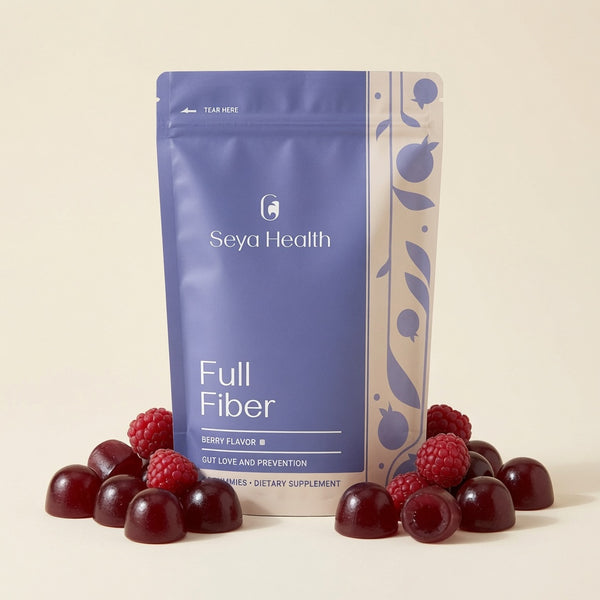
Getting enough fiber from food every day is hard. Seya Full Fiber is 6 grams from three fibers in one, in three small gummies, so you have a reliable daily floor. Plant based, no gelatin, no sugar alcohols, 60 gummies per pouch.
Shop Full FiberKeep reading
fiber
Can a Multivitamin Replace Vegetables? What Supplements Can't Do for Your Gut

constipation
The Best Way to Beat Constipation in Your 30s (and Where Fiber Gummies Fit)
fiber
The Gut-Skin Axis: Does Your Gut Health Affect Your Skin?
The gut-skin axis, explained: how your gut bacteria and blood sugar affect your skin, w...