Home/ The Journal/ bloating
bloating
Digestive Enzymes vs Fiber for Bloating After 50: Which One Does Your Gut Need?

Short version: Digestive enzymes vs fiber for bloating after 50 comes down to the cause. An enzyme helps only when you lack that exact enzyme, like lactase for milk sugar. Fiber works on a different problem, a slow gut. Bloating is common: 16% to 31% of people have it, per the NIDDK.
- Enzymes target one trigger. Lactase is for lactose. Alpha-galactosidase is for beans and similar foods.
- A general enzyme blend has little placebo-controlled bloating research behind it that we could verify.
- Fiber can ease a stalled gut, and soluble fiber has trial support in IBS. It can also add gas for the first few weeks.
- New or lasting bloating after 50 deserves a clinician's look before you buy anything.
Last updated October 2026.
Your waistband fits at 8am. By 4pm it does not.
So you stand in the supplement aisle and wonder: digestive enzymes vs fiber for bloating after 50, which one? Here is the plain answer. Neither is a magic fix, and they do very different jobs. About 20% of Americans said they had bloating in the past week, and women were more likely than men to report gut symptoms, per Almario et al., American Journal of Gastroenterology, 2018 (PMID 30323268).
This guide shows what each one does, what the research says, and how to pick a first step.
Why do you get bloated in the first place?
Bloating is usually gas, trapped gas, or a gut that moves slowly. Not a lack of effort on your part.
The NIDDK explains the main route this way:
"Undigested carbohydrates will pass to your large intestine, where bacteria break them down and create gas." — NIDDK, National Institutes of Health
That is chemistry. It is a signal, not a character flaw.
The causes stack up, too. A 2021 review by Lacy and colleagues (PMID 32246999) lists food intolerances, a past gut infection, a sensitive gut, and slow transit. It also notes that bloating often travels with constipation and IBS. Treatment works best when the cause is found first, and no single plan has worked for everyone.
That is why one shelf item rarely settles it. For the full mechanism, see why bloating happens.

Do digestive enzyme supplements help with bloating?
Sometimes, but only when the enzyme matches your trigger.
The best-backed case is lactase. If milk is the trigger, the NIDDK lists lactase products as one option for lactose intolerance in its gas treatment guide. A 2016 review by Ianiro et al. (PMID 26806042) reviews pancreatic enzymes and lactase as the main enzyme uses in gut care.
The bean enzyme is weaker. In a small double-blind crossover trial of 19 people, alpha-galactosidase cut gas events after a bean-heavy chili meal. But Ganiats et al., Journal of Family Practice, 1994 (PMID 7964541) found no difference in bloating or pain between the enzyme and placebo groups.
Then there is the new open-label data. In a 2026 cohort, 78% of buyers of a FODMAP enzyme blend reported better bloating and gas after 4 weeks, per the Gastro Hep Advances study (PMID 41908325). That sounds big. But there was no placebo group, and the buyers chose the product themselves. The authors call it a first report that needs more research.
Digestive enzymes vs fiber for bloating: how do they compare?
They solve different problems. Here is the side-by-side.
| Digestive enzymes | Fiber | |
|---|---|---|
| What it does | Breaks down one food component before it reaches your colon | Adds bulk or feeds gut bacteria, which supports regularity |
| Works best when | You know the trigger, like milk or beans | You eat too little fiber or run slow |
| Best evidence | Lactase and prescription pancreatic enzymes | Soluble fiber in IBS, 14 trials |
| Weak spot | Blends lack placebo-controlled bloating trials we could find | Can add gas for the first weeks |
Read the last row twice. Both choices have a catch.
Is fiber or a digestive enzyme better for bloating?
If you are constipated or low on fiber, fiber is the better first step. If one food reliably sets you off, an enzyme for that food may be worth a talk with your clinician.
Here is the fiber evidence. A meta-analysis of 14 trials with 906 adults with IBS found a benefit from fiber overall. Soluble fiber carried it, while bran did not help, per Moayyedi et al., American Journal of Gastroenterology, 2014 (PMID 25070054). For soluble fiber alone, about 1 extra person in 7 improved compared with control.
Be careful with that result. It measured overall IBS symptoms, not bloating alone. And it does not mean fiber settles bloating for everyone.
Your fiber target also matters. Women need about 25 g a day, and about 21 g after 50, per the National Academies. Most women land well short. See how much fiber women over 40 need.
Can fiber cause bloating at first?
Yes. This is the catch most labels skip.
Fiber your gut cannot digest gets fermented by bacteria. That makes gas. A review of low-digestible carbohydrates, which include fiber, found they can cause discomfort and flatus, especially at high intakes. The effects were transient, per Grabitske and Slavin, Critical Reviews in Food Science and Nutrition, 2009 (PMID 19234944). The NIDDK says it more simply: "Some people have more gas symptoms when they consume too much fiber," in its eating and diet guide.
So go slow. Add a little at a time over a few weeks, and drink water as you climb. If gas stays bad, back off a step. We walk through the signs in can you eat too much fiber.
Which should you try first after 50?
Match the step to the pattern you see.
- Bloating after milk or ice cream. Ask a clinician about lactose. A lactase product may be one option.
- Bloating after beans. That is an oligosaccharide issue. Go slow on beans, or ask a clinician about an enzyme.
- Bloating with slow, hard stools. Build up fiber from food first. A supplement can close the gap on days food falls short.
- Bloating that is new, constant, or comes with pain, weight loss, or blood in the stool. Skip the aisle. Call your clinician.
Nothing here replaces that last step. Bloating is a symptom with many causes. For a different gut angle, see fiber vs probiotics for bloating and fiber and IBS.
Where Seya fits, honestly
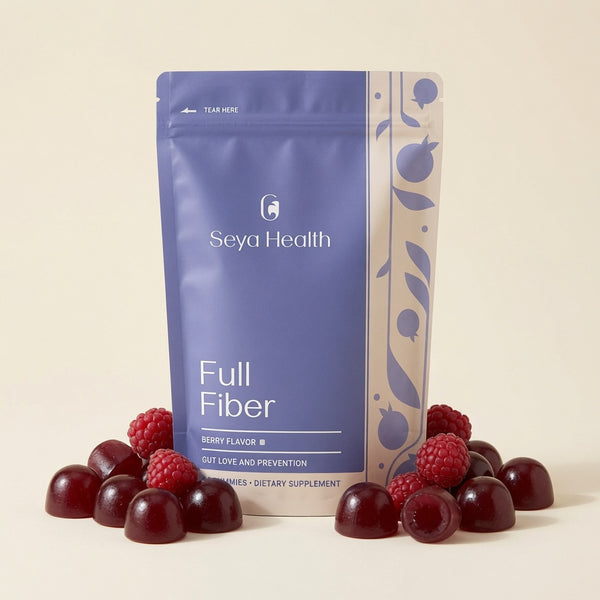
Seya sells one product today. A vegan fiber gummy.
It is not an enzyme. It gives about 6 g of fiber from three gummies, mostly resistant tapioca fiber, a fermentable prebiotic. At that dose the honest claim is that it supports regularity. It can also add gas while your gut adjusts, so start slowly. We say that up front.
Read how it compares in fiber supplements for women over 40. And for the type of fiber behind it, see the guide to fiber types.
This is education, not medical advice. Talk to a qualified clinician before starting a fiber or enzyme supplement, especially if you take medication or have a gut condition.
These statements have not been evaluated by the Food and Drug Administration. This product is not intended to diagnose, treat, cure, or prevent any disease.
Frequently asked questions
Do digestive enzyme supplements help with bloating?
Sometimes, when the enzyme matches your trigger. Lactase has the clearest support for milk-related symptoms. In a small trial, alpha-galactosidase cut gas after a bean meal but did not change bloating or pain. A 2026 open-label study of an enzyme blend showed gains in bloating, but it had no placebo group. General enzyme blends have little placebo-controlled bloating research that we could verify, so talk to a clinician before relying on one.
Is fiber or a digestive enzyme better for bloating?
It depends on the cause. If you eat too little fiber or run constipated, fiber is the better first step, and soluble fiber has trial support in IBS. If one food reliably sets you off, an enzyme for that food may help. Neither is a guaranteed fix. New, lasting, or painful bloating after 50 should be checked by a clinician first.
Can fiber cause bloating at first?
Yes. Gut bacteria ferment fiber and make gas, so a fast jump in fiber can cause bloating and gas for a few weeks. Studies describe these effects as transient. Add fiber slowly, drink water, and step back if symptoms get strong. That is fermentation at work, though ongoing pain is worth a clinician's call.
Related reading
- Why bloating happens: the real mechanism, explained
- Fiber vs. probiotics for bloating and gut health
- Fiber and IBS: will it calm your gut or make bloating worse?
- Fiber supplements for women over 40
Seya Full Fiber
Most women fall short on fiber. Seya Full Fiber gives you 6 grams from three fibers in three small vegan gummies. Plant based, no gelatin, no sugar alcohols.
Shop Full Fiber