
Home/ The Journal/ bloating
bloating
The Balloon Effect: Why Bloating Happens and How to Deflate
We’ve all had those days where our favorite jeans suddenly feel two sizes too small by 4:00 PM. Bloating—that uncomfortable, tight, "full" sensation in your abdomen—is one of the most common digestive complaints, particularly among women.

Short version: Bloating and distension are two different things. Bloating is what you feel. Distension is your belly measurably getting bigger. And the second one is often driven by a reflex in your diaphragm, not by extra gas.
- 23.4% of women report bloating versus 12.2% of men, about twice the rate.
- In people with bloating, the belly pushes out even when gas volume has not increased.
- 62% of healthy women report bloating in the 5 days before their period.
Last updated August 2026.
Your jeans fit at 8am. By 4pm they do not.
Why bloating happens comes down to two things that get blurred into one. Bloating is the sensation of pressure and fullness. Distension is your abdomen actually measurably expanding.
You can have one without the other. And when your belly does visibly push out, the cause is often not more gas.
It is a reflex. In studies of people with bloating, the diaphragm contracts downward while the abdominal wall relaxes and pushes forward, producing visible distension with no increase in the volume of gut contents.
Read that twice. Your stomach really does get bigger. It is a muscle coordination problem, not a discipline problem.
Why bloating happens: air in, gas made
Two sources. Air you swallow, and gas your bacteria make.
As the NIDDK explains, gas normally enters your digestive tract when you swallow air and when bacteria in your large intestine break down certain undigested carbohydrates.
That fermentation is normal. It is your gut bacteria eating. The byproducts are hydrogen, methane, and carbon dioxide.
Trouble starts when things slow down. If transit slows, gas sits longer in one place. More time fermenting, more volume, more stretch on the intestinal wall.
So constipation and bloating tend to travel together. We unpack the slowdown itself in constipation explained.
Why does your belly actually get bigger?
This is the mechanism the old advice misses entirely.
Normally, when your gut fills, your body makes room gracefully. The diaphragm relaxes upward and the abdominal wall tightens, so the extra volume is absorbed without your belly protruding.
In many people with bloating, that coordination inverts. The pattern is called abdominophrenic dyssynergia, and it involves a paradoxical contraction of the diaphragm along with relaxation and protrusion of the abdominal wall.
The result is a belly that pushes visibly outward and downward. Researchers found that patients with irritable bowel syndrome and functional dyspepsia "had no increase in gas volume but did show a diaphragmatic descent and caudoventral redistribution of the abdominal wall and intestinal contents," per the narrative review of abdominophrenic dyssynergia (American Journal of Gastroenterology, 2022).
Same gas. Different shape.
So if you have ever been told to just eat less because your stomach looks distended, that advice was aimed at the wrong system. This is a reflex in your torso muscles. It is a signal, not a character flaw.
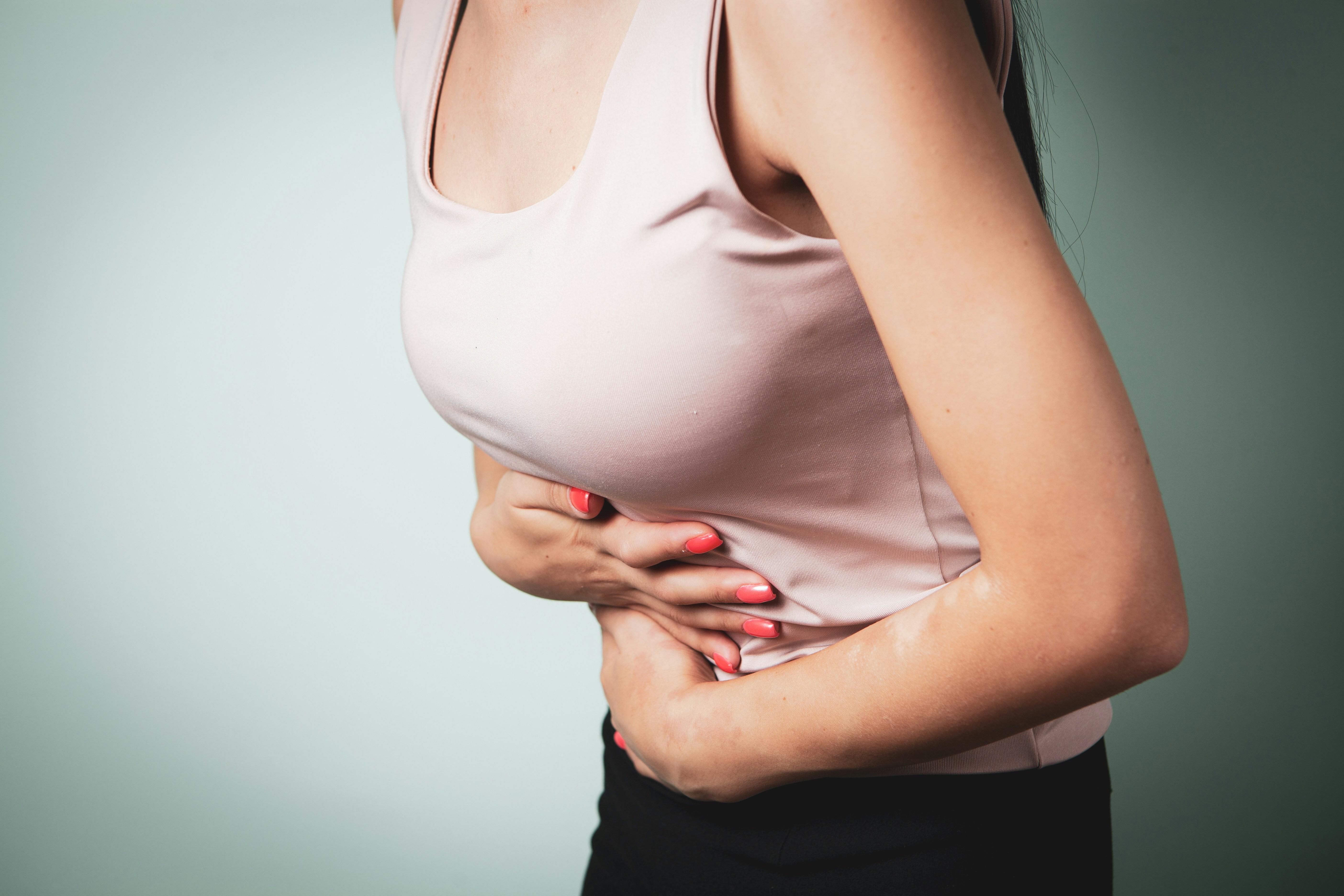
Why do women bloat more than men?
Because they do, and the data is not subtle.
The Rome Foundation surveyed 51,425 people across 26 countries. Nearly 18% of the global sample reported bloating at least once a week. Split by sex, 23.4% of women reported it against 12.2% of men. Women were about twice as likely to report bloating, and made up 64.9% of everyone who did. The full analysis is in the Rome Foundation Global Epidemiology Study (Gastroenterology, 2023).
Twice as likely. And for a long time that gap got filed under "sensitive stomach" instead of studied.
Part of it is anatomical, part hormonal, and part is that women's gut transit is on average slower. But the honest answer is that the mechanism is not fully mapped, because the research that would map it has not been prioritized. That is the same pattern behind women getting the wrong drug doses.
Why is it worse right before your period?
Because your cycle changes your gut, on a schedule.
In a study of 156 healthy premenopausal women, 62% reported bloating in the 5 days before menses, compared with 51% during. Abdominal pain followed the same shape, 58% before and 55% during. Nearly three-quarters reported at least one gut symptom premenstrually. See gastrointestinal symptoms before and during menses in healthy women (BMC Women's Health, 2014).
So the week your bloating peaks is predictable. That is useful. A symptom you can anticipate is a symptom you can plan around.
We go deeper on the cycle pattern in luteal phase bloating.
How do you deflate?
Work the mechanism, not the mirror.
Slow down transit problems first. If you are constipated, the gas has nowhere to go, so regularity usually has to come before comfort. Movement helps here more than most people expect.
Swallow less air. Eating fast, chewing gum, and drinking through a straw all add gas that has nothing to do with your food.
Then look at fermentation. Certain carbohydrates ferment fast and hard, and cutting the specific ones that trigger you does more than cutting food in general. The food-by-food breakdown lives in foods to avoid when bloated and the best foods for bloat relief.
And know when to stop self-managing. New, persistent, or worsening distension, especially alongside bleeding, fever, or pain that wakes you at night, needs a doctor rather than a diet change.
Does fiber help bloating or make it worse?
Honestly? Both, depending on timing and dose.
Fiber is what your gut bacteria ferment. So adding a lot of it quickly can increase gas and make you feel worse for a week or two. That is the part supplement marketing tends to skip.
What fiber reliably supports is regularity. And because trapped gas behind slow transit is a real driver of bloat, better regularity often helps the bloating indirectly, over weeks rather than hours.
So the rule is boring and correct. Increase gradually. Drink more water. Judge it at a month, not at a day.
Where Seya fits, honestly
Seya makes one product at launch. A fiber gummy.
Three vegan gummies deliver about 5 grams of resistant tapioca fiber, roughly half the dose used in the larger fiber trials. At that dose the evidence earns a grade of C. So here is our claim and nothing more: it supports regularity.
It is not a debloating product. The evidence that fiber reduces bloating specifically is mixed, and in the short term more fiber can mean more gas. We would rather tell you that than sell you a flat stomach in 7 days.
If your distension is new, persistent, or painful, see a doctor. This is education, not a diagnosis.
These statements have not been evaluated by the Food and Drug Administration. This product is not intended to diagnose, treat, cure, or prevent any disease.
Frequently asked questions
What is the difference between bloating and distension?
Bloating is the subjective sensation of pressure, tightness, or fullness in your abdomen. Distension is an objective, measurable increase in the size of your abdomen. They often occur together, but you can feel bloated without visibly distending, and you can distend without much discomfort. The distinction matters because they have partly different causes and different fixes.
Why does my stomach bloat so much?
Usually a combination of gas and timing. Gas enters your digestive tract when you swallow air and when gut bacteria ferment undigested carbohydrates. If your transit is slow, that gas sits and accumulates instead of moving through. In many people the visible swelling is amplified by a muscle reflex in which the diaphragm contracts downward while the abdominal wall relaxes outward.
Why do women bloat more than men?
Rate data is clear even if the mechanism is not. In a survey of 51,425 people across 26 countries, 23.4% of women reported weekly bloating compared with 12.2% of men, roughly twice the rate, and women made up 64.9% of everyone reporting it. Slower average gut transit, hormonal cycling, and anatomy all likely contribute, but the underlying mechanism remains under-researched.
Does fiber help bloating or make it worse?
It can do either. Fiber is fermented by gut bacteria, so a sudden large increase often produces more gas and temporary discomfort for one to two weeks. Over a longer horizon, fiber supports regularity, and better regularity reduces the trapped gas that drives a lot of bloating. Increase gradually, drink more water, and judge the effect after about a month.
How do you get rid of bloating fast?
There is no reliable instant fix, and that is worth knowing before you buy one. Gentle movement such as a walk can help move gas along. Reducing swallowed air by slowing your eating and skipping gum and straws helps within the same day. For anything recurring, addressing constipation and identifying your specific fermentable triggers works better than any quick remedy.
When should you see a doctor about bloating?
See a doctor if distension is new, persistent, or getting worse, or if it comes with losing weight without trying, rectal bleeding, vomiting, fever, or pain that wakes you at night. Bloating that starts for the first time after roughly age 50 also warrants evaluation. Persistent bloating is one of the more commonly overlooked symptoms in women, so it is worth being direct with your clinician.
Related reading
- How Much Fiber Do Women Actually Need? Grams by Age, and Why It's More Than You Think
- Menopause Belly: Why It Happens and What Actually Helps
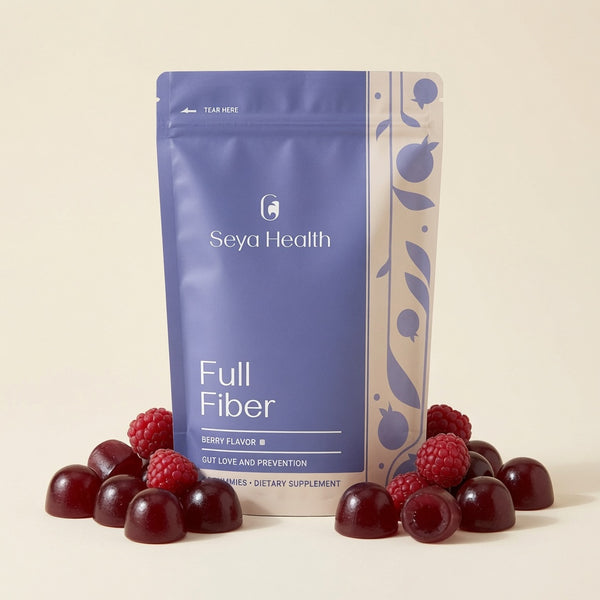
Seya Full Fiber
More than 90% of women fall short on fiber. Seya Full Fiber gives you 6 grams from three fibers in one, in three small gummies that feed the beneficial bacteria in your gut. Plant based, no gelatin, no sugar alcohols.
Shop Full FiberKeep reading
fiber
Can a Multivitamin Replace Vegetables? What Supplements Can't Do for Your Gut

constipation
The Best Way to Beat Constipation in Your 30s (and Where Fiber Gummies Fit)
fiber
The Gut-Skin Axis: Does Your Gut Health Affect Your Skin?
The gut-skin axis, explained: how your gut bacteria and blood sugar affect your skin, w...