Home/ The Journal/ comparisons
comparisons
Fiber gummies vs powder vs capsules: which form actually works?

Short version: In the fiber gummies vs powder vs capsules question, the form matters less than two things: which fiber is inside, and how much. We pulled 24 fiber gummy labels from the NIH label database. Most hold 1.5 to 2.5 g of fiber per gummy, and none use psyllium. Psyllium capsules hold only 0.33 to 0.5 g each. One serving of psyllium powder can hold 5 g.
- Powder: most fiber per serving, and the only easy way to get a full dose of psyllium.
- Capsules: real psyllium, no taste, but you may need 12 or more pills to match one scoop.
- Gummies: easiest habit, but a different kind of fiber, and less of it.
Last updated November 2026. We make Seya, a fiber gummy, so weigh what we say with that in mind.
You want more fiber. So you go to the store and see three shelves: tubs of powder, bottles of capsules, and jars of gummies.
They all say "fiber" on the front. But they are not the same thing in a different shape. The form decides which fiber can fit inside, and how much of it you get per piece.
Here is how the three compare, using real labels and the research on each fiber type.
Fiber gummies vs powder vs capsules: which form works best?
For staying regular, the best-studied pick is psyllium taken as a powder or in capsules. Gummies are easier to take, but they use other fibers with less proof for that job.
A 2022 review pooled 16 trials with 1,251 adults who had long-term constipation. With fiber, 66% got better, compared with 41% on control. Psyllium and pectin were the fibers that clearly helped. The gains showed up at doses above 10 g a day, taken for at least 4 weeks. See van der Schoot et al. (Am J Clin Nutr, 2022).
That is the key point. The studies tested a type of fiber at a dose, not a shape. So the useful question is which form lets you take enough of the right fiber, day after day.
How much fiber is in one gummy, capsule, or scoop?
We checked the NIH Dietary Supplement Label Database on November 16, 2026. We looked only at products listed as still on the market. These are label claims, not lab tests.
| Form | Fiber per piece (label) | Pieces for 6 g of fiber | Usual fiber type |
|---|---|---|---|
| Powder | 5 g per 6 g serving (Konsyl psyllium) | About 1 serving | Psyllium, or others |
| Capsules (9 psyllium labels) | 0.33 to 0.5 g | 12 to 18 | Psyllium |
| Gummies (23 of 24 labels) | 1.5 to 2.5 g | 3 to 4 | Inulin, polydextrose, FOS, corn fiber |
Source: the NIH Office of Dietary Supplements label database. One gummy label held only 0.15 g per gummy, so we left it out of the range.
Some quick math helps here. Metamucil's psyllium capsules list 2 g of fiber per 5 capsules. The label allows up to 4 servings a day, which is 20 capsules for 8 g of fiber. See the Metamucil capsule label. A Konsyl psyllium powder gives 5 g in a single serving.
So capsules can carry real psyllium. You just have to swallow a lot of them to reach the doses the trials used.
Why don't fiber gummies use psyllium?
Psyllium soaks up water and turns into a thick gel, which is hard to pack into a chewy candy. Of the 24 gummy labels we pulled, not one listed psyllium.
Instead, gummies use fibers that dissolve and stay thin, such as inulin from chicory root, polydextrose, and fructooligosaccharides (FOS). Metamucil's own gummies use inulin and a soluble corn fiber called Fibersol, not the psyllium in its powder. See the Metamucil Fiber Gummies label.
Seya is no different. Our 3-gummy serving holds about 6 g of fiber, mostly resistant tapioca fiber. That is a soluble fiber, not a gel-former like psyllium.

Does it matter if a fiber forms a gel?
Yes, for some goals. A 2017 review on fiber physics explains why. See McRorie and McKeown (J Acad Nutr Diet, 2017).
Gel-forming fibers like psyllium hold on to water all the way through the gut. That keeps stools bulky and soft. Thick gels in the small gut are also tied to lower cholesterol and better blood sugar control.
Thin, fermentable fibers work another way. The review says inulin, FOS, and wheat dextrin do not have that laxative effect, and do not give the gel-linked cholesterol and blood sugar benefits. Gut bacteria break these fibers down instead, and that can mean more gas.
So if regularity is your main goal, the fiber type in a powder or capsule may matter more than the ease of a gummy. If you mostly want to close a daily fiber gap in a way you will stick with, a gummy can still help.
Do fiber capsules work as well as powder?
If the capsule holds the same psyllium, the fiber should act the same once it is in your gut. We could not find a trial that tested psyllium capsules against psyllium powder head to head.
The real gap is dose. The 9 capsule labels we checked hold 0.33 to 0.5 g of fiber each. To pass the 10 g a day used in the review above, you would need about 20 to 30 capsules a day.
Some people do fine with that. Others find it a lot of pills. A fair middle path is to use capsules to top up a high-fiber diet, rather than to supply all of it.
Why do fiber powders and capsules need so much water?
Because dry psyllium swells. If it swells before it reaches your stomach, it can get stuck.
The FDA requires a choking warning on these products. It covers psyllium and other gel-forming fibers sold dry, and it names capsules and powders. Read the rule at 21 CFR 201.319.
That is why the capsule labels we read say to take each serving with at least 8 ounces, a full glass, of liquid. The Metamucil capsule label also says to swallow one capsule at a time while sitting or standing upright.
If you have trouble swallowing, or have had a narrowed esophagus, skip dry psyllium and ask your clinician what to use.
Are fiber gummies as effective as powder?
Not gram for gram for regularity, based on what is in them. Most gummies carry less fiber per serving, and a type with less trial support for bowel habits.
But "effective" also means "taken." Only about 5% of Americans meet their fiber goal, per Quagliani and Felt-Gunderson (Am J Lifestyle Med, 2017). The label Daily Value is 28 g a day, per 21 CFR 101.9. A powder that sits in the cabinet adds 0 g.
If you will truly take a gummy every day and a powder you will not, the gummy may do more for you. For a deeper look at whether gummies hold up, see how fiber supplements work.
Which form is right for you?
Match the form to your goal and your habits.
- You want the best-studied option for regularity: psyllium powder. It gives the most fiber per serving. See our best fiber supplement for constipation guide.
- You want psyllium but hate the texture: capsules, if you are fine with many pills and a full glass of water.
- You want a habit you will keep, on the go: gummies. Check the fiber type and the sugar line. Our fiber gummy label guide walks through it.
- You are watching cost: powder nearly always wins. We did the math in are fiber gummies worth the money?
- You take daily medicines: fiber can affect how some pills are absorbed. See how to time fiber around medications.
Whatever the form, start low and build up over a week or two. The 2022 review found more gas in the fiber groups, so a slow start makes sense.
Where does Seya fit, honestly?
Seya is a gummy. Each 3-gummy serving gives about 6 g of fiber, mostly resistant tapioca fiber, with 3 g of added sugar. It supports regularity as part of a fiber-rich diet. It is not psyllium, and it does not match a full powder dose.
If you want psyllium's gel, use a powder or capsules, and you can still use a gummy to fill gaps. Comparing gummy brands? See Metamucil vs Olly vs Vitafusion fiber gummies or what is better than Metamucil. Also on the way: a Seya creatine gummy, coming January 2027 and not yet for sale. For that format debate, see creatine gummies vs powder.
Frequently asked questions
Are fiber gummies as effective as powder?
Not gram for gram for regularity. Most fiber gummies hold 1.5 to 2.5 g of fiber each and use inulin or similar fibers, not psyllium. Psyllium powder gives more fiber per serving and has the strongest trial support. A gummy you take every day can still help close a fiber gap.
Is it better to take fiber pills or powder?
The fiber inside can be the same psyllium, so the main difference is dose. Psyllium capsules hold 0.33 to 0.5 g of fiber each, so matching one 5 g powder serving takes 10 or more capsules. Take either one with a full glass of water.
Do fiber capsules work as well as powder?
If they contain the same psyllium, they should work the same once swallowed, but no trial has compared them head to head. The catch is pill count. Getting past 10 g of fiber a day, the dose tied to better results in a 2022 review, takes about 20 to 30 capsules.
Are fiber gummies as good as Metamucil powder?
They are different products. Metamucil powder uses psyllium, a gel-forming fiber. Metamucil's own gummies use inulin and Fibersol instead, at 5 g per 3 gummies. For regularity, psyllium has more evidence. For ease, gummies are simpler.
Do fiber gummies work for constipation?
The evidence is weaker than for psyllium. A 2017 review says fermentable fibers like inulin and FOS do not have a laxative effect. Gummies can support regularity as part of a fiber-rich diet. If constipation is ongoing, see a clinician.
This is education, not medical advice. If you have a gut condition, trouble swallowing, or a sudden change in bowel habits, talk to your clinician before you add fiber.
These statements have not been evaluated by the Food and Drug Administration. This product is not intended to diagnose, treat, cure, or prevent any disease.
Written and reviewed by the Seya Health Editorial Team. Every health claim on this page is sourced to primary research or a government source. Labels were checked on November 16, 2026. Metamucil, Konsyl, Olly, and Vitafusion are trademarks of their respective owners, and Seya has no ties to those companies.
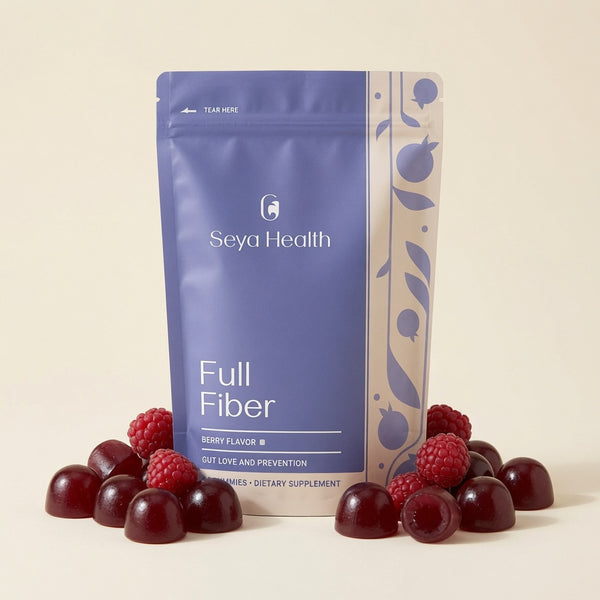
Seya Full Fiber
Most women fall short on fiber. Seya Full Fiber gives you 6 grams from three fibers in three small vegan gummies. Plant based, no gelatin, no sugar alcohols.
Shop Full Fiber