
Home/ The Journal/ blood sugar
blood sugar
How to Quiet Food Noise Naturally: Can Fiber and Nutrition Turn Down the Volume?

The short version: Here is how to quiet food noise naturally: you cannot switch it off with a salad, but you can turn the volume down. In a study of 1,070 people, those with the biggest blood-sugar dips after breakfast ate 312 more calories over the day and felt 9% hungrier, on the exact same meals. Steadier blood sugar, protein in the morning, real fiber, and more sleep are the natural levers. None of them is willpower.
- Big blood-sugar dippers ate 75 more calories in the 3 to 4 hours after breakfast, and 312 more across the day.
- In 20 young women, a 350-calorie breakfast with 35 g of protein lowered food-craving brain activity and cut evening snacking.
- In 80 short sleepers, adding 1.2 hours of sleep a night cut daily intake by about 270 calories.
- Most US women get about 15 g of fiber a day against a 25 g target. That gap is the one a fiber gummy can honestly help close.
Last updated August 2026.
Can you quiet food noise naturally? Partly, yes. Not to zero, but down.
This is a plain guide to how to quiet food noise naturally, using food and sleep instead of willpower. Start with one number. In a study of 1,070 people, the ones with the biggest blood-sugar dips after breakfast ate 312 more calories over the day, and felt 9% hungrier, eating the same meals as everyone else.
You have probably filed that 4pm pull under willpower. Most people do.
Here is the part nobody explains. That pull is not a character flaw. It is a signal. And the signal gets louder for reasons that have nothing to do with how hard you are trying: a blood-sugar drop, a breakfast with no protein, a short night. Change the inputs, and you change the volume.
What is food noise, really?
Food noise is a stream of thoughts about food that you did not ask for and cannot easily turn down.
In 2025, obesity researchers writing in Nutrition & Diabetes gave it a formal definition. Their words: "persistent thoughts about food that are perceived by the individual as being unwanted and/or dysphoric." What sets it apart from normal food thoughts, the same paper says, is that it resembles rumination.
So it has a name now. That matters more than it sounds. If the loudness runs on a mechanism, then quieting it is not a test of your character. It is a set of inputs you can actually change.
How to quiet food noise naturally — what actually works?
Four levers, in order of how much evidence stands behind them: steadier blood sugar, protein in the morning, enough sleep, and closing your daily fiber gap. Each targets a different reason the signal gets loud. None of them switches the signal off, and none of them is discipline.
| Natural lever | What it turns down | A real number |
|---|---|---|
| Steadier blood sugar | the post-meal crash that spikes hunger | 312 fewer calories a day in low dippers |
| Protein at breakfast | food-craving brain activity and evening snacking | 35 g of protein in a 350-calorie meal |
| More sleep | the reward pull of high-calorie food | about 270 fewer calories a day with +1.2 h sleep |
| Closing the fiber gap | the fullness signal your gut is short on | most women get 15 g against a 25 g target |
Does steadier blood sugar turn down the volume?
This is the strongest natural lever, and it has the cleanest number.
Researchers tracked 1,070 people wearing continuous glucose monitors across 8,624 standardized meals and more than 70,000 free-choice ones. The finding: the dip 2 to 3 hours after eating, not the peak, is what predicts hunger. Read the postprandial glycaemic dips study in Nature Metabolism. Big dippers were 9% hungrier, ate 75 more calories at the next meal and 312 more across the day, and reached for that meal about 30 minutes sooner.
Same food. Different curve. That is the point. A sharp spike-and-crash morning writes a hungrier afternoon into your body before noon.
Food fiber is one of the best ways to flatten that curve. Viscous fibers in oats, beans, and lentils slow how fast sugar crosses into your blood, so the meal lands as a gentle rise instead of a spike and crash. We break down the fullness side of this in how fullness actually works.
Can protein at breakfast quiet the cravings?
Yes, and this one has a brain scan behind it, not just a food diary.
In a crossover trial, 20 young women who normally skipped breakfast ate a 350-calorie meal with 35 g of protein, from eggs and lean beef. Before dinner, researchers scanned their brains. Read the higher-protein breakfast study in the American Journal of Clinical Nutrition.
The protein breakfast lowered activity in the brain regions that drive food craving and reward. It raised PYY, a fullness hormone, and lowered ghrelin, the hunger one. And it cut high-fat snacking that evening. A cereal breakfast of the same calories did not do the same job.
So the morning meal is not just fuel. It sets how loud the signal runs the rest of the day.
What does sleep have to do with food noise?
More than most people credit. Short sleep turns the reward pull up, and the fix is not more effort.
In a 2-week trial, 80 adults who normally slept under 6.5 hours got one session of sleep coaching. They added about 1.2 hours a night. Read the sleep-extension trial in JAMA Internal Medicine. On the extra sleep, they ate about 270 fewer calories a day, without being told to change their eating at all.
Read that again. The only thing that changed was the sleep. The food followed.
If your food noise is loudest after a five-hour night, that is not you being weak. That is a tired reward system doing exactly what tired reward systems do.
Where does fiber fit, and what can Seya honestly say?
Fiber is the throughline under two of these levers. It steadies blood sugar, and it feeds the fullness signals your gut makes. But the honest scope matters.
Most US women get about 15 g of fiber a day against a 25 g target, per the MedlinePlus dietary fiber overview. That 10 g shortfall, running for years, is a real gap. Food fiber closes most of it: the oats, beans, and lentils above.
Seya makes one product. A fiber gummy. 3 vegan gummies carry about 5 g of resistant tapioca fiber, which is roughly half the dose most fiber studies use. We grade that evidence a C, so we make one claim for it: it supports regularity.
It does not quiet food noise, and nothing on this page says it does. What it does is help patch that daily gap on the days your food does not. How much fiber you actually need is covered in what fiber actually does in a woman's body.
This is education, not medical advice. Talk to your clinician before adding fiber, especially if you are pregnant, have inflammatory bowel disease, or take medication that affects digestion.
These statements have not been evaluated by the Food and Drug Administration. This product is not intended to diagnose, treat, cure, or prevent any disease.
What about the medication route?
It works on a different part of the system. GLP-1 medications like semaglutide act on the brain's reward circuit directly, and in one trial cut a day's food intake by 24%.
That is a real and separate lever, with real trade-offs and a prescription. We cover the brain side of it in full in the medication route: how GLP-1s quiet cravings in the brain, and the mechanism in how GLP-1 actually works. The food levers on this page are not a substitute for a drug, and a drug is not a reason to skip them. If you are on a GLP-1, talk to your prescriber before changing anything.
Frequently asked questions
Can nutrition changes actually reduce food noise?
Yes, within limits. No food switches food noise off, but several nutrition changes turn the signal down, and each has a number behind it. The strongest lever is steadier blood sugar: in 1,070 people, the biggest post-breakfast dips predicted 9% more hunger and 312 more calories eaten across the day, on identical meals.
A 350-calorie breakfast with 35 g of protein lowered food-craving brain activity and cut evening snacking in a trial of 20 women. And closing the everyday fiber gap, from about 15 g toward a 25 g target, supports the fullness signals your gut produces. These are inputs you can change, not tests of willpower.
How can you quiet food noise without medication?
Work the four natural levers. First, steady your blood sugar: build meals around fiber and protein so you get a gentle rise instead of a spike and crash, since the 2 to 3 hour dip is what drives the next craving. Second, front-load protein at breakfast, around 35 g, which lowered reward-driven eating and evening snacking in a controlled trial.
Third, protect your sleep: short sleepers who added 1.2 hours a night ate about 270 fewer calories a day without trying. Fourth, close your daily fiber gap with food. None of this removes food noise, but together the levers make the signal quieter and easier to live with, and none of them is discipline.
Is food noise a sign of a lack of willpower?
No. Food noise is defined in a 2025 Nutrition & Diabetes paper as persistent, unwanted thoughts about food that resemble rumination. It runs on measurable signals, including how far your blood sugar dips after a meal and how much you slept.
In the glucose study, people eating identical meals felt hunger differently based on their own blood-sugar curve, which is biology, not character. Treating it as a discipline problem is both inaccurate and unhelpful. Treating it as a signal you can influence with food and sleep is what the evidence supports.
Does fiber help with food noise?
There is a plausible mechanism and no direct proof. Food fiber steadies blood sugar and feeds the gut signals that register fullness, both of which sit upstream of food noise. But no trial has measured food noise as an outcome of eating more fiber.
Most US women get about 15 g a day against a 25 g target, so closing that gap is worthwhile on its own. Seya's fiber gummy supplies about 5 g of resistant tapioca fiber, roughly half the studied dose, so its honest claim is support for regularity, not a food-noise fix.
Related reading
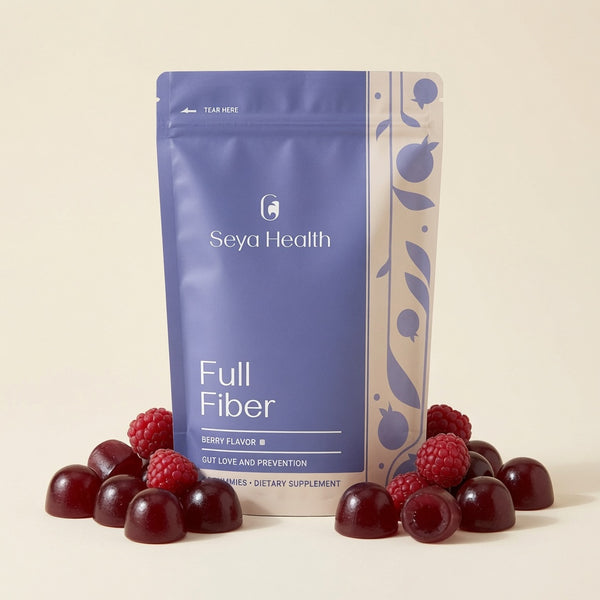
Seya Full Fiber
More than 90% of women fall short on fiber. Seya Full Fiber gives you 6 grams from three fibers in one, in three small gummies that feed the beneficial bacteria in your gut. Plant based, no gelatin, no sugar alcohols.
Shop Full FiberKeep reading

fiber
Can a Multivitamin Replace Vegetables? What Supplements Can't Do for Your Gut

constipation
The Best Way to Beat Constipation in Your 30s (and Where Fiber Gummies Fit)
fiber
The Gut-Skin Axis: Does Your Gut Health Affect Your Skin?
The gut-skin axis, explained: how your gut bacteria and blood sugar affect your skin, w...