
Home/ The Journal/ blood sugar
blood sugar
Is Resistant Tapioca Starch Keto-Friendly? Fiber Without the Blood-Sugar Spike

Short version: Is resistant tapioca starch keto-friendly? Yes, at the doses a supplement uses. Your enzymes cannot break it down, so it does not land in your blood as glucose. Plain tapioca starch is the opposite. Dry tapioca runs 88.7 g of carbohydrate against 0.9 g of fiber per 100 g. Same root. Two different ingredients.
- A keto diet holds carbohydrate near 20 to 50 g a day, per StatPearls, NCBI Bookshelf. Plain tapioca blows that budget in 2 spoonfuls.
- The FDA found that cross-linked phosphorylated RS4 "can help reduce insulin levels following a meal containing a carbohydrate that raises blood glucose levels," per its March 2019 constituent update.
- "Net carbs" has no legal meaning. The FDA regulates 2 lines on a label: Total Carbohydrate and Dietary Fiber.
- Keto's quiet cost is regularity. Gut complaints hit about half of people who start it.
Last updated September 2026.
You cut carbs to 30 g a day. Then you turned over a fiber label and saw the word starch.
Fair question. Here is the answer.
Resistant tapioca starch is keto-friendly at supplement doses. Your gut enzymes cannot digest it, so it reaches your colon intact instead of becoming glucose. Plain tapioca starch is not keto at all. Dry tapioca carries 88.7 g of carbohydrate and just 0.9 g of fiber per 100 g, at 358 calories, per USDA FoodData Central.
Same cassava root. One word changes the whole picture.
Below: the carb math, what net carbs really mean on a US label, what the trials show about blood sugar, and the fiber problem keto creates by accident.
Is resistant tapioca starch keto-friendly?
Yes. It is fiber, and fiber does not feed your blood sugar the way starch does.
Starch is a chain of glucose. Your small intestine snips those chains apart and the glucose goes into your blood. That is why bread moves a glucose meter.
Resistant starch skips that step. The molecule is built so your enzymes cannot get a grip on it. It travels to your colon, where your gut bacteria ferment it. Nothing arrives as blood glucose along the way.
The FDA writes the rule that decides what counts. Its definition covers "non-digestible soluble and insoluble carbohydrates (with 3 or more monomeric units)" that the agency has found to have a real physiological benefit, per its questions and answers on dietary fiber.
Resistant tapioca fiber sits inside that definition. Plain tapioca starch does not. We unpack the ingredient itself in what resistant tapioca starch is.
Is regular tapioca starch keto?
No. Not close.
A keto diet keeps carbohydrate low enough to shift your body into burning fat. StatPearls puts the line here:
"When daily carbohydrate intake falls below roughly 20 to 50 grams, the resulting decrease in insulin levels triggers increased lipolysis." — The Ketogenic Diet: Clinical Applications, Evidence-based Indications, and Implementation, StatPearls, NCBI Bookshelf
Now hold that against tapioca. Per 100 g of dry tapioca pearls: 88.7 g of carbohydrate, 3.35 g of sugars, and 0.9 g of fiber. Subtract the fiber and you still have 87.8 g of carbohydrate that digests.
That is 4 days of carbs on a 20 g budget. From one small bowl.
Here is the same comparison, side by side.
| Per 100 g | Plain tapioca starch or pearls | Resistant tapioca fiber |
|---|---|---|
| Digestible carbohydrate | About 87.8 g | Near zero, by design |
| Dietary fiber | 0.9 g | Counted as fiber on the label |
| Where it ends up | Small intestine, then your blood as glucose | Colon, where bacteria ferment it |
| Fits a 20 to 50 g carb day | No | Yes, at supplement doses |
| Used for | Thickening, chewy texture, boba | Prebiotic fiber that supports regularity |
If a recipe calls for tapioca starch as a thickener, that is the carb-heavy version. More on it in is tapioca starch bad for you.

What are net carbs, and does the FDA define them?
No, it does not. Net carbs is a shopping habit, not a legal term.
US labels carry 2 regulated lines here: Total Carbohydrate and, under it, Dietary Fiber. Nothing on an FDA label is called net carbs.
People calculate it themselves. Total carbohydrate, minus fiber, minus sugar alcohols. The logic is sound as far as it goes, because fiber is defined by the fact that you cannot digest it.
The soundness depends on the fiber being real fiber. That is the whole point of the FDA list. A manufacturer cannot label a carbohydrate as fiber just because it wants the net-carb number to look better.
So the practical rule on keto is simple. Trust the fiber line when it names a fiber the FDA recognizes. Count everything else.
Does resistant starch spike your blood sugar?
The evidence says it does the opposite, and the strongest data sits with one specific type.
A 2023 meta-analysis pooled 36 randomized trials covering 982 people with type 2 diabetes or prediabetes. Resistant starch type 2 lowered blood glucose after a meal, with a standardized mean difference of −0.96. It improved the insulin response too, at −0.71, per Pugh et al., Frontiers in Nutrition, 2023 (PMID 37051127).
The FDA reached a related finding for the chemically modified type, RS4, and said so plainly:
"Based on available evidence, FDA has determined that the scientific evidence suggests that cross-linked phosphorylated RS4 can help reduce insulin levels following a meal containing a carbohydrate that raises blood glucose levels." — US Food and Drug Administration, March 27, 2019
Now the honest part. The same meta-analysis flagged that resistant starch types 3, 4, and 5 still need more research on glucose. So the fair claim is that resistant starch does not raise your blood sugar, and some forms may lower the response to a meal. Not that any gummy manages your glucose.
We go deeper on that in fiber and blood sugar after 40.
Why does keto slow your gut down?
Because you removed the foods your fiber came from, and nothing replaced them.
Think about what leaves a keto plate. Beans. Oats. Fruit. Whole grains. Those are the biggest fiber sources most women eat. Cut carbs hard and the fiber goes with them, quietly, on day one.
The clinical literature has tracked the result for decades:
"Gastrointestinal complaints affect about half of patients starting the ketogenic diet and are a significant reason for early discontinuation or dietary modification." — StatPearls, NCBI Bookshelf
Constipation shows up on the standard short-term side-effect list, alongside nausea, headache, and fatigue.
Read that again, because it matters. If your gut stalled 3 weeks into keto, you did not fail at keto. You subtracted your fiber and nobody told you. That is a mechanism, not a character flaw.
What backed up is fixable, and it does not require abandoning the diet. See constipation, explained.
How much fiber do you need on keto?
The target does not change because your carbs did. Women need about 25 g a day, and about 21 g after 50, per the National Academies.
Most women never get there. More than 90% of US women fall short of the daily fiber target, per Thompson, Nutrients, 2021. On keto that gap gets wider, fast.
The good news is that fiber and carbs are not the same thing on a plate. These are low in digestible carbohydrate and still carry fiber:
- Chia and flax seeds. Mostly fiber and fat, very little digestible carbohydrate.
- Avocado. One of the few whole foods that is high fiber and low net carb at once.
- Leafy greens and cruciferous vegetables. Spinach, kale, broccoli, cauliflower.
- Nuts, especially almonds and pecans. Fiber plus fat, easy to overdo on calories.
- Recognized fiber supplements. Fiber that is counted as fiber on the label, not as digestible carbohydrate.
Add fiber slowly. About 5 g more per week, with water. Your gut bacteria need time to adjust, and rushing it is what causes the gas people blame on the fiber itself.
Where Seya fits, honestly
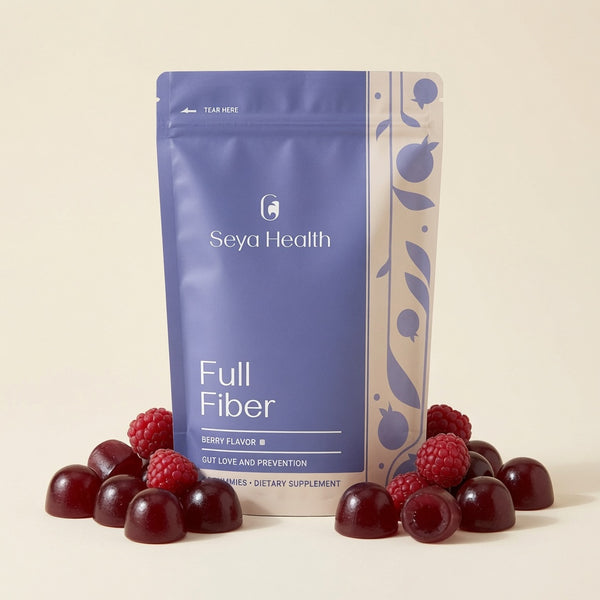
Seya makes a vegan fiber gummy. Here is the panel, so you can do your own math.
3 gummies deliver 25 calories and 5,650 mg of dietary fiber, which is 5.65 g. That splits into 4,500 mg of resistant tapioca fiber, 950 mg of prebiotic soluble fiber, and 200 mg of cellulose. Total sugars are 3 g. There are zero sugar alcohols, which is why it does not carry the bloat that sugar-alcohol gummies can bring.
For a carb budget, the 3 g of sugar is the number to count. The 5.65 g of fiber is the part your body does not digest.
What that dose can honestly claim is that it supports regularity. It is about a fifth of the 25 g daily target, so it closes part of the gap, not all of it. It is not a keto product, it does not put you into ketosis, and it will not keep you there. The rest of your fiber still comes from your plate.
This is education, not medical advice. Talk to a qualified clinician before starting a very-low-carbohydrate diet, especially if you take medication for blood sugar or have a digestive condition.
These statements have not been evaluated by the Food and Drug Administration. This product is not intended to diagnose, treat, cure, or prevent any disease.
Frequently asked questions
Is resistant tapioca starch keto-friendly?
Yes, at the doses used in a supplement. Resistant tapioca fiber is built so your digestive enzymes cannot break it into glucose, so it reaches the colon and is fermented by gut bacteria instead of entering your blood as sugar. That is different from plain tapioca starch, which carries 88.7 g of carbohydrate per 100 g and digests quickly. A keto diet holds carbohydrate near 20 to 50 g a day, and a fiber supplement at roughly 5 g does not threaten that budget.
How many net carbs are in resistant tapioca starch?
Close to zero of the digestible kind, because the whole ingredient is counted as dietary fiber on a US label. Net carbs is not an FDA term, though. The agency regulates 2 lines: Total Carbohydrate and Dietary Fiber. The common calculation subtracts fiber and sugar alcohols from total carbohydrate, and it only holds when the fiber on the label is one the FDA actually recognizes as fiber.
Does resistant starch raise blood sugar?
No, and some forms lower the rise from a meal. A 2023 meta-analysis of 36 randomized trials in 982 people found resistant starch type 2 lowered blood glucose after a meal, with a standardized mean difference of −0.96, and improved the insulin response at −0.71. The FDA separately found that cross-linked phosphorylated RS4 can help reduce insulin levels after a carbohydrate-containing meal. Evidence for resistant starch types 3, 4, and 5 is still developing.
Why does a keto diet cause constipation?
Because the foods you cut are where most of your fiber lived. Beans, oats, fruit, and whole grains carry the bulk of a typical fiber intake, and a very-low-carbohydrate diet removes nearly all of them at once. Gastrointestinal complaints affect about half of people starting a ketogenic diet, per StatPearls, and constipation is on the standard short-term side-effect list. The fix is adding back fiber that is not digestible carbohydrate.
Can you eat tapioca on keto?
Not in normal food amounts. Dry tapioca pearls hold 88.7 g of carbohydrate and 0.9 g of fiber per 100 g, at 358 calories, per USDA FoodData Central. Even a small serving uses most of a day's carb allowance. Tapioca starch as a thickener has the same problem in a smaller package. Resistant tapioca fiber is a separate ingredient and behaves nothing like it.
How much fiber should you eat on a keto diet?
The same as anyone else. Women need about 25 g a day, and about 21 g after 50, per the National Academies. More than 90% of US women already fall short before cutting carbs. Low-carb sources that still deliver fiber include chia, flax, avocado, leafy greens, cruciferous vegetables, and nuts. Add about 5 g more per week with water so your gut has time to adjust.
Related reading
Seya Full Fiber
More than 90% of women fall short on fiber. Seya Full Fiber gives you 6 grams from three fibers in one, in three small gummies that feed the beneficial bacteria in your gut. Plant based, no gelatin, no sugar alcohols.
Shop Full FiberKeep reading

fiber
Can a Multivitamin Replace Vegetables? What Supplements Can't Do for Your Gut

constipation
The Best Way to Beat Constipation in Your 30s (and Where Fiber Gummies Fit)

fiber
The Gut-Skin Axis: Does Your Gut Health Affect Your Skin?
The gut-skin axis, explained: how your gut bacteria and blood sugar affect your skin, w...