Short version: The link between prebiotic fiber and immune system function runs through your gut bacteria. They ferment the fiber into short-chain fatty acids, and animal studies show these signals can shape immune cells. Human data is thin. Two trials of 40 to 44 older adults found that a prebiotic fiber, taken for 10 weeks, shifted some immune markers. That is promising, but it does not show that fiber protects anyone from illness.
- What it is: a prebiotic is a food that your own gut microbes use.
- The link: gut bacteria turn fiber into short-chain fatty acids that talk to immune cells.
- The limit: most of the mechanism work is in mice, and the human trials are small.
- The easy step: eat more prebiotic foods, such as onions, leeks, garlic, and whole grains.
Last updated October 2026.
Does the fiber you eat have anything to do with your immune system?
It might. The link runs through your gut microbes, and the idea is real science. But the loudest online claims race far past the evidence.
Below: what researchers have found, what remains guesswork, and which foods are worth adding this week.
What is prebiotic fiber?
Prebiotic fiber is a food that your gut bacteria use to grow.
The formal definition comes from a 2017 expert panel. A prebiotic is "a substrate that is selectively utilized by host microorganisms conferring a health benefit." See Gibson et al. (Nat Rev Gastroenterol Hepatol, 2017).
Not every fiber fits. A fiber only counts as a prebiotic if it feeds your gut microbes and has a documented benefit. Common examples are inulin, oligofructose, and galacto-oligosaccharides (GOS).
The difference from probiotics is simple. Probiotics are live bacteria you swallow. Prebiotics are the food for the bacteria you already have. We break that down in fiber vs. probiotics.
How does prebiotic fiber affect your immune system?
Through the chemicals your gut bacteria make when they eat fiber.
The main ones are short-chain fatty acids, or SCFAs. Your own cells cannot digest most fiber. Gut bacteria ferment it and release SCFAs as a by-product. These then enter the blood and signal to other cells.
A study in mice shows how far the signal can reach. Mice on a high-fiber diet had more SCFAs in the blood. They were also protected against allergic inflammation in the lung. Mice on a low-fiber diet had fewer SCFAs and worse lung inflammation. One SCFA, propionate, changed the immune cells made in the bone marrow. See Trompette et al. (Nat Med, 2014).
That was a mouse study. It shows a pathway exists. It does not show the same effect in your body.
Does prebiotic fiber change immune function in people?
In a few small trials, yes, on some markers. The picture is early.
Here is the best-known human data, side by side.
| Study | Who | What they took | What changed |
|---|---|---|---|
| Vulevic et al., 2008 | 44 healthy older adults | 5.5 g a day of GOS for 10 weeks, vs. placebo | More immune cell "eating" (phagocytosis) and natural killer cell activity. Lower IL-6, IL-1 beta, and TNF-alpha. |
| Vulevic et al., 2015 | 40 healthy older adults | Same GOS dose and length | Higher natural killer cell activity and IL-10. Lower IL-1 beta. |
| Lei et al., 2018 | 688 people in 12 trials | Prebiotics or probiotics around a flu shot | Higher flu antibody levels, by 13.6% to 20% depending on the strain. |
Read the table with care. The first two were double-blind, placebo-controlled crossover trials, which is a strong design. But each was small, and they measured blood markers, not how many colds or infections people got. See Vulevic et al. (Am J Clin Nutr, 2008) and Vulevic et al. (Br J Nutr, 2015).
The third row mixes prebiotics and probiotics together, and the authors flagged "high heterogeneity," which means the trials differed a lot. See Lei et al. (Drug Des Devel Ther, 2018).
What does eating more fiber have to do with infections?
People who eat more fiber tend to die less often from infections. But that is a pattern, not a proof.
The NIH-AARP study followed about 31,000 deaths over an average of 9 years. People in the top fifth for fiber intake had a 22% lower risk of death from any cause than people in the bottom fifth. Risk of death from heart, infectious, and respiratory disease was also lower, by 34% to 59% in women. See Park et al. (Arch Intern Med, 2011).
This kind of study cannot say fiber caused the drop. People who eat more fiber also tend to eat better and move more in other ways. It is a clue, not an answer.

Which foods have prebiotic fiber?
Many everyday plant foods do. You may be eating some already.
- Onions, leeks, and garlic. Rich in inulin and related fibers.
- Wheat and other whole grains. Wheat supplies most of the inulin in American diets.
- Chicory root and Jerusalem artichokes. Among the highest inulin foods, though harder to find.
- Beans, lentils, and oats. Add fermentable fiber of several kinds.
How much do Americans actually get? A national survey of more than 15,000 people found an average of 2.6 g of inulin and 2.5 g of oligofructose a day. Wheat gave about 70% of it and onions about 25%. See Moshfegh et al. (J Nutr, 1999).
The trials above used 5.5 g a day of one specific fiber. So there is room to eat more, but the data cannot tell you an ideal amount.
How do you add prebiotic fiber without the gas?
Go slowly. Gut bacteria ferment prebiotics, and fermentation makes gas.
- Add one new prebiotic food at a time, in small amounts.
- Raise your fiber by about 5 g a week, not all at once.
- Drink water with your fiber.
- Give each change a couple of weeks before judging it.
If you are not sure how much you need overall, see how much fiber women need per day. If gas or bloating gets in the way, read can you eat too much fiber.
Some people with IBS or other gut conditions react badly to prebiotics. Check with your clinician if you have a diagnosed condition.
What does this not mean?
It does not mean fiber will keep you from getting sick.
No fiber, prebiotic or otherwise, stops an infection. Sleep, vaccines, handwashing, and medical care do far more. Prebiotic fiber is one small input among many.
The honest summary: the gut-immune link is real biology, early in the human evidence, and worth supporting through food.
Where Seya fits, honestly
Seya makes a fiber gummy that supports regularity and digestive comfort. We do not claim it supports immune health, and no trial has tested it for that.
If you want a gentle way to close the fiber gap, see what is in a fiber gummy. For the bigger picture of how gut health changes with age, read fiber and gut health after 40.
This is education, not medical advice. Talk to a qualified clinician before adding any supplement.
These statements have not been evaluated by the Food and Drug Administration. This product is not intended to diagnose, treat, cure, or prevent any disease.
Frequently asked questions
What are prebiotic foods?
Prebiotic foods are plant foods with fibers that feed your gut bacteria. Common ones are onions, leeks, garlic, wheat and other whole grains, chicory root, beans, and oats.
How do prebiotics support immune function?
Gut bacteria ferment prebiotic fiber into short-chain fatty acids. In mice, these shaped immune cells. In two small trials of older adults, a prebiotic fiber changed some blood markers of immune activity. It has not been shown to prevent infections.
What is the difference between prebiotics and probiotics?
Probiotics are live bacteria you swallow. Prebiotics are the fibers that feed the bacteria already in your gut. Some products combine both.
Does fiber boost your immune system?
Not in a way that can be promised. Eating more fiber is linked to lower infection deaths in a large study, but that pattern does not prove fiber is the cause.
Can prebiotic fiber cause gas or bloating?
Yes, especially if you add a lot at once. Gut bacteria make gas when they ferment fiber. Add about 5 g a week and drink water to let your gut adjust.
Written and reviewed by the Seya Health Editorial Team. Every health claim on this page is sourced to primary research, as of October 2026. This article is educational and not a substitute for medical advice.
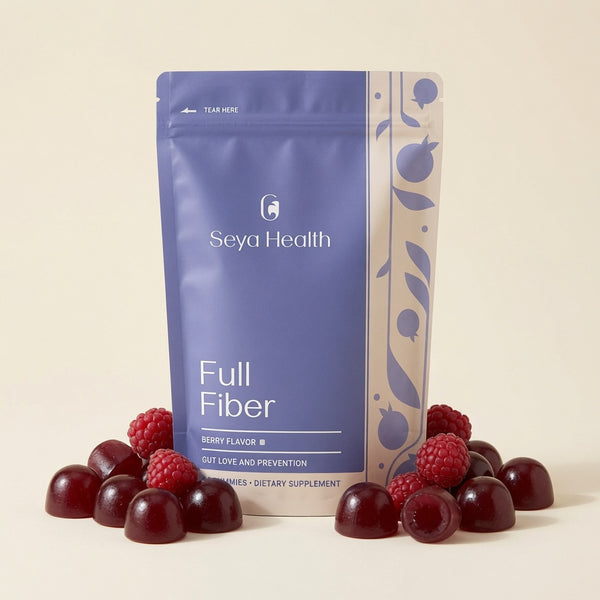
Seya Full Fiber
Most women fall short on fiber. Seya Full Fiber gives you 6 grams from three fibers in three small vegan gummies. Plant based, no gelatin, no sugar alcohols.
Shop Full Fiber