
Home/ The Journal/ creatine
creatine
What is creatine? What it does in your body and why women need it

Short version: What is creatine? It is a compound your body makes from 3 amino acids and stores mostly in muscle, about 95% of it. It helps your cells refill their quick energy. Women don't need a supplement to survive, but paired with lifting, it may help you hold on to muscle.
- What it is: not a protein, not a steroid, and not a stimulant.
- Where it comes from: your liver and kidneys, plus meat and fish.
- Why women care: lower total stores, and muscle loss around menopause.
- The usual dose: 3 to 5 g a day.
Last updated November 2026.
You've seen the tubs. The gym guys. The giant scoop.
So you figured creatine wasn't for you.
That isn't a knowledge gap on your part. It's a research gap. A 2021 review of creatine in women opens by saying the "evidence for use among females is understudied."
So let's start at the start. What it is. What it does. And whether you need it.
What is creatine?
Creatine is a natural compound that helps your cells make quick energy. Your body builds it, and you also get it from meat and fish.
The International Society of Sports Nutrition calls it a "naturally occurring non-protein amino acid compound." See Kreider et al. (JISSN, 2017).
Here's where it lives:
- About 95% sits in your muscles.
- The small remainder is in places like your brain.
- About two thirds of the muscle supply is stored as phosphocreatine, the ready-to-use form.
Each day, about 1% to 2% of what's in your muscles breaks down and leaves in your urine. That waste product is called creatinine. So your body has to replace about 1 to 3 g a day, depending on how much muscle you have.
What does creatine do in your body?
It refills your cells' fastest fuel. That fuel is called ATP.
Think of ATP as cash in your pocket. You spend it quickly on every hard effort. Phosphocreatine is the backup that tops up the cash, fast.
That helps most during short, hard work, like jumping, sprinting, or lifting. See Smith-Ryan et al. (Nutrients, 2021).
It does not give you a buzz. It does not burn fat. You won't feel it kick in like coffee.
Taking it can raise the amount in your muscles. In one early study, muscle levels rose by as much as 50% in some people on high doses. The rise was greatest in those who started low. See Harris et al. (Clin Sci, 1992).
The step-by-step version is in how creatine powers strength training.
What is creatine made of?
Three amino acids: arginine, glycine, and methionine. Your liver and kidneys put them together. See Antonio et al. (JISSN, 2021).
The supplement is different. Creatine monohydrate is creatine bound to one water molecule, and it's made in a factory, not squeezed from a steak.
One published process mixes sodium sarcosinate with cyanamide in water. The crystals are then filtered and dried. See Kreider et al. (Nutrients, 2022).
It's the most commonly studied form. The same authors concluded in 2011 that no other form had been shown to be a more effective source of creatine. In 2022, they were still warning about unsupported claims for other forms. For the head-to-head, see monohydrate vs HCl.
Where does creatine come from?
About half comes from your own body and about half from food, if you eat meat. It's found mainly in red meat and seafood.
A typical diet doesn't deliver much. Vegan and meat-eating diets give about 0 to 1.5 g a day, per the 2022 review.
| Source | About how much creatine | Worth knowing |
|---|---|---|
| Your liver and kidneys | Makes up what food doesn't | Vegetarians rely on this for nearly all of it |
| 1 pound of uncooked beef or salmon | 1 to 2 g | Hard to eat every day |
| 1.1 kg of fresh, uncooked steak | 5 g | About 2.4 pounds for one daily dose |
| Plants | Close to none | Vegan diets can sit near 0 g |
| A monohydrate supplement | 3 to 5 g a day is typical | The easy way to reach a studied dose |
The steak figure comes from Harris and colleagues. The pound figure comes from the 2017 position stand.

Is creatine a protein?
No. It is built from amino acids, but it isn't a protein, and it doesn't do a protein's job.
| Creatine | Protein powder | |
|---|---|---|
| Main job | Refills quick energy | Gives you building blocks for muscle |
| Typical serving | 3 to 5 g | Much larger, often tens of grams |
One doesn't replace the other. Many people use both. More here: creatine vs protein.
It isn't a steroid either. Anabolic steroids are a synthetic version of testosterone, and creatine is not. See is creatine a steroid?
Is creatine vegan?
Creatine in food isn't. Creatine monohydrate usually is, since the process above starts with chemicals rather than meat. Check the label, because a gummy may contain gelatin.
Diet does change your stores. In a 6-month trial, 40 women who ate meat were split into groups. Muscle creatine fell within 3 months in the 15 who went vegetarian with no supplement. See Blancquaert et al. (Br J Nutr, 2018).
A review of 9 studies found supplements raised muscle levels in vegetarians, often above those of meat eaters. Brain phosphocreatine did not change. See Kaviani et al. (IJERPH, 2020).
Do women need creatine?
Not to stay alive. Your body makes it. Whether you'd do better with more is the real question, and for many women the answer may be yes.
Two facts get quoted, and you should see both. The 2021 review says women have "70–80% lower endogenous creatine stores" than men. The same review also reports about 10% higher resting levels in women's muscle.
Those can both hold up. Our read is that one is the total amount and one is how packed the tissue is. Women tend to carry less muscle overall, which also shows up as lower daily creatine loss. See Brosnan et al. (Amino Acids, 2011).
So don't read that big number as a deficiency. It isn't one.
The better reasons to care:
- Food: the 2021 review says women are reported to eat less creatine than men.
- Muscle: menopause comes with faster muscle and strength loss, per the 2026 analysis below.
- Brain: the same 2021 review says women have been reported to have lower levels in the frontal lobe. Whether a supplement changes how you think is still unsettled.
Those authors also note its effects in women "are not well understood." That's the honest state of it. For the full rundown, see what creatine does for women.
What is creatine good for in women over 50?
Holding on to muscle and strength, mostly if you also lift. Don't count on it for bones.
A 2026 analysis pooled 7 trials and 608 women past menopause. Creatine added 0.37 kg of lean mass. It also added 7.5 kg to a leg press max. See Naddafha et al. (JISSN, 2026).
The authors called those "small but meaningful gains in lean mass and strength."
The details matter. Benefits showed up at 5 g or more a day with lifting. Trials at 3 g or less without lifting showed nothing measurable. Bone density did not change overall.
If the same weights feel heavier than they did at 40, that's not you slacking. Muscle gets harder to keep at this stage of life. More in creatine for menopause and creatine for women over 60.
How much creatine do people take?
Most people take 3 to 5 g a day, per the 2021 review. Some start with a "loading" week, but you can skip it.
In one older study, 3 g a day for 28 days raised muscle levels about as much as 20 g a day for 6 days. It just took longer. That study had 31 men and no women, so treat it as a guide. See Hultman et al. (J Appl Physiol, 1996).
Comparing products? Start with the best creatine for women.
Is creatine safe?
For healthy adults at usual doses, it has a strong safety record. The 2017 position stand found no compelling evidence of harm at up to 30 g a day for up to 5 years. Some authors of that paper disclose research grants from companies that sell creatine, so weigh that too.
In the trials in women past menopause, side effects were mild and similar to placebo. Kidney measures did not change.
Three things to know:
- Water: you may hold a little extra at first. See creatine water retention.
- Lab work: it can raise creatinine by about 0.13 mg/dL. See Tsiaras et al. (J Ren Nutr, 2026) and creatine vs creatinine. Tell your doctor before blood work.
- Who should ask first: anyone with kidney disease or who could be pregnant. Safety data is lacking for both. See Longobardi et al. (Front Nutr, 2025).
Where Seya fits
Seya sells a vegan fiber gummy today that supports regularity. Our creatine gummy is coming January 2027. It is not on sale, so we are not sharing a dose or price.
The tub was never designed with you in mind. That doesn't mean the science has nothing for you.
This guide is education, not medical advice. No supplement can promise results.
These statements have not been evaluated by the Food and Drug Administration. This product is not intended to diagnose, treat, cure, or prevent any disease.
Frequently asked questions
What is creatine and how does it work?
Creatine is a compound your body makes and stores, mostly in muscle. Stored as phosphocreatine, it helps your cells quickly remake ATP, their fastest fuel. That supports short, hard efforts like lifting or sprinting.
What is creatine made of?
Your body makes it from 3 amino acids: arginine, glycine, and methionine. Supplements are usually creatine monohydrate, which is creatine bound to one water molecule and made in a factory.
Where does creatine come from?
Your liver and kidneys make it, and you also get it from red meat and seafood. A pound of uncooked beef or salmon holds about 1 to 2 g. Plants hold close to none.
What is creatine good for in women?
Its best evidence in women is for strength and exercise performance, especially with lifting. Research on mood and brain function is promising but early. Its effects in women are still less studied than in men.
What is creatine good for in women over 50?
Mainly muscle and strength. A 2026 analysis of 608 women past menopause found small gains at 5 g or more a day with lifting. Bone density did not change overall.
Is creatine a protein?
No. It's built from amino acids, but it isn't a protein and it won't replace one. Creatine helps refill quick energy, while protein gives you building blocks for muscle.
Is creatine vegan?
Creatine monohydrate usually is, since it's made from chemicals rather than meat. Check the label, because a gummy may use gelatin. Food sources of creatine are animal products.
Do women have lower creatine stores than men?
Total stores are reported to be 70% to 80% lower. Resting levels in muscle tissue are reported to be about 10% higher. That big number is not a deficiency, and women tend to carry less muscle overall.
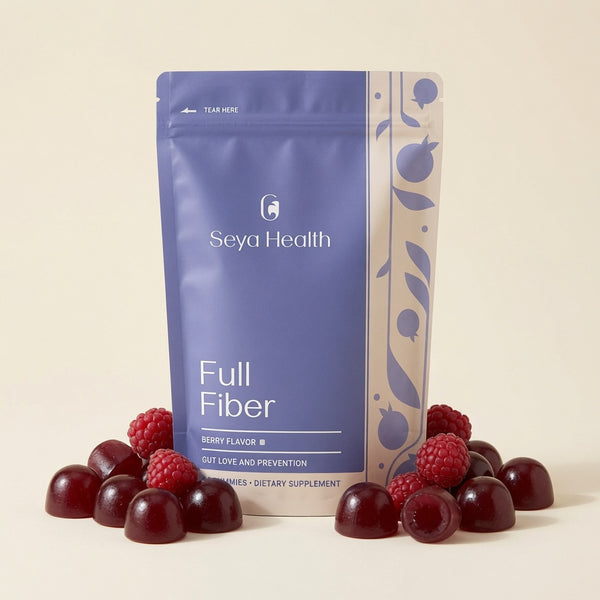
Seya Full Fiber
Most women fall short on fiber. Seya Full Fiber gives you 6 grams from three fibers in three small vegan gummies. Plant based, no gelatin, no sugar alcohols.
Shop Full FiberKeep reading

bone health
Best supplements for women over 40: what the evidence supports for heart, bones and muscles (and what's hype)

creatine
How long does creatine take to work? A realistic timeline for women

constipation