
Home/ The Journal/ best creatine for women
best creatine for women
Best creatine for women with PCOS: what to look for

Short version: For the best creatine for women with PCOS, buy single-ingredient creatine monohydrate and take 3 to 5 g daily. Choose a tub with an independent test seal. Nobody has run a creatine trial in PCOS yet, so this is a plain, low-fuss pick to use alongside lifting, with your clinician in the loop.
- Skip: "hormone" blends that bundle creatine with herbs or inositol.
- Count: grams of creatine per scoop or per gummy.
- Lift: twice a week, as the PCOS guideline suggests.
Last updated November 2026.
PCOS already comes with a long list of things to manage. Cycles, cravings, skin, hair, labs. Now creatine is trending too.
Shop for it and you hit tubs labeled for "hormone support," "cycle balance," or "women's metabolism." Some pack in five extra ingredients.
This guide cuts that down to five quick checks you can run in the store aisle or on a product page.
What is the best creatine for women with PCOS?
Single-ingredient creatine monohydrate. No brand makes a version proven for PCOS, whatever the label says.
Here is why. When we searched the research in November 2026, we found no clinical trial that gave creatine supplements to women with PCOS. The one PCOS paper with creatine in the title looked at a muscle enzyme in blood, not a supplement. See this 2019 study of creatine kinase in women with PCOS.
PCOS is common. The 2023 international guideline puts it at 10% to 13% of women. See Teede et al. (J Clin Endocrinol Metab, 2023). Yet supplement research in PCOS is thin.
That means the label claims on PCOS tubs rest on research in other groups. Your best move is to buy the version those groups were studied on.
| Check | What to look for | Why it matters |
|---|---|---|
| Ingredient list | One line: creatine monohydrate | Herb and inositol blends muddy what you take. |
| Grams per serving | 3 to 5 g in one scoop or a few gummies | Matches the daily amount in the research. |
| Sugar | Low, if it is a gummy | Many women with PCOS track added sugar. |
| Seal | Independent testing, such as NSF | No one checks supplements before they hit shelves. |
| Clinician | Told before you start | The 2023 guideline asks for this. |
Which form of creatine should you buy?
Go with monohydrate, usually the least expensive tub on the shelf.
Pricier types, like HCl or "buffered" creatine, promise better absorption or less bloat. Eleven researchers reviewed that promise in 2021. They report no published study where those types, gram for gram, push more creatine into muscle. See Antonio et al. (JISSN, 2021).
Nothing about PCOS gives a reason to think another type would suit you better. Save the money.
Our creatine forms compared guide goes deeper on each one.

Should you skip "hormone balance" blends?
For creatine, yes. Buy it on its own.
Blends that mix creatine with herbs, inositol, or "hormone" extracts make two things hard. You cannot tell what is doing what. And you cannot easily tell your clinician what you take.
The 2023 PCOS guideline says women taking inositol and other complementary therapies should tell their health professional. It also says specific types, doses, or mixes of inositol cannot yet be recommended. See the 2023 guideline.
One ingredient per product keeps it simple. If you want inositol too, buy it on its own and talk it over with your care team.
Also check for a proprietary blend. FDA label rules let a blend show one total weight without the amount of each ingredient. See 21 CFR 101.36. A creatine line in grams is what you want to see.
How much creatine should you take?
The studied range is 3 to 5 g a day, or about 0.1 g per kg of body weight. The 2021 review calls that range well tolerated. See Antonio et al. (2021).
Women may have more to gain from that daily dose. A 2021 review notes that women have 70% to 80% lower natural creatine stores than men. See Smith-Ryan et al. (Nutrients, 2021).
You do not need a loading phase. Taking a steady dose each day fills your muscles more slowly, over a few weeks. Our guide on whether you need a loading phase explains the trade-off.
Take it at any time of day. Daily matters more than timing.
How do you check that a creatine is tested?
Turn the tub around and hunt for an independent seal.
Supplements reach shelves without FDA sign-off. The agency states that it does not review or test them first. See the FDA supplement questions and answers. Quality rests on the maker.
Seals help. NSF Certified for Sport describes screening for contaminants and banned substances, plus confirming that what is listed is actually in there.
No seal on the package? Email the company and ask for a certificate of analysis tied to your lot number. Our post on creatine purity and safety covers what a good report shows.
Are creatine gummies a good option with PCOS?
Sometimes. Two numbers decide it.
First, grams of creatine per gummy. Multiply until you hit 3 to 5 g and see how many you would chew each day. Second, added sugar. Many women with PCOS keep an eye on it, and five or six gummies can add up.
Our do creatine gummies work guide walks through the sum, and best creatine gummies for women compares brands.
If the dose is too low or the sugar is too high, plain powder in water is the simple answer.
Does creatine cause hair loss with PCOS?
The worry comes from one small study. In 2009, 20 male rugby players took creatine. Their DHT, a hormone tied to hair loss, rose. Hair was not measured. See van der Merwe et al. (Clin J Sport Med, 2009).
That result has not been repeated, and it was not done in women. The 2021 expert review says current evidence does not show that creatine causes hair loss. See Antonio et al. (2021).
PCOS can already affect hair, so it is fair to ask. If thinning is a concern, raise it with your clinician before you start. Our post on whether creatine causes hair loss has the full story.
What should you pair with creatine for PCOS?
Strength training. Creatine is the small extra.
The 2023 PCOS guideline asks adults to add muscle-strengthening work on 2 non-consecutive days a week, on top of weekly aerobic activity. See Teede et al. (2023).
The research on lifting in PCOS is early. A 2022 review found only six studies. Changes were small and the evidence was weak. See Kite et al. (Med Sci, 2022).
Creatine supports strength gains when you train. It does not replace the training. Our creatine for women who lift guide covers how to start.
Who should skip creatine or ask first?
- Anyone with kidney disease. Ask before you buy.
- Anyone pregnant, trying to conceive, or breastfeeding. Ask your clinician.
- Anyone on several medicines. Have a pharmacist check the list.
- Anyone due for blood work. Creatine can nudge one kidney lab number.
That last one is a lab quirk, not harm. A 2026 meta-analysis of 19 trials found creatine raised serum creatinine by 0.13 mg/dL, with no change in eGFR. See Tsiaras et al. (J Ren Nutr, 2026). Tell your clinician you take it so your labs are read the right way. Our creatine and medications guide covers common prescriptions.
Where Seya fits, honestly
Right now we sell a fiber gummy that supports regularity. That is our only product.
A Seya creatine gummy is coming January 2027. You cannot buy it yet, and we are not naming a dose or price before the recipe is locked.
Shopping today? Run the five checks above on any brand. Creatine is not a PCOS treatment and is no swap for anything your clinician prescribed. Treat this page as education, not medical advice. For the bigger picture, start with our best creatine for women guide.
These statements have not been evaluated by the Food and Drug Administration. This product is not intended to diagnose, treat, cure, or prevent any disease.
Frequently asked questions
What is the best creatine for women with PCOS?
Single-ingredient creatine monohydrate, 3 to 5 g daily, with an independent test seal. No creatine study has been run in PCOS, so check in with your clinician first.
Is creatine monohydrate the best form for PCOS?
Yes, as far as evidence goes. A 2021 review of creatine types found nothing published showing another type loads muscle better, and nothing about PCOS changes that.
Are creatine gummies a good option with PCOS?
They can work if a few gummies add up to 3 to 5 g and the added sugar stays low. Seya's creatine gummy is coming January 2027 and cannot be bought yet.
Should I buy a creatine blend made for hormones?
Plain creatine is the simpler pick. Blends make it hard to know what you take, and the PCOS guideline asks women to tell their clinician about any complementary therapy.
Does creatine help PCOS?
No trial has tested it in women with PCOS. Creatine supports strength when you train, and the PCOS guideline does recommend muscle-strengthening exercise. Creatine is not a PCOS treatment.
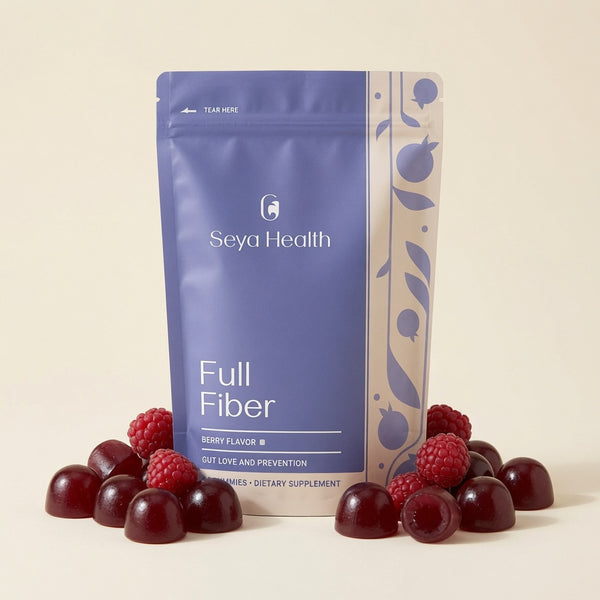
Seya Full Fiber
Most women fall short on fiber. Seya Full Fiber gives you 6 grams from three fibers in three small vegan gummies. Plant based, no gelatin, no sugar alcohols.
Shop Full FiberKeep reading

bone health
Best supplements for women over 40: what the evidence supports for heart, bones and muscles (and what's hype)

creatine
How long does creatine take to work? A realistic timeline for women

constipation