

Short version: Creatine for women who lift is one of the best-studied supplements there is, but the gains are small. A 2026 review of 34 studies in women who train found a small boost to strength, power, and lean mass. It works on top of your training, not in place of it.
- What to expect: a few more reps, slightly heavier lifts over months, a little more muscle.
- Bulky? No. Women after menopause gained about 0.37 kg of lean mass on average.
- Dose: 3 to 5 g a day of creatine monohydrate, every day.
- Skip it or ask first if you have kidney disease, are pregnant, or take daily medicine.
Last updated November 2026.
You lift two or three times a week. You track your sets. Someone at the gym says creatine helped them, and now your feed is full of it.
So is it worth adding? And will it change how your body looks in ways you did not sign up for?
Here is what the trials in women who train actually show, in plain numbers. Seya does not sell a creatine product yet, so no brand paid to be here.
Is creatine good for weightlifting?
Yes, for most people. Creatine helps most with short, hard efforts, and a set of 5 to 10 reps is exactly that.
Your muscles store creatine as a fast fuel. Food alone keeps those stores about 60% to 80% full. A daily supplement tops them up. See Kreider et al. (JISSN, 2017).
Fuller stores help your muscles keep up their power across hard sets, so you can do a bit more work each session. Over weeks, that extra work adds up. The lifting builds the strength. Creatine helps you do a bit more of it.
Want the full science of how this fuel works? Read how creatine powers strength training. This post is about what to expect as a woman who lifts.
What do meta-analyses say about creatine in women?
They say the effect is real but small, and the research is still thin.
The newest review pulled together 34 studies with 692 women who exercise or train. Here is what it found:
- Overall: a small benefit (an effect size of 0.23).
- Strength, power, and hard efforts: a small benefit (0.30).
- Lean mass and body shape: a small benefit (0.24).
The authors rated their certainty as low. The studies used very different plans and doses. See Lin et al. (Front Nutr, 2026).
An earlier review of 23 trials found clear gains in men but not in women. There were only 49 women in it, so it could not say much. See Wang et al. (Nutrients, 2024).
A review written just about women still concluded that creatine appears to help strength before menopause. See Smith-Ryan et al. (Nutrients, 2021).
Creatine for women who lift: does it make you stronger?
It can, when you pair it with steady lifting. The clearest numbers come from women after menopause.
A 2026 review pooled 7 trials with 608 postmenopausal women. Those on creatine added about 7.5 kg more to their leg press than women on a placebo. See Naddafha et al. (JISSN, 2026).
Two details matter here:
- The gains showed up when women took 5 g or more a day and lifted.
- Trials with 3 g or less a day and no lifting showed no effect.
So the lifting is not optional. Creatine on its own did not make women stronger. If you are curious about creatine without the gym, see creatine if you don't work out.

How does creatine build muscle?
Mostly by helping you train a little harder. More reps over time is a stronger signal for muscle to grow.
Creatine also pulls water into your muscle cells. Experts say that extra cell water may itself be a signal for growth. See Antonio et al. (JISSN, 2021).
But keep the size of this in view. A review of 10 trials scanned muscles directly with MRI or ultrasound. Creatine plus lifting added only about 0.1 to 0.16 cm of muscle thickness compared with lifting alone. The authors called it a "very small" effect. See Burke et al. (Nutrients, 2023).
That is a real gain. It is not a new body.
Will creatine make women bulky?
No. The numbers are far too small for that.
In the postmenopausal review, women on creatine gained about 0.37 kg of lean mass more than placebo. That is less than a pound, over months of training. See Naddafha et al. (2026).
What you may notice is the scale moving in week one. If you start with a big "loading" dose, you can gain 1 to 3 kg in about a week. Most of that is water stored inside the muscle, not fat. See Antonio et al. (2021).
Skip the loading dose and that jump is usually smaller and slower. For a week-by-week look, read the creatine weight gain timeline.
Want to look leaner and stronger? That comes from lifting, protein, and sleep. Creatine is a small helper on top. For how training itself should differ for women, see women aren't smaller men.
How much creatine should women take for strength training?
Most experts say 3 to 5 g a day, or about 0.1 g per kg of body weight. See Antonio et al. (2021).
A few simple rules:
- Pick monohydrate. It is the form used in nearly all of the trials.
- Take it every day, rest days too. It works by filling your stores over weeks, not by a pre-workout kick.
- Loading is optional. In one classic study, 3 g a day for 28 days raised muscle creatine about as much as 20 g a day for 6 days. See Hultman et al. (J Appl Physiol, 1996) and do you need a loading phase.
- Timing is a minor detail. See before or after your workout.
Lifting after menopause? The trials that worked used 5 g or more a day. That is a useful line to aim for. See creatine for menopause.
Do women need creatine if they eat little meat?
You may get more out of it. Creatine comes mostly from meat and fish, so plant-based eaters tend to start lower.
In one 8-week lifting trial, vegetarians began with less creatine in their muscles. On creatine, they gained more muscle creatine, more lean tissue, and did more total work than meat eaters. See Burke et al. (Med Sci Sports Exerc, 2003).
A 2025 trial in 15 vegans and vegetarians found creatine raised muscle creatine in one week. But sprint power did not change in that short time. See Bonne et al. (Physiol Rep, 2025).
The takeaway: if you eat little meat, creatine fills a bigger gap. The payoff still comes from weeks of training.
Is long-term creatine use safe for women?
For healthy adults, the research is reassuring. The leading sports nutrition group found no good evidence of harm from up to 30 g a day for 5 years in healthy people. See Kreider et al. (2017).
In the postmenopausal trials, side effects were mild and similar to placebo. Kidney tests did not change. See Naddafha et al. (2026).
Talk to your doctor first if you:
- have kidney disease or reduced kidney function,
- are pregnant or breastfeeding,
- take daily prescription medicine.
Creatine can also raise a blood marker called creatinine without harming the kidneys, per a 2025 review in BMC Nephrology. Tell your doctor you take it before lab work, and see creatine vs creatinine. For more, see is creatine safe for women and creatine side effects in women.
Where Seya fits, honestly
Seya sells one product today: a fiber gummy that supports regularity. Our creatine gummy is coming January 2027. It is not on sale yet, and we will not share its dose, price, or ingredients until the formula is final.
Until then, any plain monohydrate with an outside lab seal will do the job. See how to choose a creatine. This is education, not medical advice. No supplement can promise results.
These statements have not been evaluated by the Food and Drug Administration. This product is not intended to diagnose, treat, cure, or prevent any disease.
Frequently asked questions
Is creatine good for weightlifting?
Yes. It tops up the fast fuel your muscles use for short, hard sets, so you can do a bit more work each session. The training itself builds the strength.
What are the benefits of creatine for women's strength training?
A 2026 review of 34 studies in women who train found small gains in strength, power, and lean mass. Certainty was low, so expect modest results.
Does creatine work for older women?
In 7 trials of postmenopausal women, creatine plus lifting added about 7.5 kg to leg press and 0.37 kg of lean mass versus placebo. It worked at 5 g or more a day with training.
Will creatine make women bulky?
No. Lean mass gains in women average well under 1 kg. Any early jump on the scale is mostly water stored in muscle.
How much creatine should women take for strength training?
3 to 5 g of creatine monohydrate a day, or about 0.1 g per kg of body weight. Take it daily, including rest days.
Do women need creatine if they eat little meat?
They may benefit more. Vegetarians start with lower muscle creatine and, in one lifting trial, gained more lean tissue on creatine than meat eaters.
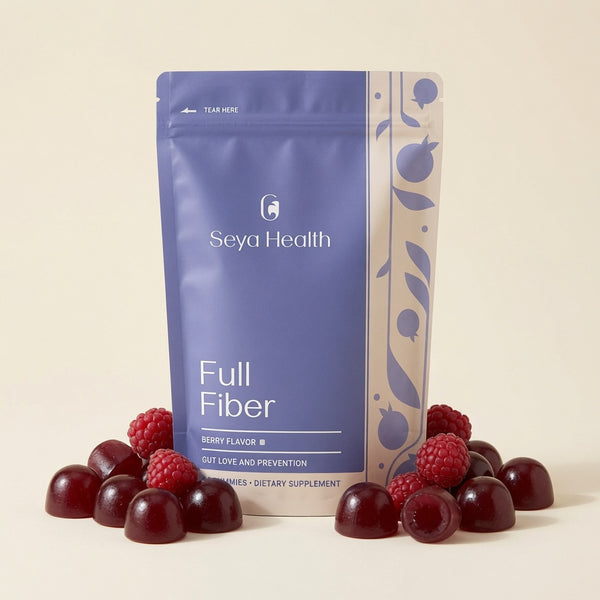
Seya Full Fiber
Most women fall short on fiber. Seya Full Fiber gives you 6 grams from three fibers in three small vegan gummies. Plant based, no gelatin, no sugar alcohols.
Shop Full FiberKeep reading

bone health
Best supplements for women over 40: what the evidence supports for heart, bones and muscles (and what's hype)

creatine
How long does creatine take to work? A realistic timeline for women

constipation