
Home/ The Journal/ digestive health
digestive health
Soluble vs. Insoluble Fiber: Which Does a Woman's Gut Actually Need?

Short version: The soluble vs insoluble fiber question has one honest answer. A woman's gut needs both. Soluble fiber turns to gel and calms things. Insoluble fiber adds bulk and moves things. The FDA target is 28 g a day, and most women get about half.
- The FDA Daily Value for fiber is 28 g a day. The average American woman gets closer to 15 g.
- In a 275-person trial, soluble fiber helped 57% of IBS patients, versus 35% on placebo. Insoluble bran made symptoms worse for some.
- Only about 5% of Americans hit the fiber target at all, so the real goal is closing the gap, not picking a side.
Last updated August 2026.
You eat salad. You eat whole grain bread. You still feel bloated, or stuck, or both.
Here is the part nobody explains. Not all fiber does the same job. There are two main kinds, and the soluble vs insoluble fiber split decides how your gut actually feels.
The direct answer: a woman's gut needs both, in balance. Soluble fiber forms a gel and softens things. Insoluble fiber adds bulk and speeds things up. And most of us are short on the whole category. The FDA sets the Daily Value at 28 g a day, yet the average American woman gets about 15 g, per the FDA's own labeling rule, 21 CFR 101.9. That gap is the real problem. The rest is below.
Soluble vs insoluble fiber: what is the difference?
One dissolves. One does not. That is the whole split.
Soluble fiber dissolves in water and turns into a gel. That gel slows digestion, which is how it softens stool and blunts a blood-sugar spike. Insoluble fiber does not dissolve. It stays intact, adds bulk, and pushes things through faster. The MedlinePlus medical encyclopedia lays out both mechanisms plainly.
So they are not competitors. They are two tools for two jobs.
| Type | What it does | Best for |
|---|---|---|
| Soluble fiber | Absorbs water, forms a gel, slows digestion | Softer stool, steadier blood sugar, heart |
| Insoluble fiber | Adds bulk, holds its shape, speeds transit | Regularity, that stuck, heavy feeling |
Most plant foods carry a mix of both. You are not choosing one over the other at the grocery store. You are just making sure enough of each lands on your plate.
What foods have soluble fiber, and what foods have insoluble fiber?
The easy way to remember it: soluble is soft foods, insoluble is scratchy foods.
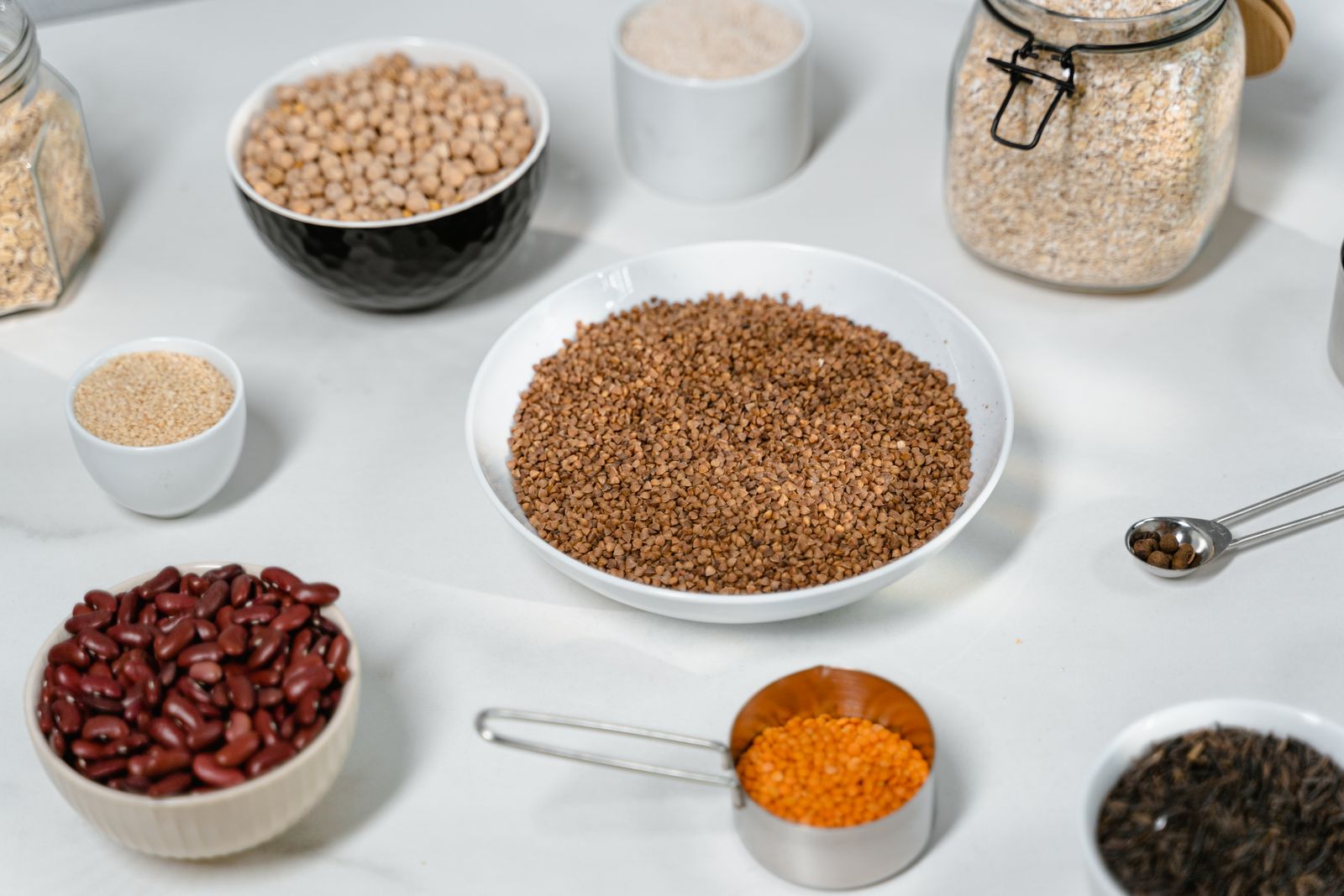
Soluble fiber shows up in oats, beans, lentils, apples, blueberries, and chia seeds. Insoluble fiber lives in wheat bran, whole wheat, quinoa, brown rice, leafy greens like kale, nuts, and the skins on fruit. That split comes from the Harvard T.H. Chan School of Public Health fiber guide.
A few foods are stars because they carry a lot of one type:
- Soluble-heavy: oats, barley, beans, lentils, apples, oranges, psyllium.
- Insoluble-heavy: wheat bran, whole grains, nuts, seeds, and vegetable skins.
You do not need a spreadsheet. Eat a range of plants across the week and both types come along for the ride. Want the full grocery list built for women? We keep one in high fiber foods for women.
Which type does a woman's gut actually need?
Both. But if your gut is touchy, the type matters more than you think.
Here is where it gets specific for women who deal with bloating, cramping, or IBS. Soluble and insoluble fiber affect a sensitive gut very differently.
A 2009 trial in The BMJ put 275 primary-care IBS patients on 10 g of soluble fiber (psyllium), 10 g of insoluble fiber (bran), or a placebo for 12 weeks. In the first month, 57% of the psyllium group felt better, versus 35% on placebo, a relative risk of 1.60. Bran did not beat placebo, and it caused the most dropouts, because it made symptoms worse for some people. Read the randomized trial of soluble versus insoluble fiber in irritable bowel syndrome.
So the bloat you have been blaming on yourself may not be a discipline problem at all. For a lot of women, it is a fiber-type mismatch. Too much scratchy bran, not enough gel. That is a signal, not a character flaw, and it is one you can adjust.
The practical read: if your gut is calm, get both freely. If your gut flares, lean soluble first and add insoluble slowly. We go deeper on the touchy-gut version in flaxseed vs psyllium for perimenopause constipation.
What is prebiotic fiber and resistant starch?
This is the part that connects fiber to your gut bacteria. And it sits mostly on the soluble side.
Some soluble fibers do more than form a gel. They also feed the bacteria in your colon. Those bacteria ferment the fiber and make short-chain fatty acids, including butyrate, the main fuel your colon cells run on. That is the prebiotic effect, described in a review of colonic fermentation and short-chain fatty acids.
Resistant starch is one of these fermentable fibers. It resists digestion in the small intestine and reaches the colon intact, where your bacteria treat it as food. It behaves like a soluble, prebiotic-type fiber, per a physiological review of resistant starch and short-chain fatty acids.
Resistant tapioca starch is one source of it, and it is the fiber Seya uses. If you want the plain-English version of how that works, we wrote what resistant tapioca starch is. The short version: it is a soluble-type fiber that feeds your gut, not just fills it.
How do you get both kinds of fiber in a day?
You do not track grams of each. You build a plate that carries both by default.
A simple pattern works:
- Soluble at breakfast. Oats, chia, or berries. The gel-formers.
- Insoluble at lunch and dinner. Whole grains, leafy greens, and skins-on vegetables. The bulk.
- Beans and lentils anytime. They carry a strong dose of both.
- Water with all of it. Fiber needs fluid to do its job, especially the soluble gel.
And go slow. Add about 3 to 5 g at a time and hold it a few days. Pile it on too fast and you buy gas and bloating, which is the opposite of the point.
Why does the gap stay so wide even when you try? Only about 5% of Americans meet the fiber recommendation at all, per a fiber-intake review in the American Journal of Lifestyle Medicine. This is not a you problem. It is a food-supply problem. The full picture is in what fiber actually does in a woman's body, and the after-40 angle is in fiber and gut health after 40.
Where Seya fits, honestly
Seya makes one product at launch. A fiber gummy.
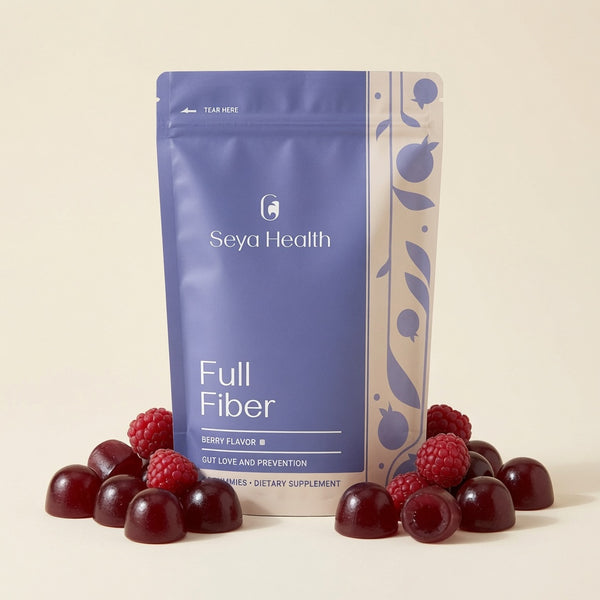
Three vegan gummies deliver about 5 g of resistant tapioca fiber, a soluble, prebiotic-type fiber. That is real fiber toward your 28 g day, and it is honest to grade its evidence a C, since 5 g is about half the 10 g dose the studies leaned on. So we make one claim. It supports regularity.
It does not fix a medical condition, and it is not a full day of fiber on its own. It does not replace the beans, the oats, and the greens. It is one soluble-side nudge toward a target most women miss.
The soluble side has a real heart footnote, too, though it is modest. The FDA authorizes a claim that 7 g a day of soluble fiber from psyllium, or 3 g of oat and barley beta-glucan, may lower heart-disease risk, written into federal regulation, 21 CFR 101.81. In one review, roughly 10 g of psyllium a day lowered LDL cholesterol by about 13 mg/dL, per a 2018 meta-analysis in the American Journal of Clinical Nutrition. Real, but a lever, not a drug.
This is education, not medical advice. Talk to your clinician before adding a supplement, especially if you have IBS or take daily medication.
These statements have not been evaluated by the Food and Drug Administration. This product is not intended to diagnose, treat, cure, or prevent any disease.
Frequently asked questions
What is the difference between soluble and insoluble fiber?
Soluble fiber dissolves in water and forms a gel that slows digestion, softens stool, and blunts blood-sugar spikes. Insoluble fiber does not dissolve; it adds bulk and speeds transit, which is what keeps you regular. Most plant foods carry a mix of both, so the goal is not to pick one but to get enough of the whole category. The FDA Daily Value is 28 g a day, and the average American woman gets about 15 g.
What foods have soluble fiber, and what foods have insoluble fiber?
Soluble fiber is highest in oats, barley, beans, lentils, apples, oranges, chia seeds, and psyllium. Insoluble fiber is highest in wheat bran, whole wheat, quinoa, brown rice, leafy greens like kale, nuts, seeds, and the skins on fruit. Many foods, like beans and apples, carry both. Eating a range of plants across the week is the simplest way to cover both types without counting grams.
Which type of fiber does a woman's gut actually need?
Both, but the balance matters if your gut is sensitive. In a 2009 BMJ trial of 275 IBS patients, soluble fiber (psyllium) helped 57% of people versus 35% on placebo, while insoluble bran did not beat placebo and made symptoms worse for some, causing the most dropouts. If your gut is calm, get both freely. If it flares with bloating or IBS, lean soluble first and add insoluble slowly.
What is resistant starch, and is it soluble fiber?
Resistant starch is a fiber that resists digestion in the small intestine and reaches the colon intact, where gut bacteria ferment it into short-chain fatty acids like butyrate, the main fuel for colon cells. It behaves like a soluble, prebiotic-type fiber, feeding your gut rather than just adding bulk. Resistant tapioca starch is one source of it, and it is the fiber Seya uses in its gummy.
How do you get both kinds of fiber in a day?
Build a plate that carries both by default: soluble foods like oats, chia, and berries at breakfast, and insoluble foods like whole grains, leafy greens, and skins-on vegetables at lunch and dinner. Beans and lentils bring a strong dose of both. Drink water with all of it, since fiber needs fluid to work, and add fiber slowly, about 3 to 5 g at a time, to avoid gas and bloating. Only about 5% of Americans meet the fiber target, so closing the gap matters more than perfecting the ratio.
Related reading
- How Much Fiber Do Women Actually Need? Grams by Age, and Why It's More Than You Think
- Brown Rice vs. White Rice vs. Bread: Which Carbs Give Women the Most Fiber?
Seya Full Fiber
More than 90% of women fall short on fiber. Seya Full Fiber gives you 6 grams from three fibers in one, in three small gummies that feed the beneficial bacteria in your gut. Plant based, no gelatin, no sugar alcohols.
Shop Full FiberKeep reading
fiber
Can a Multivitamin Replace Vegetables? What Supplements Can't Do for Your Gut

constipation
The Best Way to Beat Constipation in Your 30s (and Where Fiber Gummies Fit)
fiber
The Gut-Skin Axis: Does Your Gut Health Affect Your Skin?
The gut-skin axis, explained: how your gut bacteria and blood sugar affect your skin, w...