Home/ The Journal/ constipation
constipation
Partially hydrolyzed guar gum: the gentle fiber for constipation?

Short version: Partially hydrolyzed guar gum (PHGG) is a gentle fiber, and it may help some people with constipation. It mixes thin, has almost no taste, and tends to cause little gas. In one small study of 39 adults with chronic constipation, 4 weeks of PHGG cut the time stool spent in the colon from about 57 hours to 46 hours. But most constipation studies on PHGG were small or had no placebo group. Psyllium still has the stronger proof.
- What it is: guar bean fiber, cut into shorter pieces so it dissolves instead of turning to gel. Sunfiber is the best-known brand.
- Best evidence: less bloating in a 12-week placebo trial in IBS, at 6 g a day.
- Weaker evidence: regularity. Results range from helpful to no change.
- Usual dose in studies: 5 to 6 g a day, for at least 4 weeks.
Last updated November 2026.
Maybe you tried psyllium and it felt like drinking wet sand. Maybe bran left you puffy by lunch. So now you are looking for a fiber that is easier on you.
PHGG keeps coming up. People call it the gentle fiber. That part is mostly true. The harder question is whether it actually gets things moving. Here is what the trials show, study by study, including the ones that found nothing.
What is partially hydrolyzed guar gum?
It is fiber from the guar bean, a pod plant also called cluster bean. Plain guar gum is very thick. Food makers use tiny amounts of it to thicken ice cream and sauces.
To make PHGG, an enzyme cuts those long fiber chains into shorter ones. "Partially hydrolyzed" just means "partly broken down." The shorter chains still count as soluble fiber. But they no longer form a gel. Stir a scoop into water or coffee and it disappears.
That is the whole reason it feels gentle. There is no sludge to choke down, and no thick gel sitting in your stomach. A 2026 review of guar fiber and gut health calls PHGG one of the most studied fibers in people. It also says the data "vary in quality and maturity" from one outcome to the next. Keep that line in mind.

Does PHGG help with constipation?
It might, but the proof is thinner than the marketing. Here are the studies on PHGG and slow, hard, or rare bowel movements:
| Study | Who | Dose and time | Placebo group? | What happened |
|---|---|---|---|---|
| Polymeros, 2014 | 49 adults with chronic constipation (39 finished) | Daily PHGG, 4 weeks | No | Colon transit fell from about 57 to 46 hours. More bowel movements per week. |
| Russo, 2015 | 68 adults with IBS and constipation | Daily PHGG, 4 weeks | No | Better symptom scores, stool form, and transit. Less laxative use. |
| Chan, 2022 | 52 care-home residents, average age 84 | 5 g a day in water, 4 weeks | Yes (plain water) | No change in how often they went or stool form. Fewer laxatives in weeks 3 and 4. |
The best news is in the first study. Stool moved faster, and the biggest change was in people with the slowest guts. Their transit time dropped from about 86 hours to 64 hours.
But that study had no placebo group. Neither did the second. People in a study often feel better just from being in it. So those gains are a hint, not proof.
The one placebo-style trial was mixed. Older adults in care homes did not go more often. They did need fewer laxatives by the third week. That is a real, if small, result.
How does PHGG compare with other fibers in the research?
Not as well as psyllium so far. A 2022 review of 16 randomized trials with 1,251 adults looked at fiber for chronic constipation. Psyllium and pectin were the fibers with clear effects. Doses above 10 g a day and at least 4 weeks worked best. The review did not single out PHGG.
Why do people call PHGG the gentle fiber?
Because in trials, people tend to stick with it. That says a lot about how it feels day to day.
The clearest example is a 12-week randomized trial in IBS. It enrolled 121 people. Half got 6 g of PHGG a day, and half got a placebo. The PHGG group had less bloating and gas than the placebo group. The benefit lasted at least 4 weeks after they stopped. Only 22% of the PHGG group dropped out, compared with 49% on placebo.
Notice what it did not change. Pain scores, quality of life, and other IBS symptoms stayed about the same. The win was comfort, mainly less bloating.
Gentle is not the same as gas-free, though. In a 2024 lab study using stool samples from 41 people, gut bacteria still fermented PHGG and made gas. Your bacteria feed on it, which is part of the point. Most people just notice less of it than with inulin or chicory root.
If bloating is your main problem, read our guide to fiber and IBS too.
Can PHGG help loose stools too?
Yes, which surprises a lot of people. PHGG seems to nudge stool toward normal from both sides.
In a 3-month placebo trial of 44 adults who tended toward loose stools, PHGG made stool form more normal. It did not change how often they went. Their gut bacteria shifted too, with more Bifidobacterium.
A 3-week trial in 20 healthy adults also found changes in stool frequency and form. But most of those changes faded once people stopped. So if PHGG works for you, it works while you take it. It is a daily habit, not a one-time fix.
How do you take PHGG for constipation?
Start low, give it a month, and drink water. Here is the routine that matches the studies:
- Dose: about 5 to 6 g a day. That was the amount in the care-home trial and the IBS trial. Some products split this into two servings.
- Start: try half a dose for the first week if your gut is touchy, then build up.
- Mix: stir it into water, coffee, tea, or soup. It should not thicken.
- Fluids: drink a full glass with it. The care-home trial used 200 ml of water, a little under one cup.
- Time: judge it after 4 weeks, not 4 days. The care-home group only saw fewer laxatives by week 3.
- Pair it: food fiber still matters most. Women 19 to 50 need about 25 g a day in total, per a 2017 review of US fiber intake. See how much fiber women need per day.
Take medicines at a different time of day from any fiber supplement unless your pharmacist says otherwise. And check with your clinician first if you have had a bowel blockage, trouble swallowing, or gut surgery.
PHGG vs psyllium: which should you try first?
If your main goal is more regular bowel movements, psyllium has the better proof. If psyllium made you gassy or you could not stand the texture, PHGG is a fair next try.
| PHGG | Psyllium | |
|---|---|---|
| Texture in water | Thin, dissolves | Thick gel |
| Taste | Almost none | Mild, grainy |
| Regularity evidence | Small studies, mixed | Strongest of any fiber in the 2022 review |
| Bloating evidence | Placebo trial in IBS | Usually low gas |
| Studied dose | 5 to 6 g a day | Often over 10 g a day |
For the full ranking of soluble fibers, including tapioca fiber and inulin, see the best soluble fiber supplements. To compare powders, pills, and gummies, read the best fiber supplement for constipation. If fiber alone is not enough, magnesium citrate for constipation explains a different route.
When is constipation more than a fiber problem?
Fiber helps everyday slow digestion. It is not the answer for everything. The NIDDK says to see a doctor right away if you are constipated and have any of these:
- Bleeding from your rectum or blood in your stool
- Constant pain in your belly
- Being unable to pass gas
- Vomiting, fever, or lower back pain
- Losing weight without trying
Also see a doctor if self-care does not help, or if colon or rectal cancer runs in your family.
Where does Seya fit, honestly?
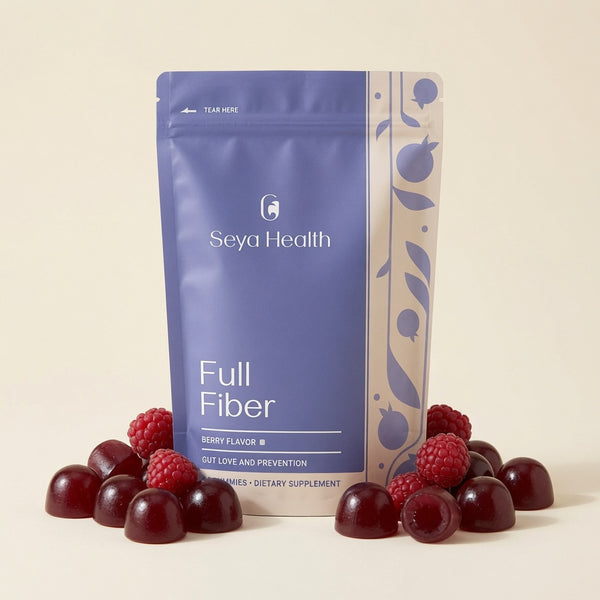
Seya Full Fiber does not contain PHGG. It is a vegan gummy made mostly with resistant tapioca fiber, about 6 g in three gummies, plus 80 mg of magnesium citrate and 100 mg of ginger root. It supports regularity. It has 3 g of added sugar and no sugar alcohols.
If you want PHGG itself, buy a PHGG powder. If you want a chewable fiber you will actually remember to take, that is where our gummy fits. Either way, about 6 g is a top-up, not your whole day. A Seya creatine gummy is coming January 2027.
This is education, not medical advice. If you take daily medication or have a gut condition, check with your clinician first.
These statements have not been evaluated by the Food and Drug Administration. This product is not intended to diagnose, treat, cure, or prevent any disease.
Frequently asked questions
Is partially hydrolyzed guar gum good for constipation?
It may help some people. A small study without a placebo group found faster colon transit and more bowel movements after 4 weeks. A placebo-style trial in care-home residents found no change in bowel frequency but less laxative use. Psyllium has stronger evidence.
How long does PHGG take to work?
Give it about 4 weeks. Most studies ran 4 to 12 weeks, and the care-home trial saw less laxative use only in weeks 3 and 4.
How much PHGG should I take a day?
Studies mostly used 5 to 6 g a day. Start with less if your gut is sensitive, and drink a full glass of water with it.
Is Sunfiber the same as PHGG?
Yes. Sunfiber is a brand name for partially hydrolyzed guar gum. Other brands sell PHGG under their own names.
Does PHGG cause gas or bloating?
Usually less than other fermentable fibers. In a 12-week IBS trial, 6 g a day lowered bloating scores compared with placebo. It still makes some gas as gut bacteria ferment it.
Is PHGG better than psyllium?
For texture and taste, many people prefer PHGG. For regularity, psyllium has more proof, mostly at doses over 10 g a day.
Written and reviewed by the Seya Health Editorial Team. Every health claim on this page is sourced to primary research. Study details were checked against the published abstracts in November 2026. This article is educational and not a substitute for medical advice.
Seya Full Fiber
Most women fall short on fiber. Seya Full Fiber gives you 6 grams from three fibers in three small vegan gummies. Plant based, no gelatin, no sugar alcohols.
Shop Full Fiber