Home/ The Journal/ fiber supplements
fiber supplements
The Best Soluble Fiber Supplements: Psyllium, Tapioca, Sunfiber (PHGG), and Inulin Ranked

Short version: For staying regular, psyllium is the best soluble fiber supplement on the evidence. In a 2022 review of 16 trials, 66% of adults with constipation improved on fiber vs. 41% on placebo, and psyllium was the standout. Sunfiber (PHGG) is the gentlest on gas. Inulin feeds gut bacteria but causes the most gas. Resistant tapioca fiber is easy to take but has less research.
- Best for regularity: psyllium. It also has the strongest data for lower LDL cholesterol.
- Gentlest: partially hydrolyzed guar gum (PHGG), sold as Sunfiber. Best data is for bloating in IBS.
- Best prebiotic: inulin. Real gains in stool frequency, but the most gas of the four.
- Easiest to take daily: resistant tapioca fiber, common in gummies. Fewer trials, so smaller claims.
Last updated October 2026.
"Soluble fiber" sounds like one thing. It is not.
Psyllium turns into a thick gel. Inulin stays thin and gets eaten by gut bacteria. PHGG sits in between. Each one does a different job in your gut, and each one has a different track record in studies.
So we ranked the four you see most on labels. We scored them on three things: how well they help you stay regular, how much gas they cause, and how strong the research is. Here is what came out on top, and who each one suits.
What is the best soluble fiber supplement?
Psyllium, if your main goal is regularity. It has more trials, larger effects, and better tolerance than the others.
The clearest proof comes from a 2022 meta-analysis of 16 randomized trials with 1,251 adults who had chronic constipation, per van der Schoot et al., American Journal of Clinical Nutrition, 2022 (PMID 35816465). Fiber worked better than placebo overall. But when the authors broke it down by type, psyllium and pectin were the fibers with significant effects.
The review also found what "enough" looks like. Gains showed up at doses above 10 g a day, taken for at least 4 weeks.
That does not make psyllium right for everyone. If gas is your problem, or you hate thick drinks, another fiber may be the better fit. Here is the full ranking.
Soluble fiber supplements ranked: the comparison table
Use this as a quick guide. Ratings reflect the human trials cited below, not marketing claims.
| Rank | Fiber | Gel or thin? | Regularity evidence | Gas and bloating | Best for |
|---|---|---|---|---|---|
| 1 | Psyllium husk | Thick gel | Strong | Low | Constipation, LDL cholesterol |
| 2 | PHGG (Sunfiber) | Thin | Mixed | Low | Sensitive guts, bloating |
| 3 | Inulin (chicory root) | Thin | Moderate | Highest | Feeding gut bacteria |
| 4 | Resistant tapioca fiber | Thin | Limited | Less studied | An easy daily habit |
Sources: van der Schoot 2022; Gunn 2022; Niv 2016; Collado Yurrita 2014. "Gel or thin" follows the fiber groups in McRorie and McKeown, Journal of the Academy of Nutrition and Dietetics, 2017 (PMID 27863994).
Why does it matter if a fiber forms a gel?
Because the gel is what holds water in your stool.
The 2017 McRorie review split soluble fibers into two kinds. Gel-forming fibers like psyllium are fermented slowly. Much of the gel reaches the end of your colon intact, so it keeps stool soft and bulky. Thin fibers like inulin are fermented quickly by bacteria. They get used up on the way, so they hold less water by the time stool forms.
That one fact explains most of this ranking. The gel fiber wins on regularity. The fast-fermenting fibers win on feeding bacteria, and they lose on gas.
For a deeper look at the fiber families, see our guide to fiber types and soluble vs. insoluble fiber.

1. Psyllium: the best soluble fiber for regularity
Psyllium comes from the husk of Plantago ovata seeds. It is the fiber in Metamucil and in most store-brand fiber powders.
It has the deepest stack of human trials. A few that stand out:
- Softer stool. In a trial of 170 adults with chronic constipation, 5.1 g of psyllium twice a day raised stool water and total stool output more than the stool softener docusate, per McRorie et al., Alimentary Pharmacology and Therapeutics, 1998 (PMID 9663731).
- IBS. In a 12-week trial of 275 adults with IBS, 57% responded to 10 g of psyllium in the first month vs. 35% on placebo. Wheat bran did worse, and people quit it most often, per Bijkerk et al., BMJ, 2009 (PMID 19713235).
- Cholesterol. A meta-analysis of 28 trials found about 10 g of psyllium a day lowered LDL cholesterol by 0.33 mmol/L, roughly 13 mg/dL, per Jovanovski et al., American Journal of Clinical Nutrition, 2018 (PMID 30239559). The FDA allows a heart-health claim for 7 g or more a day of soluble fiber from psyllium as part of a diet low in saturated fat and cholesterol, under 21 CFR 101.81.
It is also kinder on gas than you might expect. In a 2022 MRI study of 19 adults with IBS, inulin raised colon gas, while psyllium did not raise breath hydrogen, a marker of fermentation, per Gunn et al., Gut, 2022 (PMID 34353864).
The trade-offs. The helpful dose is big, often 10 g or more. Powders thicken fast and can feel gritty. And it must go down with plenty of fluid. FDA rules require psyllium and other gum fibers sold as laxatives to carry a choking warning, because they can swell and block the throat if taken without enough water, per 21 CFR 201.319.
Comparing psyllium brands? Our better-than-Metamucil guide breaks down the labels, and flaxseed vs. psyllium covers another option.
2. Sunfiber (PHGG): the gentlest soluble fiber
PHGG stands for partially hydrolyzed guar gum. Plain guar gum is very thick. PHGG is guar that has been broken into shorter pieces, so it mixes into water without a gel. Sunfiber is the best-known brand. It is made by Taiyo.
Its strength is comfort. The studies:
- Bloating. In a 12-week double-blind trial of 121 adults with IBS, 6 g of PHGG a day eased bloating scores more than placebo. It did not change other IBS symptoms, per Niv et al., Nutrition and Metabolism, 2016 (PMID 26855665).
- Easier than bran. In an open trial of 188 IBS patients, about half of the wheat bran group switched to PHGG after 4 weeks. Only about 1 in 10 went the other way, per Parisi et al., Digestive Diseases and Sciences, 2002 (PMID 12184518).
For constipation, the picture is mixed. In 52 nursing-home residents, 5 g of PHGG a day did not change bowel frequency, but they used fewer laxatives by weeks 3 and 4, per Chan et al., Journal of Nutrition, Health and Aging, 2022 (PMID 35297467). In 60 constipated women, an inulin and PHGG blend did no better than placebo for bowel movements over 3 weeks, per Linetzky Waitzberg et al., Nutrición Hospitalaria, 2012 (PMID 22566311).
The trade-offs. Smaller trials, and some are funded by the maker. The research is strongest for bloating and IBS-type symptoms, not classic constipation.
3. Inulin: the best prebiotic, with the most gas
Inulin is a thin soluble fiber, usually made from chicory root. Gut bacteria ferment it fast, and it reliably feeds bifidobacteria. That makes it a true prebiotic. We cover that side in what prebiotic fiber does for your gut.
It does help regularity, a bit:
- In a 4-week crossover trial of 44 adults with constipation, 12 g of chicory inulin a day raised stool frequency from a median of 3 to 4 a week vs. placebo, per Micka et al., International Journal of Food Sciences and Nutrition, 2017 (PMID 27492975).
- A meta-analysis of 5 trials with 252 people found inulin improved stool frequency and consistency. Pain and bloating did not improve, per Collado Yurrita et al., Nutrición Hospitalaria, 2014 (PMID 25208775).
The trade-off is gas. In the 2022 Gut MRI study, inulin caused the biggest rise in colon gas of anything tested. At lower doses it is easier. Healthy adults handled up to 10 g a day of native inulin in a 2010 trial, with gas as the main complaint, per Bonnema et al., Journal of the American Dietetic Association, 2010 (PMID 20497775).
Inulin also shows up in foods like Jerusalem artichoke. See our Jerusalem artichoke guide.
4. Resistant tapioca fiber: easy to take, less research
Resistant tapioca fiber comes from cassava. It resists digestion, so it reaches the colon, where bacteria ferment it. It is thin, mild in taste, and holds its shape well, which is why it shows up in gummies and bars.
Here is the honest part. We could not find trials that test it head to head against psyllium, PHGG, or inulin for regularity or gas. So it ranks fourth on evidence, not because it fails, but because it has not been tested as much. We explain the ingredient in what resistant tapioca starch is.
Its real advantage is the habit. A fiber you take every day beats a better fiber that sits in the cupboard.
Which soluble fiber should you choose?
Match the fiber to your goal:
- You want to stay regular. Start with psyllium. Aim to build toward the 10 g range the trials used, with a full glass of water.
- Fiber usually makes you bloated. Try PHGG at around 5 to 6 g a day, the dose used in the IBS trials.
- You want to feed your gut bacteria. Inulin, but start with 2 to 3 g and build slowly.
- You keep skipping your fiber. Pick the form you will actually take, like a gummy, and add fiber-rich food around it.
- You want LDL support. Psyllium has the strongest data and the FDA-allowed claim.
Whatever you pick, go slow. Add a few grams, hold for a week, then add more. Drink enough water. If you take daily medicine, ask your pharmacist how to time it with fiber. Our post on how fiber supplements work covers timing and safety.
See a clinician if constipation is new, comes with pain, blood in stool, or weight loss, or does not improve after a few weeks.
How much soluble fiber do you need a day?
There is no separate target for soluble fiber. The goal is total fiber: about 25 g a day for women up to age 50, and about 21 g after, per the National Academies.
A supplement is a top-up, not the whole plan. Oats, beans, lentils, apples, and chia seeds all add soluble fiber. For a full list, see our high-fiber foods for women. If you are comparing products, our guide to the best fiber supplements for women covers labels, price per gram, and what to skip.
Where does Seya fit, honestly?
Seya Full Fiber is a vegan gummy made with resistant tapioca fiber. Three gummies give about 6 g of fiber, plus magnesium citrate and ginger root.
By our own ranking, that puts us in the fourth slot on evidence. We are fine with that. At this dose, the honest claim is that it supports regularity and helps close part of your daily fiber gap. If your main goal is constipation relief, psyllium powder has more proof. If you want an easy daily habit with no gel and no sugar alcohol, a fiber gummy is one option. Our Seya vs. Metamucil gummies comparison shows the labels side by side.
This is education, not medical advice.
These statements have not been evaluated by the Food and Drug Administration. This product is not intended to diagnose, treat, cure, or prevent any disease.
Frequently asked questions
What is the best soluble fiber supplement?
For regularity, psyllium has the strongest evidence. A 2022 meta-analysis of 16 trials found psyllium and pectin were the fibers with significant effects on constipation, mostly at doses above 10 g a day for at least 4 weeks. PHGG is gentler on gas, and inulin is the strongest prebiotic.
Is psyllium soluble fiber?
Yes. Psyllium husk is mostly soluble fiber that forms a thick gel in water. Because gut bacteria ferment it slowly, much of that gel reaches the end of the colon intact, where it holds water and keeps stool soft and bulky. That is why it does well in constipation trials.
Which soluble fiber causes the least gas?
Psyllium and PHGG tend to cause the least. In a 2022 MRI study in adults with IBS, inulin raised colon gas, while psyllium did not raise breath hydrogen, a sign of fermentation. In a separate IBS trial, 6 g a day of PHGG eased bloating scores vs. placebo. Inulin causes the most gas of the common options.
Is Sunfiber gentler than psyllium?
For many people, yes, in feel. Sunfiber is PHGG, which mixes thin and has trial data for easing bloating in IBS. Psyllium is also low in gas but forms a thick gel and needs a bigger dose. For regularity, psyllium has the stronger evidence. For comfort, PHGG often wins.
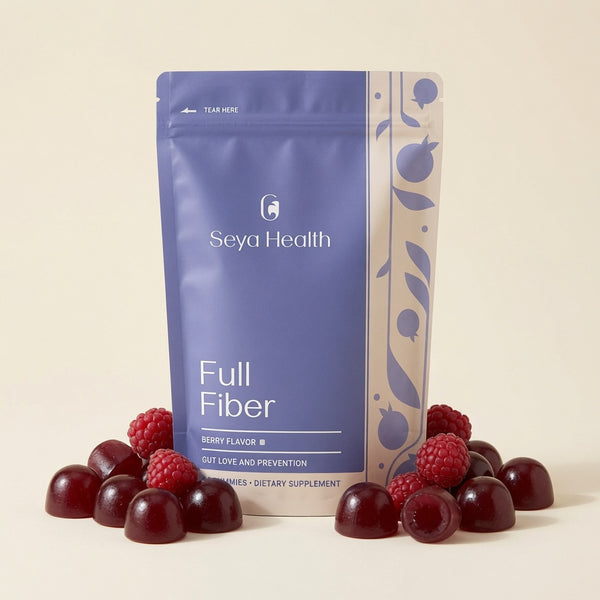
Seya Full Fiber
Most women fall short on fiber. Seya Full Fiber gives you 6 grams from three fibers in three small vegan gummies. Plant based, no gelatin, no sugar alcohols.
Shop Full Fiber