
Home/ The Journal/ digestive health
digestive health
Peptides for Gut Health: What's Hyped, What's Proven, and Where Fiber Fits
Peptides for gut health, from BPC-157 to GLP-1s and collagen: what is hyped, what is actually proven, and why feeding your gut fiber is the foundation that works.

"Peptides for gut health" is one of wellness's hottest searches, but the honest picture is messier than the hype. The most talked-about one, BPC-157, is not FDA-approved and has not been proven in people. GLP-1 peptides are real medicines, but they are known for gut side effects, not gut healing. Collagen peptides are mostly sold for skin and joints. Meanwhile, the most evidence-backed way to support your gut is far less glamorous: feed it fiber, so your own body makes butyrate, the compound that fuels and supports your gut lining.
What people actually mean by "peptides"
Peptides are just short chains of amino acids, the same building blocks that make up protein. That is a very broad category, which is a big part of the confusion. When someone searches "peptides for gut health," they could mean any of a few very different things:
- Research peptides like BPC-157, promoted online as gut healers
- GLP-1 medications like Ozempic and Wegovy, which are peptides
- Collagen peptides, the powders sold in tubs
- Food-derived peptides, an early area of research
These are not the same, and the evidence behind them is very different. It is worth taking them one at a time.
The buzzy one: BPC-157
BPC-157 is a synthetic peptide that gets promoted all over social media as a "gut-healing peptide." The claims are big: rebuild the gut lining, calm inflammation, fix leaky gut.
Here is the honest status, and it matters before you spend a dollar. As of 2025, BPC-157 is not FDA-approved and remains investigational.1 The encouraging results come from animal and laboratory studies, and they have not been validated in large human trials. No medical guidelines currently recommend it for any gut condition.1 It is sold as a research chemical rather than an approved medicine, so the quality of what you would actually be buying, and its long-term safety in people, are not established.
That does not mean it will never pan out. It means the marketing is running well ahead of the evidence, and buying an unregulated injectable off the internet is a real risk. If you are curious about it, that is a conversation for a doctor, not a checkout page.
The marketing is running well ahead of the evidence. That is the pattern to watch for with any trendy gut fix.
GLP-1 peptides: real drugs, but not gut healers
GLP-1 medications like Ozempic and Wegovy are peptides too, and they are genuinely powerful. But their relationship with your gut is mostly about side effects, especially constipation, rather than healing.2 Fiber is one of the main ways to manage that, which we cover in relieving GLP-1 constipation and what to eat on a GLP-1.
Collagen peptides
Collagen peptides are the friendly, widely sold kind, and you have probably seen them in coffee-shop lattes. They are mostly marketed for skin, hair, and joints, and the direct evidence that they do much for your gut is thin. They are a food ingredient, not a gut treatment. There is nothing wrong with them, but do not expect them to overhaul your digestion.
How to tell gut-health hype from help
The peptide trend is a good example of a pattern worth learning, because the next buzzy gut product is already on its way. Before you buy anything that promises to fix your gut, ask four quick questions:
- Is it approved, or a research chemical? "Investigational" and "research use only" are polite ways of saying not approved for people.
- Is the evidence in humans, or just animals? Impressive rat studies are a starting point, not a green light.
- Who is selling it? If the same site that explains the benefits also takes your payment, read with extra care.
- Does it replace the basics, or skip them? Anything that lets you ignore fiber, sleep, and stress is usually overpromising.
Run those four checks and most trendy gut fixes lose a lot of their shine.
The missing half: your gut makes its own helpers
Here is what gets lost in all the peptide talk. Your gut does not need an exotic injectable to make repair compounds. It already makes them, from fiber.
When you eat fermentable fiber, your gut bacteria turn it into short-chain fatty acids. One of them, butyrate, is the main fuel for the cells that line your colon, and it helps support the barrier that keeps your gut wall doing its job.34 In other words, the "gut healing" people are chasing with expensive peptides is something your own body does every day, as long as you feed it. We go deeper on this in leaky gut and the gut barrier.
The catch is that most people do not feed it enough. More than 90% of women fall short on fiber, and the average adult gets only about 17 grams a day, roughly half of what is recommended.56 So before chasing a trendy peptide, it is worth feeding the system your gut already runs on.
The boring foundation that actually works
The unglamorous truth is that the best-supported gut plan is variety and consistency. A range of fiber-rich foods, like beans and lentils, oats, berries, leafy greens, and ground flax, feeds a diverse gut community that makes more of these helpful compounds. Add fiber slowly, drink water, and give it time.
If getting enough fiber every day is the part that never quite happens, a simple daily source closes the gap. Seya Full Fiber gives you 6 grams of fiber from three fibers in one. The fermentable fibers feed the beneficial bacteria in your gut and support the short-chain fatty acid production behind all of this. It is plant based with no gelatin, has no sugar alcohols, and comes as 60 gummies per pouch. To picture the amount, 6 grams is about half an avocado, or three quarters of a cup of chickpeas.
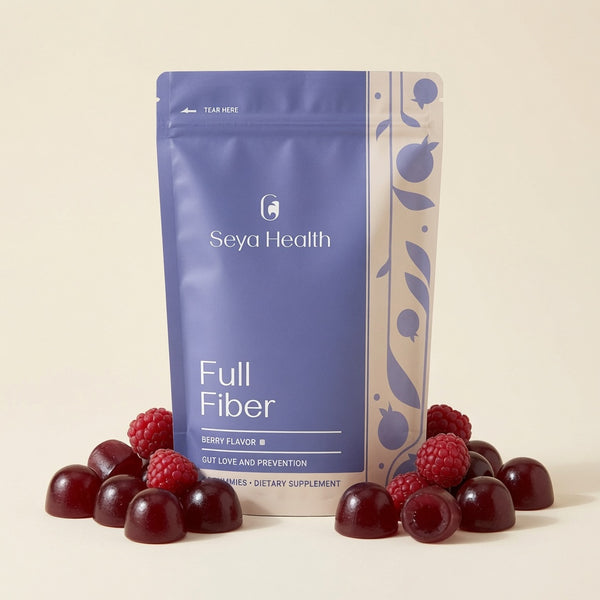
Seya Full Fiber
Three fibers in one, 6 grams per serving, to feed the bacteria that make butyrate and support a healthy gut. Plant based, no gelatin, no sugar alcohols.
Shop Full FiberWant the basics first? Start with how much fiber women need per day, and see how fiber stacks up against the other popular gut buy in fiber vs probiotics.
When to talk to a doctor
If you have real gut symptoms, see a doctor who can evaluate them, rather than self-prescribing peptides from the internet. And do not start any peptide, whether a prescription drug or a research chemical, without medical guidance. Fiber and steady daily habits are the supportive foundation. They are not a substitute for care when something is wrong.
Frequently asked questions
Are peptides good for gut health?
It depends which. GLP-1 peptides are medicines with gut side effects, BPC-157 is not FDA-approved and is unproven in people, and collagen peptides are mostly marketed for skin and joints.1 The best-supported gut move is feeding your gut fiber.
Is BPC-157 FDA-approved?
No. As of 2025 it is investigational and not FDA-approved, its evidence comes from animal studies rather than human trials, and no medical guidelines recommend it for gut conditions.1 Talk to a doctor before considering it.
What is the best thing for gut health?
Feeding your gut bacteria with a variety of fiber, so they make butyrate and other helpful compounds, plus the basics: sleep, movement, and managing stress.3
Do collagen peptides help the gut?
They are mostly sold for skin, hair, and joints, and the direct evidence for gut benefits is limited. They are fine to enjoy, but they are not a gut treatment.
Does fiber support the gut lining?
Indirectly, yes. Fiber feeds the bacteria that make butyrate, which is the main fuel for the cells lining your colon and helps support the gut barrier.4
Sources
- 1 Better Living MD. Can BPC-157 Support Gut Health? What the Science Really Says.
- 2 Cleveland Clinic. GLP-1 Diet: What To Eat & Avoid.
- 3 Frontiers in Immunology (2019). Short-Chain Fatty Acids, Gut Epithelial and Immune Regulation.
- 4 Acute Effects of Butyrate on Tight Junction Protein Expression in Human Colonic Tissues. PMC (2020).
- 5 American Society for Nutrition. Most Americans are not getting enough fiber in our diets.
- 6 USDA Economic Research Service. Dietary fiber consumption data.
This article is general information, not medical advice. It does not recommend the use of any research peptide. BPC-157 is not FDA-approved. Seya Full Fiber is a dietary supplement, not a medication, and is not intended to diagnose, treat, cure, or prevent any disease. Talk to your healthcare provider about gut symptoms and before starting any peptide or supplement.
Related reading
Keep reading
fiber
Can a Multivitamin Replace Vegetables? What Supplements Can't Do for Your Gut

constipation
The Best Way to Beat Constipation in Your 30s (and Where Fiber Gummies Fit)
fiber
The Gut-Skin Axis: Does Your Gut Health Affect Your Skin?
The gut-skin axis, explained: how your gut bacteria and blood sugar affect your skin, w...