Home/ The Journal/ bloating
bloating
Luteal Phase Bloating and Poor Sleep: Why They Hit Before Your Period

Short version: Poor sleep before your period is common, and it is not in your head. After you ovulate, your core body temperature runs 0.3°C to 0.7°C higher, and a warmer body has a harder time settling into sleep. Bloating, cramps, and a busy, anxious mind pile on in the same few days.
- Heat: progesterone warms you up in the luteal phase, the two weeks after ovulation.
- Feeling vs. measuring: women with strong PMS rate their sleep worse in that week, even when lab tests look close to normal.
- Bloating: 62% of healthy women in one clinic survey had bloating in the 5 days before their period.
- What helps: a cool room, a fixed wake time, caffeine cut off 6+ hours before bed, and steady meals.
Last updated October 2026.
It is 2 a.m. You are hot, your jeans from today still feel tight, and your brain will not stop replaying a work email. Your period is due in three days.
If that night sounds familiar, you have company. The U.S. Office on Women's Health says over 90% of women get some premenstrual symptoms, and it lists sleep problems and bloating right next to each other, per womenshealth.gov.
Here is why the week before your period can wreck your sleep, why bloating tends to show up at the same time, and what you can do about both tonight.
Is disrupted sleep before your period normal?
Yes. It is one of the most common complaints of the late luteal phase, the last few days before bleeding starts.
A review by sleep researchers Fiona Baker and Kathryn Lee found that poorer sleep quality before and during a period is common in women with premenstrual symptoms or painful cramps, per Baker and Lee, Sleep Medicine Clinics, 2018 (PMID 30098748). An earlier review found that women rate their sleep lowest around the start of their period, per Baker and Driver, Sleep Medicine, 2007 (PMID 17383933).
But not every woman gets it. In a study that tracked 213 young women every day for two full cycles, three patterns showed up. Some had more trouble sleeping around their period. Some had more trouble mid-cycle. And some had no monthly change at all, per Van Reen and Kiesner, Archives of Women's Mental Health, 2016 (PMID 26973332).
So if your sleep dips every month in the same spot, that is a real pattern. If it does not, that is normal too.
Why can't I sleep the night before my period?
Three things stack up in that window: a warmer body, a shifting brain chemistry, and physical discomfort. Each one alone is small. Together, they can turn a good sleeper into a light one.
1. You are running warm
After ovulation, progesterone rises and nudges your thermostat up. Core body temperature sits 0.3°C to 0.7°C higher in the luteal phase than in the first half of your cycle, and the gap is clearest during sleep, per Baker, Siboza, and Fuller, Temperature, 2020 (PMID 33123618).
Your body normally cools down a little to fall asleep and stay asleep. In the luteal phase, the daily rise and fall of your temperature is also flatter, so that cool-down signal is weaker.
2. Your sleep gets lighter
Lab studies show small but real shifts. In one sleep lab study, women had more time awake after first falling asleep in the late luteal phase than in the follicular phase, the first half of the cycle. This was true for women with severe PMS and for women without it, per Baker et al., Sleep, 2007 (PMID 17969462).
Another lab study found less deep sleep overnight in the late luteal phase. Women with strong premenstrual mood symptoms also felt sleepier and less alert the next afternoon, per Lamarche et al., Journal of Sleep Research, 2007 (PMID 17716275).
Does anxiety make premenstrual sleep worse?
Often, yes. How you feel about the night counts as much as what a sleep lab can measure.
This part surprises people. In a study of 18 women with severe PMS and 18 women without it, the PMS group said their sleep was worse in the late luteal phase. But the overnight brain recordings did not show a matching drop in sleep quality.
What did line up was anxiety. The more anxious a woman felt, the worse she rated her sleep, per Baker et al., Journal of Sleep Research, 2012 (PMID 22417163). Lying awake with a racing mind feels like a terrible night, even if you dozed more than you think.
That does not mean the problem is fake. It means calming your mind before bed may help you feel more rested, not just your body. For more on the mood side, see PMS explained.

Why do bloating and poor sleep hit at the same time?
Because they share a calendar. Both tend to peak in the same few days before bleeding starts.
A survey of 156 healthy women at a gynecology clinic asked about symptoms in the 5 days before their period. Bloating was the most common gut symptom, at 62%. Fatigue was close behind, at 53%, per Bernstein et al., BMC Women's Health, 2014 (PMID 24450290).
The two traveled together. Among women who felt tired before their period, 77% also had bloating. Among women who did not feel tired, it was 44%. That study shows a link, not that one causes the other. Still, it fits what many women notice: a puffy, tight belly is hard to get comfortable with at night, and a short night makes everything feel worse the next day.
For the full breakdown of why your belly swells, read our guide to luteal phase bloating. If you want to understand the timing of the whole phase, start with the luteal phase, explained.
How can I get good sleep during my period?
Work with the heat, protect your schedule, and take pressure off your gut in the evening. None of these are fancy. They are the habits with the clearest backing.
Keep your room and your bed cool
You are starting the night warmer than usual, so give your body a head start. Turn the thermostat down a little, use lighter sheets, and keep a glass of water by the bed.
Keep the same wake time, even on weekends
The American College of Obstetricians and Gynecologists says regular sleep habits, waking up and going to bed at the same times every day, may help lessen PMS moodiness and fatigue, per ACOG. The Office on Women's Health suggests aiming for about eight hours a night.
Stop caffeine early
Caffeine lasts longer than most people think. In a trial, 400 mg of caffeine, about two to three 12-ounce cups of coffee per the FDA, still cut into sleep when it was taken 6 hours before bed, per Drake et al., Journal of Clinical Sleep Medicine, 2013 (PMID 24235903). If bedtime is 10 p.m., make your last coffee before 4 p.m. this week.
What evening habits ease bloating at bedtime?
The goal is to go to bed with a calmer belly and a calmer mind.
Eat dinner a bit earlier and a bit lighter
A big, salty, late meal is a recipe for lying awake with a full, tight belly. Try to finish eating two to three hours before bed. Go easy on the foods that tend to make gas, which we list in foods to avoid when bloated.
Move during the day
A walk or a light workout can help both your gut and your mood. Our guide to cycle syncing your workouts covers what to try in the luteal phase.
Give your mind somewhere to go
Since anxiety drives so much of how bad a night feels, try a wind-down that works for you: a short list of tomorrow's tasks, a few slow breaths, a book instead of a phone. If cramps keep you up, a heating pad on your belly can feel good, then take it off before you fall asleep so you do not overheat.
Where does fiber fit in?
Fiber will not make you sleep. Let's be clear about that. What it can do is support a steadier gut the rest of the month, so the week before your period starts from a better place.
In the clinic survey above, 15% of women had constipation before their period. Being backed up adds to that heavy, bloated feeling. A daily fiber habit supports regularity, and our leafy greens and fiber guide shows easy food swaps.
Seya's fiber gummies are one way to add a few grams a day: 3 vegan gummies with resistant tapioca fiber, about 5 grams of fiber. The evidence that fiber supports regularity is graded C at that dose, which is roughly half of what the bigger studies used, so we claim exactly that and nothing more. Start slow and drink water as you add fiber.
These statements have not been evaluated by the Food and Drug Administration. This product is not intended to diagnose, treat, cure, or prevent any disease.
When should you see a doctor?
Talk to your doctor or nurse if any of these sound like you:
- Your sleep, mood, or energy before your period is bad enough to hurt your work or relationships. ACOG says severe PMS like this may be premenstrual dysphoric disorder (PMDD), and sleep problems and bloating are both on its symptom list.
- You sleep badly all month, not just before your period. That points to a different cause worth checking.
- You snore loudly, gasp at night, or wake up exhausted no matter how long you sleep.
- Your bloating does not go away after your period, or comes with weight loss, blood in your stool, or a lot of pain. See when bloating isn't normal.
A simple tip before your visit: track your sleep, bloating, and mood for two cycles. A pattern on paper helps your doctor see what you are living with.
Frequently asked questions
Is disrupted sleep common around menstruation?
Yes. Reviews find poorer sleep quality before and during a period is common, mostly in women with PMS or painful cramps. In a study of 213 women, some slept worse around their period, some mid-cycle, and some saw no change.
Why can't I sleep the night before my period?
Your body runs 0.3°C to 0.7°C warmer after ovulation, your sleep gets a bit lighter, and bloating, cramps, and anxiety can all add up. Anxiety in particular makes the night feel worse.
How can I get good sleep during my period?
Keep your bedroom cool, wake at the same time every day, stop caffeine at least 6 hours before bed, and eat dinner earlier. A heating pad can ease cramps before you drift off.
Does progesterone make you sleepy or keep you awake?
Progesterone raises your body temperature after ovulation, and a warmer body has a harder time staying asleep. In one lab study, women with strong PMS also felt sleepier the next afternoon in the late luteal phase.
Does bloating before your period make sleep worse?
It can make it harder to get comfortable. In one survey, 77% of women who felt tired before their period also had bloating, versus 44% of women who did not feel tired.
Can a sleep tracker show changes before my period?
Often it shows temperature and heart rate changes more than sleep changes. In a 2022 study of 26 healthy women wearing an Oura ring, skin temperature and heart rate rose in the luteal phase, but measured sleep stayed steady, per Alzueta et al., International Journal of Women's Health, 2022 (PMID 35422659).
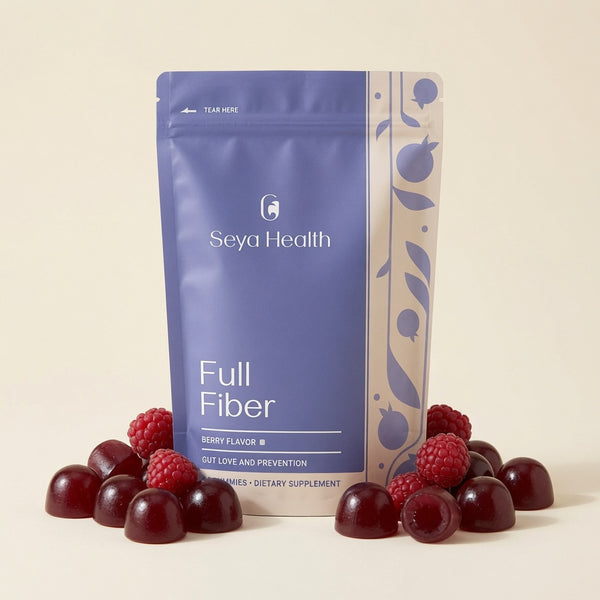
Seya Full Fiber
Most women fall short on fiber. Seya Full Fiber gives you 6 grams from three fibers in three small vegan gummies. Plant based, no gelatin, no sugar alcohols.
Shop Full Fiber