
Home/ The Journal/ cholesterol
cholesterol
Soluble fiber: the best food sources and supplements, and why it matters for women

Short version: The best food sources of soluble fiber are beans, Brussels sprouts, oranges, pears, oats, and barley. Half a cup of cooked kidney beans or Brussels sprouts gives about 3 g, per the NIH. The best soluble fiber supplement for gel and cholesterol is psyllium: 1 tablespoon gives about 5 g.
- Target: the NIH's cholesterol guide suggests at least 5 to 10 g of soluble fiber a day.
- Food alone can get there: oatmeal, a pear, an orange, beans, and Brussels sprouts add up to about 11 g.
- Why women should care: LDL cholesterol jumps in the year around your last period.
Last updated November 2026.
Most fiber labels give you one number. Total fiber. That is it.
But soluble fiber is the part that turns to gel. It is the type tied to lower LDL cholesterol and a slower rise in blood sugar. And the Nutrition Facts label does not have to list it at all.
So we went to the source. The NIH's heart institute printed a table of soluble fiber per serving in its cholesterol guide. We used it to rank the foods, build a simple day, and answer the label questions people search most.
What is the best source of soluble fiber?
Beans and Brussels sprouts lead the whole-food list. Half a cup of cooked kidney beans has 3 g of soluble fiber. Lima beans have 3.5 g. Half a cup of cooked Brussels sprouts has 3 g. Those numbers come from Box 15 of the NHLBI guide to lowering cholesterol with TLC (NIH Pub. 06-5235, 2005).
Psyllium beats every food by a wide margin. One tablespoon of ground psyllium seed has 5 g, per the same table. That is why it shows up in so many fiber powders.
MedlinePlus lists the same core group: oat bran, barley, nuts, seeds, beans, lentils, peas, and some fruits and vegetables. See the MedlinePlus entry on soluble vs. insoluble fiber.

Soluble fiber foods ranked: grams per serving
Here is the NIH table, sorted by soluble fiber. Total fiber is in the last column so you can see how much of each food is the gel-forming kind.
| Food | Serving | Soluble fiber (g) | Total fiber (g) |
|---|---|---|---|
| Psyllium seed, ground | 1 tbsp | 5 | 6 |
| Lima beans | 1/2 cup cooked | 3.5 | 6.5 |
| Kidney beans | 1/2 cup cooked | 3 | 6 |
| Brussels sprouts | 1/2 cup cooked | 3 | 4.5 |
| Black, navy, or pinto beans | 1/2 cup cooked | 2 | 5.5 to 7 |
| Orange or grapefruit | 1 medium | 2 | 2 to 3 |
| Pear | 1 medium | 2 | 4 |
| Northern beans | 1/2 cup cooked | 1.5 | 5.5 |
| Prunes | 1/4 cup | 1.5 | 3 |
| Oatmeal, oat bran, or barley | 1/2 cup cooked | 1 | 2 to 4 |
| Apple, banana, peach, or nectarine | 1 medium | 1 | 2 to 4 |
| Lentils or chickpeas | 1/2 cup cooked | 1 | 6 to 8 |
| Broccoli or carrots | 1/2 cup cooked | 1 | 1.5 to 2.5 |
Source: NHLBI, Your Guide to Lowering Your Cholesterol With TLC, Box 15. Values are rounded and vary by variety and how long food is cooked.
Two surprises stand out. Lentils have 8 g of total fiber but only 1 g of it is soluble. Oranges are the reverse: almost all of their small fiber load is the soluble kind.
Oats deserve a note too. Half a cup of cooked oatmeal looks modest at 1 g. A full cup doubles it, and oats bring beta-glucan, the gel-forming fiber the FDA singles out (more below).
How do you get more soluble fiber in your diet?
Stack two or three soluble foods at each meal. You do not need a powder to hit the low end of the NIH target. Here is one food-only day built from the table:
- Breakfast: 1/2 cup cooked oatmeal with sliced pear, about 3 g soluble.
- Snack: 1 orange, about 2 g.
- Lunch: 1/2 cup kidney beans in a salad or soup, about 3 g.
- Dinner: 1/2 cup roasted Brussels sprouts, about 3 g.
That totals about 11 g of soluble fiber and about 19 g of total fiber. It clears the NIH's 5 to 10 g floor without a single supplement.
Two habits make it stick. Swap one grain for barley or oats a few times a week. Add half a cup of beans to something you already eat, like soup, tacos, or a grain bowl.
Go slow. The same NIH guide warns that a sudden jump in fiber can cause gas and cramps, so add it over a few weeks and drink water with it. Our guide to eating too much fiber covers the signs.
Want total fiber too? Start with high-fiber foods for women, then check how much fiber women need per day.
Why does soluble fiber matter for women?
Because LDL cholesterol rises fast at menopause, and soluble fiber is one of the few food levers with numbers behind it.
The SWAN study followed 1,054 women through a natural final period. Total cholesterol, LDL, and apolipoprotein B all jumped within the year before and after that last period. Most other heart risk factors just crept up with age. See Matthews et al. (J Am Coll Cardiol, 2009).
Now the fiber side. A meta-analysis of 67 controlled trials found that each gram of soluble fiber, in the 2 to 10 g a day range, was linked to LDL about 0.057 mmol/L lower. That is roughly 2 mg/dL per gram. The authors called the effect small but real. See Brown et al. (Am J Clin Nutr, 1999).
Small adds up. The NIH guide says people who added 5 to 10 g of soluble fiber a day saw about a 5% drop in LDL. Pair that with the other parts of a heart-healthy diet and it becomes one piece of a bigger plan, not a fix on its own.
The FDA has set its own bar. Foods with enough oat, barley, or psyllium fiber may carry a heart-health claim. The daily amounts behind that claim are 3 g of beta-glucan from whole oats or barley, or 7 g of soluble fiber from psyllium husk, per 21 CFR 101.81.
Blood sugar is the second reason. Gel-forming fibers like beta-glucan and psyllium slow digestion, which blunts the rise after a meal. Thin soluble fibers do not do this, per McRorie and McKeown (J Acad Nutr Diet, 2017). More in fiber and heart health for women.
Which fiber supplement has the most soluble fiber?
Psyllium husk, for most people. It is mostly soluble, it forms a thick gel, and it is one of only two supplement fibers named in the FDA heart-health rule. MedlinePlus calls psyllium "a common fiber supplement" in its soluble fiber list.
Gel matters more than the label word "soluble." The McRorie review splits soluble fibers into two groups:
- Gel-forming (viscous): psyllium, beta-glucan from oats and barley, raw guar gum, and konjac glucomannan. These carry the cholesterol and blood sugar data.
- Thin (non-viscous): inulin, fructooligosaccharides, and wheat dextrin. These feed gut bacteria but do not give the gel-based benefits.
So two products can both say "soluble fiber" and do very different jobs. For a full ranking of psyllium, PHGG, inulin, and tapioca fiber, see the best soluble fiber supplements. For how the types differ, see our fiber types guide.
Is bran soluble or insoluble fiber?
It depends on the grain. Wheat bran is mostly insoluble. Oat bran is a good soluble source.
MedlinePlus lists wheat bran as an insoluble food and oat bran as a soluble one. The NIH table gives oat bran 1 g of soluble fiber per half cup cooked.
That answers the All-Bran question too. Check the first ingredient on the box. If it says wheat bran, as classic bran cereals do, you are mostly getting insoluble fiber. That is useful for bulk, but it is not the gel type. Coarse wheat bran works in the colon by scratching the gut wall to pull in water, McRorie notes. Fine-ground bran can even be constipating.
Do fiber gummies and fiber pills contain soluble fiber?
Most do. But read which fiber it is.
Gummies usually use thin soluble fibers like inulin, chicory root, soluble corn fiber, or resistant tapioca dextrin. Those count as soluble. They are not gel-forming, so do not expect psyllium-style cholesterol effects from them. Our guide to what is in a fiber gummy breaks down the common labels.
Fiber capsules vary more. Psyllium capsules are soluble and gel-forming. Others use different fibers. The ingredient line tells you which one you have, and you often need several capsules to reach a few grams.
What is fiber jelly?
It usually means konjac jelly. Konjac root holds glucomannan, a gel-forming soluble fiber.
Glucomannan has real lipid data. A meta-analysis of 12 trials found about 3 g a day lowered LDL by about 10%. See Ho et al. (Am J Clin Nutr, 2017).
One safety point. Konjac gels are firm. Take small bites, chew well, and keep mini jelly cups away from young kids and anyone who has trouble swallowing.
Where Seya fits
Seya Full Fiber is a vegan gummy with resistant tapioca fiber, about 6 g per serving, plus magnesium citrate and ginger root. It supports regularity and helps close part of your daily fiber gap.
We are clear about what it is not. Tapioca fiber is a thin soluble fiber, not a gel like psyllium. We do not claim it lowers cholesterol or blood sugar. For those goals, the foods in the table above and psyllium have the evidence. Our creatine gummy is coming January 2027 and is a different product.
This guide is education, not medical advice. If you have high cholesterol or take daily medicine, talk with your doctor before changing your fiber routine.
These statements have not been evaluated by the Food and Drug Administration. This product is not intended to diagnose, treat, cure, or prevent any disease.
Frequently asked questions
What is the best source of soluble fiber?
Among foods, beans and Brussels sprouts lead. Half a cup of cooked lima beans has 3.5 g, and kidney beans or Brussels sprouts have 3 g, per the NIH. Ground psyllium seed beats them all at 5 g per tablespoon.
Which fiber supplement has the most soluble fiber?
Psyllium husk. It is mostly soluble, forms a thick gel, and is one of two fibers named in the FDA heart-health rule for soluble fiber, at 7 g a day.
Do fiber gummies contain soluble fiber?
Most do. Common gummy fibers like inulin, chicory root, and resistant tapioca dextrin are soluble. They are thin, not gel-forming, so they act differently from psyllium.
Are fiber pills soluble fiber?
Some are. Psyllium capsules are soluble and gel-forming. Check the ingredient line, since capsules use different fibers and often take several to reach a few grams.
How do you get more soluble fiber in your diet?
Add a soluble food to each meal: oatmeal with a pear, an orange as a snack, beans at lunch, and Brussels sprouts at dinner. That day adds up to about 11 g. Increase slowly and drink water.
Is bran soluble or insoluble fiber?
Wheat bran is mostly insoluble. Oat bran is a good soluble source, with about 1 g per half cup cooked. If a cereal like All-Bran lists wheat bran first, it is mostly insoluble.
What is fiber jelly?
Usually konjac jelly, made from konjac root. Its fiber, glucomannan, is a gel-forming soluble fiber. The gel is firm, so take small bites and chew it well.
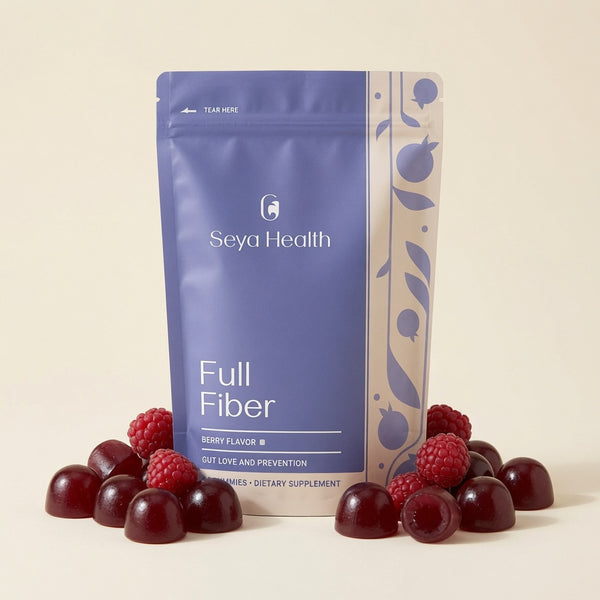
Seya Full Fiber
Most women fall short on fiber. Seya Full Fiber gives you 6 grams from three fibers in three small vegan gummies. Plant based, no gelatin, no sugar alcohols.
Shop Full FiberKeep reading

bone health
Best supplements for women over 40: what the evidence supports for heart, bones and muscles (and what's hype)

creatine
How long does creatine take to work? A realistic timeline for women

constipation