
Home/ The Journal/ bloating
bloating
The best fiber supplement for perimenopausal women, and how to choose one

Short version: The best fiber supplement for perimenopause depends on your main symptom. For most women, psyllium has the strongest evidence. In a review of 16 trials, 66% of people taking fiber got relief from constipation, compared with 41% on a placebo.
- Constipation: psyllium, more than 10 g a day, for at least 4 weeks.
- Bloating: a gentle fiber such as PHGG (Sunfiber). Go slow with inulin.
- Rising cholesterol: psyllium or oat beta-glucan, the 2 fibers with an FDA heart claim.
- Blood sugar: psyllium before meals, with the biggest effect in people whose sugar already runs high.
- Hot flashes: no fiber has good evidence here yet.
Last updated November 2026.
Walk down the supplement aisle in your 40s and every tub seems to promise the same thing. Gut health. Balance. Comfort.
But fibers are not all the same. Some form a thick gel. Some feed your gut bacteria and make gas. Some do almost nothing for the problem you actually have.
So start with one question: what is bothering you most right now? Then pick the fiber that was tested for that.
What is the best fiber supplement for perimenopause?
The one matched to your main symptom. If you only pick one, psyllium is the best-studied choice. It has trial data for constipation, cholesterol, and blood sugar.
The constipation data is the clearest. A 2022 meta-analysis pooled 16 randomized trials with 1,251 adults. Fiber worked better than placebo, and psyllium was one of the 2 fibers with a clear effect, per the review by van der Schoot and colleagues. The best results came at doses above 10 g a day, taken for at least 4 weeks.
Use this table to find your starting point.
| Your main symptom | Fiber to try first | Dose used in studies | What to expect |
|---|---|---|---|
| Constipation | Psyllium | More than 10 g a day | Softer, more frequent stools after about 4 weeks |
| Bloating and gas | PHGG (partially hydrolyzed guar gum) | 6 g a day | A modest drop in bloating over 12 weeks |
| Rising LDL cholesterol | Psyllium or oat beta-glucan | About 10 g psyllium, or 3 g beta-glucan | Psyllium lowered LDL about 13 mg/dL on average |
| Blood sugar creeping up | Psyllium, before meals | Varies by trial | Small change if your sugar is normal; more if it runs high |
| Just not eating enough fiber | Any named fiber you will take daily | Enough to close your gap | Steadier regularity |
Why does perimenopause change which fiber you need?
Because your body changes on a schedule, and some of those changes show up in your gut and your blood work.
The big one is cholesterol. The SWAN study followed 1,054 women through their final period. Most risk factors rose slowly with age. But total cholesterol, LDL cholesterol, and apoB jumped within the year before and after the last period, per the SWAN analysis by Matthews and colleagues. The authors said this rise was tied to menopause itself, not just getting older.
The other change is the fiber gap. More than 90% of US women do not get enough fiber, per the Dietary Guidelines for Americans, 2020 to 2025. The goal is 25 g a day for women 31 to 50 and 22 g a day after 51.
So a perimenopause fiber has 2 jobs. Help your gut now, and support healthy cholesterol as it starts to climb. Our guide to how much fiber women over 40 need shows how to count your daily total.
Which supplement helps perimenopause constipation?
Psyllium. It holds water and forms a soft gel, so stool stays bulky and easy to pass.
In the 2022 review, fiber also raised the number of bowel movements per week and made stools softer. The catch: flatulence was higher in the fiber groups. That is normal in the first weeks, and it is why you start low.
Ground flaxseed is a food-based option with smaller studies. We compare the 2 side by side in flaxseed vs. psyllium for perimenopause constipation. For a full 4-week plan, see how to relieve perimenopause constipation.
What fiber is best for perimenopause bloating?
A low-gas fiber. PHGG, sold as Sunfiber, is the one with trial data for bloating.
In a 12-week trial, 121 people with irritable bowel syndrome took 6 g of PHGG or a placebo each day. The PHGG group had a bigger drop in their bloating scores. The benefit lasted at least 4 weeks after they stopped, per the randomized trial by Niv and colleagues. It did not change their other symptoms, so think of it as a gentle choice, not a fix for everything.
Inulin and chicory root fiber are the opposite case. They feed gut bacteria well, but that makes gas. In a crossover study of 26 healthy adults, flatulence and bloating were the most common complaints after inulin. A 10 g dose of the short-chain kind (oligofructose) raised symptoms clearly, per the tolerance study by Bonnema and colleagues. If you already feel puffy, check the label for inulin before you buy.
Our guide to perimenopause bloating covers the non-fiber causes too.
Which fiber supports healthy cholesterol during perimenopause?
Psyllium and oat beta-glucan. These are the 2 fibers that carry an FDA-approved heart health claim.
The FDA rule lets a food make that claim if it gives 3 g or more of beta-glucan from oats or barley a day, or 7 g or more of soluble fiber from psyllium husk a day, as part of a diet low in saturated fat, per 21 CFR 101.81.
The trial data backs it up. A 2018 meta-analysis of 28 trials with 1,924 people found that about 10.2 g of psyllium a day lowered LDL cholesterol by 0.33 mmol/L, or roughly 13 mg/dL, per the review by Jovanovski and colleagues. It also lowered non-HDL cholesterol and apoB.
That is a helpful nudge, not a replacement for care. If your LDL is high, get it checked and talk to your clinician about your plan. Our piece on fiber and heart health for women goes deeper.
Does fiber help blood sugar in perimenopause?
It can, and the effect grows with how high your sugar runs.
A 2015 meta-analysis looked at 35 trials of psyllium. In people with normal blood sugar, it did not lower glucose. In people with prediabetes, the effect was modest. In people already being treated for type 2 diabetes, fasting glucose fell by 37 mg/dL when psyllium was taken before meals, per the analysis by Gibb and colleagues.
If you take diabetes medicine, ask your clinician before adding psyllium, since your numbers may shift. See fiber and blood sugar for women over 40 for meal ideas.
Does fiber help perimenopause symptoms like hot flashes?
Not in a way we can promise. The research on fiber and hot flashes is thin and mostly based on diet surveys, not supplement trials.
Fiber is a gut and heart nutrient first. For what the early studies show, read fiber and menopause. For the full list of perimenopause supplements and their evidence, see the best perimenopause supplements.
How do you choose a fiber supplement in perimenopause?
Read the back of the tub, not the front. Here is a 5-point check.
- A named fiber. Look for psyllium husk, PHGG, oat beta-glucan, inulin, or resistant tapioca fiber. Skip a "fiber blend" with no breakdown.
- Grams per serving. Compare that number to the dose in the table above. Gummies often give less fiber per serving than powders. Most constipation trials used more than 10 g.
- The fiber type for your goal. Gel-forming fibers like psyllium suit constipation and cholesterol. Fermentable fibers like inulin feed gut bacteria but cause more gas.
- Added sugar and sugar alcohols. Some gummies add sugar. Others use sugar alcohols. Know which one you are getting.
- A form you will take. A powder you skip does less than a smaller dose you take every day. Our soluble fiber ranking compares the main types.
What if you take thyroid medicine, iron, or calcium?
Space them apart. Fiber can get in the way of how some medicines are absorbed.
Levothyroxine, a common thyroid medicine, is one example. A review of what blocks its absorption lists dietary fiber, along with iron, calcium carbonate, and coffee, per the review by Liwanpo and Hershman.
Ask your pharmacist how long to wait for each of your medicines. Our guide to taking fiber with medications has the usual timing.
How do you start fiber without more bloating?
Go low and slow. Start with half a serving for 3 to 5 days. Then add a little more each week.
Drink a full glass of water with each dose. Gel-forming fiber needs water to work.
Give it 4 weeks before you judge it. That matches the shortest time that showed a clear effect in the 2022 review. Some gas in week 1 is your gut bacteria adjusting, and it usually settles.
Where does Seya fit, honestly?
We make one product today, a vegan fiber gummy. It is not a perimenopause pill.
Three gummies give you 6 g of fiber: 4,500 mg of resistant tapioca fiber, 950 mg of prebiotic soluble fiber, and 200 mg of cellulose. They also have 80 mg of magnesium citrate and 100 mg of ginger root, per our product page.
That is not a psyllium dose, and it is about half of what most constipation trials used. So our claim stays small: it supports regularity.* It is built for women who want to close part of their daily fiber gap with something easy to take. If your main goal is LDL cholesterol, psyllium or oats are the fibers with the heart claim.
*These statements have not been evaluated by the Food and Drug Administration. This product is not intended to diagnose, treat, cure, or prevent any disease.
When should you see a doctor?
If self-care does not help in a few weeks, get checked. Perimenopause is not the only cause of gut changes in your 40s.
The NIDDK says to see a doctor right away if constipation comes with blood in your stool, constant belly pain, vomiting, fever, or weight loss you did not try for, per its constipation symptoms page.

Frequently asked questions
Does fiber help perimenopause symptoms?
Fiber helps the gut and heart changes of perimenopause, like constipation, bloating, and rising LDL cholesterol. It has no good evidence for hot flashes or mood. Most women also fall short on fiber, so a supplement can help close that gap.
What fiber is best for perimenopause bloating?
A low-gas fiber such as PHGG (Sunfiber). In a 12-week trial, 6 g a day lowered bloating scores more than a placebo. Fibers like inulin and chicory root tend to make more gas, so start slow with them.
Which supplement helps perimenopause constipation?
Psyllium has the best evidence. A review of 16 trials found that fiber helped 66% of people with constipation, compared with 41% on a placebo, with the best results above 10 g a day for at least 4 weeks.
Is psyllium or a fiber gummy better in perimenopause?
Psyllium powder gives a higher, gel-forming dose, so it suits constipation and cholesterol goals. A fiber gummy gives less fiber per serving but is easier to take daily. Choose by your main goal and what you will actually stick with.
How much fiber should a perimenopausal woman get a day?
The Dietary Guidelines set 25 g a day for women 31 to 50 and 22 g a day after 51. Count food first, then use a supplement to fill the gap.
This article is educational and is not medical advice. Talk to your clinician about your own symptoms and medicines.
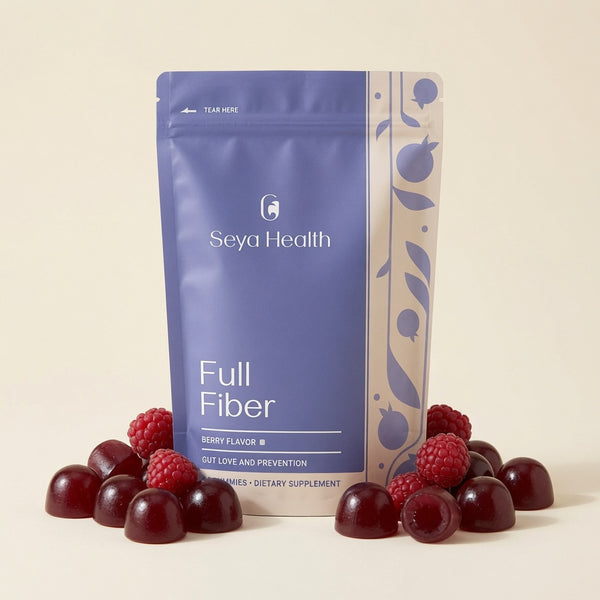
Seya Full Fiber
Most women fall short on fiber. Seya Full Fiber gives you 6 grams from three fibers in three small vegan gummies. Plant based, no gelatin, no sugar alcohols.
Shop Full FiberKeep reading

bone health
Best supplements for women over 40: what the evidence supports for heart, bones and muscles (and what's hype)

creatine
How long does creatine take to work? A realistic timeline for women

constipation