
Home/ The Journal/ constipation
constipation
When to take a fiber supplement: morning or night, before or after meals, and how fast it works

Short version: When to take a fiber supplement? The best time is the time you will stick with, every day, with a glass of water. Take it before a meal if you care about blood sugar or fullness. Keep it 2 hours from your pills. For constipation, give it at least 4 weeks.
- No study shows one clock time wins for regularity. Daily use and fluid matter more.
- Before meals: in people with type 2 diabetes, psyllium taken before meals lowered fasting blood sugar by 37 mg/dL.
- Morning fits your gut clock. Night can work too, if gas does not keep you up.
- Psyllium labels say it works in 12 to 72 hours. Steady results take weeks.
- Fiber gummies are fine to take daily. Build up slowly to limit gas.
Last updated November 2026.
You bought the fiber. Now the box says "take daily," and that is it.
Before breakfast or after? Morning or bedtime? With your vitamins, or away from them? And how long until you notice anything?
Here is what the research says about timing, and where it is honestly silent.
When to take a fiber supplement: is there a best time?
The best time is a time you can repeat every day. For regularity, steady daily use and enough fluid matter far more than the hour on the clock.
Fiber does not work like a pill that peaks and fades. It builds up in your gut over days. A 2022 review of 16 trials with 1,251 adults found that fiber helped stool frequency most at doses above 10 grams a day, taken for at least 4 weeks, per the meta-analysis in the American Journal of Clinical Nutrition. The trials did not show a winning time of day.
Timing starts to matter when you have a second goal. Use this table as a guide.
| Your goal | When to take it | Why |
|---|---|---|
| Regularity | Same time daily, with water | Daily dose and weeks of use drive results |
| Blood sugar | Just before a meal | Gel-forming fiber slows how fast carbs enter your blood |
| Feeling full | Before a meal | Some fibers lower appetite, but most do not in short tests |
| Taking pills | 2 hours away from them | Fiber can hold on to some drugs in your gut |
| Gas or bloating | Earlier in the day | Gas from fiber is less likely to bother your sleep |
Should you take fiber before or after a meal?
Before a meal is the better choice if blood sugar is your goal. If you only care about regularity, either is fine.
The best data are for psyllium, a gel-forming fiber. A review of 35 controlled trials looked at psyllium and blood sugar. In people with type 2 diabetes who took psyllium before meals for several weeks, fasting blood sugar dropped by 37 mg/dL and HbA1c dropped by 0.97%, per the 2015 meta-analysis by Gibb and colleagues.
There is a catch. The same review found no drop in blood sugar in people whose levels were already normal. And these were psyllium doses, not gummies. Different fibers act in different ways, so do not expect the same numbers from every product.
After a meal is fine for regularity. Your colon gets busy after you eat, so taking fiber with or after food fits your body's rhythm too. Our guide on fiber gummies and blood sugar goes deeper on the glucose side.
Does taking fiber before meals help you feel full?
Sometimes, but less often than ads suggest. Most fibers do not cut hunger in short tests.
A systematic review looked at 107 fiber tests in healthy adults. Only 39% lowered how hungry people said they felt. Only 22% lowered how much they ate, per the review by Clark and Slavin. Oat and barley beta-glucan, rye, and a mixed high-fiber diet had the best support.
So a fiber supplement before dinner is not a hunger switch. A high-fiber diet over time is a better bet. Our guide on fiber and fullness explains how it works for women.
Is it better to take fiber in the morning or at night?
Neither wins for regularity. Morning is easier for most people, and night has a few perks.
Morning. Your colon is most active after you wake and after breakfast. A morning dose also gives any gas time to pass during the day. It is easy to pair with a habit you already have, like coffee. See our morning bowel routine for the full plan.
Night. Fiber at dinner may help the next morning. In a study of 15 healthy adults, an evening meal with barley fiber and resistant starch led to a better blood sugar response at the next day's breakfast. People also felt fuller, per the 2008 study in the Journal of Nutrition. That was a small study with food, not a supplement.
If fiber makes you gassy, skip the bedtime dose. Gas is easier to live with at your desk than in bed.
What is the best time to take fiber for constipation, bloating, or weight?
Each goal has a slightly different answer.
- Constipation: pick a steady time, take it with a full glass of water, and give it at least 4 weeks. Morning pairs well with the natural urge after breakfast.
- Bloating: take it earlier in the day and start with a small dose. Fiber can add gas at first, which can feel like more bloating.
- Weight: before a meal is the most logical time, but the effect on hunger is small and not certain. No fiber supplement promises weight loss. Fiber is one part of eating well.
How long does it take for fiber to work?
A first effect can come in 1 to 3 days. Steady results take about 4 weeks.
The U.S. drug label for Metamucil, a psyllium powder, says it "generally produces bowel movement in 12 to 72 hours," per the label on DailyMed. That is for relief of occasional constipation, at a full dose with water.
Longer-term change is slower. In the 2022 meta-analysis, gains in stool frequency showed up with at least 4 weeks of use. Softer, easier stool came mostly with higher doses.
So do not judge a new fiber in 2 days. Give it a month, at the same time each day.

Is it okay to take fiber gummies every day?
Yes. Fiber is a nutrient you need every day, and most adults do not get enough.
The NIDDK says adults should get 22 to 34 grams of fiber a day, depending on age and sex, per its eating and diet page. Food comes first. A supplement helps fill the gap. Our guide on how much fiber women need breaks it down by age.
The main side effect is gas. In the 2022 meta-analysis, people taking fiber had more gas than people in the control groups. Start with a smaller dose for a week, then build up. Drink plenty of fluid, too. Our guide on whether fiber supplements are safe to take every day covers more.
Does timing matter if you take medication?
Yes. Keep your fiber about 2 hours away from your pills.
Fiber can bind some drugs in your gut, so less gets into your blood. The U.S. psyllium guide says not to take digoxin, aspirin, or nitrofurantoin within 3 hours of psyllium, per MedlinePlus. If you take a thyroid pill, take it first on an empty stomach and keep fiber hours away. Our full guide on fiber and medication timing lists which drugs to watch. Ask your pharmacist about your own pills.
Why does water matter so much?
Fiber pulls in water. Without enough fluid, it cannot do its job, and powders can even be unsafe.
The Metamucil label says to mix each dose with at least 8 ounces of water. It warns that taking it without enough fluid "may cause it to swell and block your throat or esophagus." Gummies do not swell the same way, but the rule still holds. The NIDDK says to drink plenty of liquids when you add fiber. Our guide on how fiber works with water explains why.
What is fiber, and what are the types?
Fiber is the part of plant food your body cannot digest. It comes in 2 main kinds.
Soluble fiber mixes with water and forms a gel. Psyllium, oat beta-glucan, and many prebiotic fibers fall here. This is the kind tied to blood sugar and fullness. Insoluble fiber adds bulk and helps stool move. Wheat bran and cellulose fall here.
Some fibers, such as resistant starch, are fermented by gut bacteria. That feeds your microbes but can add gas. Our guides to soluble vs. insoluble fiber and fiber types go into more detail.
Where Seya fits
Seya's fiber gummy gives you 6 g of fiber in 3 vegan gummies: 4,500 mg of resistant tapioca fiber, 950 mg of prebiotic soluble fiber, and 200 mg of cellulose, per our product page. It is a food supplement, not a laxative. Take it at the same time each day with water, and keep it 2 hours from your pills. It supports regularity as part of a fiber-rich diet.*
That 6 g is about half the dose that worked best in the constipation trials. It is meant to top up your food, not replace it.
Frequently asked questions
Should you take fiber before or after a meal?
Before a meal if blood sugar is your goal. In a review of psyllium trials, taking it before meals lowered fasting blood sugar in people with type 2 diabetes. For regularity alone, before or after both work.
Does taking fiber before meals help?
It can help blood sugar, mostly in people whose levels run high. For hunger, the effect is weak. In a review of 107 fiber tests, only 39% lowered appetite and 22% lowered how much people ate.
What is the best time to take fiber for constipation, bloating, or weight?
For constipation, the same time each day with water, for at least 4 weeks. For bloating, earlier in the day at a low dose. For weight, before a meal, but expect a small effect and no promised results.
Is it okay to take fiber gummies every day?
Yes. Adults need 22 to 34 grams of fiber a day, and most fall short. Start low to limit gas, drink fluids, and keep the gummies 2 hours from your medications.
How long does it take for fiber gummies to work?
Some people notice a change in 1 to 3 days. Psyllium labels say 12 to 72 hours. Steady changes in stool frequency took at least 4 weeks in clinical trials.
Do fiber gummies make you feel full?
Not much on their own. Most fiber tests did not lower hunger in the short term. Gel-forming fibers like oat beta-glucan have the best support, and a high-fiber diet works better than a single dose.
What is fiber and what are the types?
Fiber is plant material you cannot digest. Soluble fiber forms a gel and is tied to blood sugar and fullness. Insoluble fiber adds bulk. Some fibers, like resistant starch, also feed gut bacteria.
What role does fiber play in energy balance?
People who eat more fiber tend to weigh less in large population studies. Fiber may help with fullness and slows how fast carbs are absorbed. But most single doses do not cut how much you eat, so think of it as one support, not a fix.
*These statements have not been evaluated by the Food and Drug Administration. This product is not intended to diagnose, treat, cure, or prevent any disease. This article is educational and is not medical advice. Talk to your clinician or pharmacist about your own symptoms and medications.
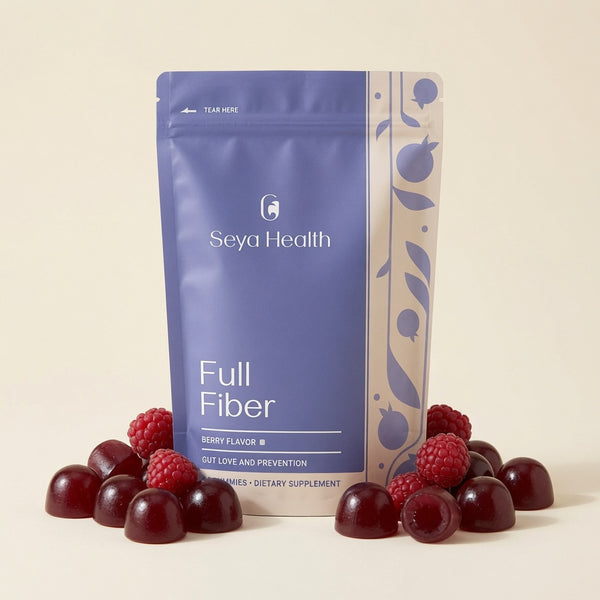
Seya Full Fiber
Most women fall short on fiber. Seya Full Fiber gives you 6 grams from three fibers in three small vegan gummies. Plant based, no gelatin, no sugar alcohols.
Shop Full FiberKeep reading

bone health
Best supplements for women over 40: what the evidence supports for heart, bones and muscles (and what's hype)

creatine
How long does creatine take to work? A realistic timeline for women

constipation